
Chess Life and Review, July 1970
Fischer vs Larsen: The Rivalry
Explore one of the Greatest Rivalries in the History of Chess
Bobby Fischer and Bent Larsen are two of the greatest legends of the game. They had a rivalry spanning 13 years from 1958-1971.
First Meeting - 1958
Bent Larsen was from Denmark and was one of the top players. He became a Grandmaster in 1956. Bobby Fischer was a rising star and teenage prodigy. Fischer and Larsen were both playing in The Portoroz Interzonal in 1958. It was a Candidates Qualification Tournament. They need to finish top six to make it to the Candidates. Fischer was 15 and Larsen was 23.
"Fischer is one baby I'm going to spank"
"One day before the commencement of the tourney, I had occasion to talk with Bent Larsen of Denmark and Fridrik Olafsson of Iceland. Larsen was relating that there were certain players in the tournament whom he had to beat in order to qualify. Among these were Cardoso, Fuster, Neikirch, Rossetto and Fischer. "Fischer is one baby I'm going to spank," he said. Olafsson warned: "Don't be too sure, be careful!" Larsen: "Don't worry. I can take care of myself."
William Lombardy, Chess Review, October 1958. (p.28)
They played each other in Round 8.
Fischer finished sixth, which meant that he qualified for the 1959 Bled-Zagreb-Belgrade Candidates Tournament at the age of 16, a record. He also became a Grandmaster automatically. Bent Larsen finished 16th in the field of 21 players.
Larsen and Fischer played a game in the 1959 Zuerich tournament (Round 6). Fischer got a large middlegame advantage but overlooked a winning move and it fizzled out to an equal position. Larsen would remember Fischer playing on for over 40 moves with the two bishops in a drawn endgame.
This game was the only draw they ever made. Fischer tied third in the tournament with 10½/15. Larsen tied fourth with 9½/15.
Next was the Candidates. Bent Larsen was Fischer's 'second' for the Candidates tournament. A second was a term for someone who helped a competing player with openings and adjournment analysis, because back in the day long games were paused and the position could be analyzed at home and the game continued on the next day.
Fischer tied for fifth place in the eight player field. Mikhail Tal won and played Mikhail Botvinnik in the 1960 World Championship.
Larsen shares an anecdote about reading a Tarzan book to Fischer when he got sick in the tournament:
https://youtu.be/XzlObDyzcyU?t=897
After the 1961 Bled Tournament, Fischer was invited to go to Copenhagen, Denmark by Børge E. Binnerup, the president of the Copenhagen Chess Federation. He was invited to play an exhibition game against Larsen and play in an simultaneous exhibition.
Shortly before the trip, Fischer had just won the Stockholm Interzonal 2.5 points ahead of Petrosian and Geller to qualify for the 1962 Candidates, a great triumph.
Fischer and Larsen played on March 9th, 1962 which was Fischer's 19th birthday. The game started at 7pm and lasted till midnight. Larsen was fond of offbeat openings so he played the Bird's Opening.
 Fischer vs Larsen Exhibition Game, March 9th, 1962. Source: Chessbase
The next day, Fischer and Larsen analyzed their game at the Danish National Broadcasting Corporation. Their game and analysis had been recorded to provide material for later broadcast (45-50 mins) on the radio (March 27th) and national television (March 28th).
1964 U.S. Championship
Fischer won the 1964 U.S. championship with an 11-0 score, defeating everybody in the tournament.
Bent Larsen was interviewed by Chess Life in August 1964 alongside other top players (Keres, Petrosian, Tal). The subject of the interviews were what they thought about Bobby:
"His play has deteriorated over the past two years."
"...he was playing against children in the U.S.A."
Q: How do you think Fischer would have done in this tourney (the Interzonal in Amsterdam)?
A: I don't think Fischer would have qualified.
Q: How can you say that?
A His play has deteriorated over the past two years. Maybe you will point to his 11-0 score in the U.S. Championship but he was playing against children in the U.S.A.
Q: You think players In the U.S.A. are so weak?
A: All I know is that when they sit down to play Fischer they play as though beaten before the game starts.
Q: Do you think other grandmasters feel the same way as you do?
A: The Russians say that Fischer is too limited and lacking in self-criticism and that he is really not a serious problem as far as the World Championship is concerned. Keres told me he would beat Fischer 8-2 in a match."
Bent Larsen Interview, August 1964, Chess Life, (p.14).
Larsen had tied first in the Amsterdam Interzonal with Smyslov, Spassky and Tal to qualify for the 1964 Candidates Tournament. Fischer didn't participate as he accused the Soviets of colluding against him to stop him from winning in the previous Candidates in 1962. After the U.S. Championship, Fischer did not play any top tournaments and instead went on a simul exhibition tour across the U.S.
In Larsen's eyes, Fischer was a spent force - a deflated balloon. Now it was Larsen's time to shine. He would become champion while Fischer looked on in the land of broken down chess players.
Larsen's opinion was buoyed by Fischer's subpar Candidates performance in 1962 and his semi-retirement in 1964. Fischer's 11-0 win was merely a 'fluke', a statement of weakness of the American players rather then any indication of Fischer's strength.
In the 1965 Candidates Matches, Larsen beat Ivkov 5½–2½. But lost to Tal 4½–5½ knocking him out of contention for the World Championship. He beat Geller in the run off match 5–4.
1966 Piatagorsky Cup
Fischer and Larsen played in the July-August 1966 Piatagorsky Cup. Before the tournament, some of the participants had an outdoor party where they played blitz. In one of the games, Larsen played an Alekhine's Defense. Fischer then sacrificed his knight on f7 for a possibility of an attack. The best response from Larsen would be to accept a perpetual check, but Larsen decided to go for a win by accepting the extra material, but putting his king in danger. Fischer won. But this was just a casual blitz game.
 Larsen vs Fischer, casual blitz game analysis. Jacequline and Gregor Piatigorsky look on.
Fischer played Larsen in Round 5:
Fischer tilted hard after losing to Larsen. He proceeded to lose two games in a row to Spassky and Najdorf. This was the only time Fischer had lost three games in a row at the top level. Then in the second half of the tournament, Fischer had a resurgence winning four games in a row in Rounds 10-13.
They played again in Round 15:
Fischer placed second with 11/18 (Spassky won with 11½/18). Larsen placed third with 10/18.
1967 Monte Carlo
During March-April 1967, Fischer and Larsen played in the Monte Carlo tournament (Round 5).
Fischer won the tournament with 7/9. Larsen tied third with 6/9.
1967-1969
Larsen won five tournaments in 1967-68:
- Winnipeg 1967
- Palma de Mallorca, 1967
- Havana (Capablanca Memorial), 1967
- Sousse (Interzonal), 1967
- Monte Carlo, 1968
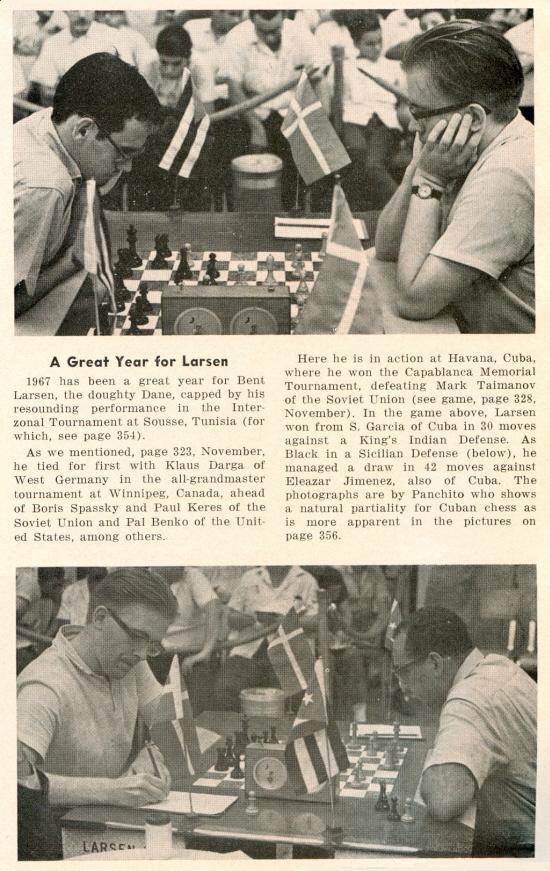 Larsen got the Chess Oscar as best player for 1967. Chess Life, 1967. Source: Edward Winter Chess Notes.
Fischer and Larsen both played in the October-November 1967 Sousse Interzonal to qualify for the Candidates. Fischer forfeited Round 10 after saying the schedule was too tough for him (the schedule had to be changed for Fischer and Reshevsky to accommodate for their religious practices). Fischer played Rounds 11 and 12 but forfeited Game 13 after the tournament arbiter didn't reverse the Round 10 Forfeit. Fischer was then scheduled to play Larsen in Round 14. Fischer didn't show up when the game started and then said he'd only play if the game was delayed. Fischer was expelled from the tournament are forfeiting this game.
Larsen won the Sousse Interzonal with 15½/21, 1½ points ahead of Korchnoi. He beat Portisch in the 1968 Candidates Matches 5½–4½. But then got knocked out by Spassky 2½–5½.
Fischer had won two tournaments in 1967 (Monte Carlo 1967, Skjope 1967). He played two tournaments in 1968. One in Netanya (June 1968) and one in Vinkovci (September 1968), which he both won. Notably Fischer rejected the 1968 U.S. Championship invitation on the basis that there wasn't enough rounds, which meant that the best player might not win by a fluke. Fischer didn't play any top Soviet players from December 1967 - February 1970.
In 1969, Larsen won Palma de Mallorca, Buesum and Lugano. Fischer didn't win any tournaments because he didn't play chess at all in 1969. In an interview Fischer said this was because there weren't any interesting tournaments. Another possibility is that Fischer was scared of the Great Dane.
USSR vs the World 1970
The USSR vs the World match was to begin at the end of March 1970. Larsen had big successes over this time (Eight 1st places since 1967). Since they were undoubtedly the two best Western players, the question was who would take board 1 (Against World Champion Boris Spassky).
FIDE President Max Euwe went to Larsen and conveyed that maybe Fischer should be Board 1, and said that Fischer had a higher Elo.
“I don’t know much about mathematics”, the grandmaster answered, “I’m a humanitarian. I’d better quit the team altogether and remain here as a Danish newspaper correspondent.”
Mikhail Tal, 1983, When Pieces Come Alive
This was a disrespectful proposal. Larsen's record was better, he won more tournaments while Fischer barely played in 1968 and didn't play at all in 1969. Euwe also asked Petrosian to help him get Larsen to agree to second board (because Petrosian was a funny guy). Petrosian approached Larsen and did the classic Petrosian stand up routine, saying "I like you. Let's play!".
Larsen then said he was gonna withdraw from the tournament if he wasn't put on Board 1.
"There is nothing to discuss! By that moment, I had won almost all tournaments, while Fischer kept staying at home and didn’t want to fight... Why did I have to yield to him in this respect? Generally, I was very much surprised when Euwe made this proposal. With all due respect to Fischer’s style of playing, I think that it was tactless to make such a proposal to me. Ambitions? No. It was a matter of principle!"
Bent Larsen, 1998
Fischer then surprisingly agreed to be on Board 2.
"Robert Fischer told the press next morning, “I decided to do this because I saw that the team was demoralized, so I wanted to try and cheer them up. But you all know that I’m a stronger player than Larsen...”
Mikhail Tal, 1983, When Pieces Come Alive
Before the start of round one, Fischer was seen saying "it was a big mistake" and that he shouldn't have agreed to it. Some say that the reason Fischer gave up Board 1 was to avoid playing Spassky. This was Fischer's first competitive game in almost two years and his record against Spassky was poor (2 draws, 2 losses).
Fischer crushed Petrosian on Board 2, 3-1 with 2 consecutive victories at the start. Larsen drew with Spassky in Round 1, then lost in a famous minature but then beat Spassky in Round 3. For Round 4, Spassky was replaced by Leonid Stein. But Larsen also beat Stein.
Despite the great performance from Larsen and Fischer, the Soviets narrowly beat the World 20½-19½.
Palma De Mallorca 1970
The Palma De Mallorca Tournament (November-December 1970) was an Interzonal for the 1971 Candidates Matches. Top 6 would qualify. Fischer and Larsen played in Round 9.
This was Fischer's only defeat in the tournament. Fischer won with 17½/22, 3½ points ahead of second place which was Bent Larsen. As they finished top six, they would both qualify to the Candidates Matches.
Fischer included Larsen in his list of the greatest chess players in history for the November 1970 issue of CHESS Magazine.
1971 Candidates Match
Fischer: "Difficult to say who will be the winner at Candidates and play the title match with Spassky. Soviet GMs probably won't be in the final for the first time. I think that in our group Taimanov will not be able to win Larsen and me. I hope Larsen or me will play title match with Spassky."
Larsen: "Bent Larsen will be a new World Champion. I will be the winner of the Candidates Matches. Fischer and I have the best chances but finally I will be the winner."
Kazic Interview before drawing of lots for Candidates matches, 1971.
Larsen said in 1968 and 1971 that he would win the Candidates' matches and then the world title, and that "Fischer will never become a world champion", because he supposedly "always fears to lose a game".
Vasily Panov. "Before the New Difficult Battles", 1971, 64 Magazine.
"(Larsen)'s good. But I think I'm the best around. I don't say that to brag. I think it's true."
Bobby Fischer, July 23rd, 1971, Life Magazine, (p.61).
Larsen defeated Uhlmann 5½-3½. Fischer defeated Taimanov 6-0. Now they would play each other in a match. The winner would face the winner of Korchnoi-Petrosian in the final match.
In July 1971, Larsen was rated no.4 in the world with a rating of 2660. Fischer was rated no.1 with a rating of 2760.
The match was scheduled to be held in Denver, Colorado in the United States, a home advantage for Fischer.
A school hall was originally suggested as a possible location for the match. Fischer smacked this proposal down promptly:
"This is no place for a match of such level", Fischer said resolutely. "I might agree to play in a university or college hall, but not in a high school."
Vasily Panov. "Before the New Difficult Battles", 1971, 64 Magazine.
Temple-Buell College was chosen in the end.
Fischer and Larsen were interviewed by newspapers before the match. Larsen mentioned that he prepared some special home preparation. Fischer was quite modest opining that if Larsen gets an early lead then he is unstoppable. But if Larsen stumbles at the beginning, then he will go on tilt.
 Drawing of the lots. Source: lancesqi
During the match, there was a heatwave. The temperatures reached 95-101 Fahrenheit (35-38 Celsius). Neither player brought seconds. Fischer brought USCF official Ed Edmondson and Larsen brought his wife.
Game 1 took place on July 6th. The opening was a French Defense. This was Larsen's grand idea to try to surprise Fischer. Larsen: "I will cause as much pressure to Fischer as I can. I'm sure that if he loses the first game, this will upset him.". Last time Larsen played the opening was in 1964 against Korchnoi.
Fischer's record against the French Defense was not the best. He lost a famous game in the 1962 U.S. Championship in round to Edmar Mednis. Game 1 followed the exact same line. However, Fischer improved on the Mednis game by playing 12.Re1 instead of 12.Ba3. During the game, the audience followed along on pocket sets. There were about 100 spectators on weekdays, and 250 on weekends.
 Source: europe-echecs
 Source: europe-echecs
There was a standing ovation for Fischer after winning this game. Fischer reportedly said that this was "one of the best games I ever played".
Game 2 was played two days later on July 8th:
"After Game 2 I knew the match was lost. I should have won Game 2. Ask Piket's father. He's the one who pointed that out really. There was some really bad analysis going around, but Piket's father pointed out exactly how I should have won."
Bent Larsen Interview, 1990, Dirk Jan ten Geuzendam
"After Round 2, I asked to see the doctor. The bad thing is that the doctor is part of the organization. He just thought that I am someone who always runs around with a high blood pressure and doesn't believe that I am not.
He would be ready to have me not play on this day but over the weekend they really hoped to have some spectators. They had very few spectators, of course. I met two young chess players from Denver in the supermarket and they didn't know that the match was going on there. The United States is like that. That is why such organizers are desperate."
Bent Larsen, New In Chess
Fischer was now 2-0. In Game 3, Larsen played an opening novelty against Fischer's famous Bc4 variation:
3-0 for Fischer. Game 4 was a King's Indian Defense.
"The last few moves were played quickly, and I'll never forget the echo that went through the auditorium when Larsen knocked over his King after 33...Nd2. We were about 25 rows back, but it sounded like a whip snapped right next to us! It wasn't only the games that were memorable."
cwcarlson, Chessgames.com user.
Now Fischer was up 4-0. Larsen postponed Game 5 because he was sick.
"Dr. Robert P. Johnston of Denver examined Larsen this afternoon and certified to the illness, the details of which were not disclosed. In accordance with the match rules, each player is allowed a maximum of two postponements."
New York Times, July 15th, 1971, (p.28).
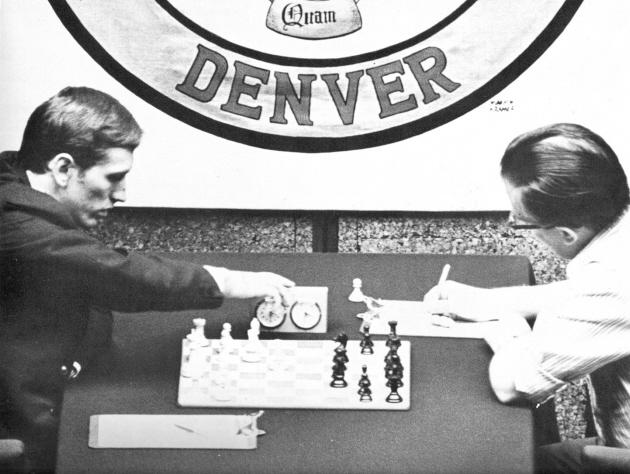 Game 5. Position after 7.Bb3. Source: Dave Cornwell. Provided by Edward Winter Chess Notes.
Fischer was now 5-0 and only needed one more win to clinch the match and qualify to the Candidates Finals. Larsen needed six wins in a row with no losses and only 1 draw to qualify.
 Fischer and Larsen Analyzing after Game 6. Source: aritearu
 Fischer and Larsen Analyzing after Game 6. Source: https://bobby-fischer-1971.blogspot.com
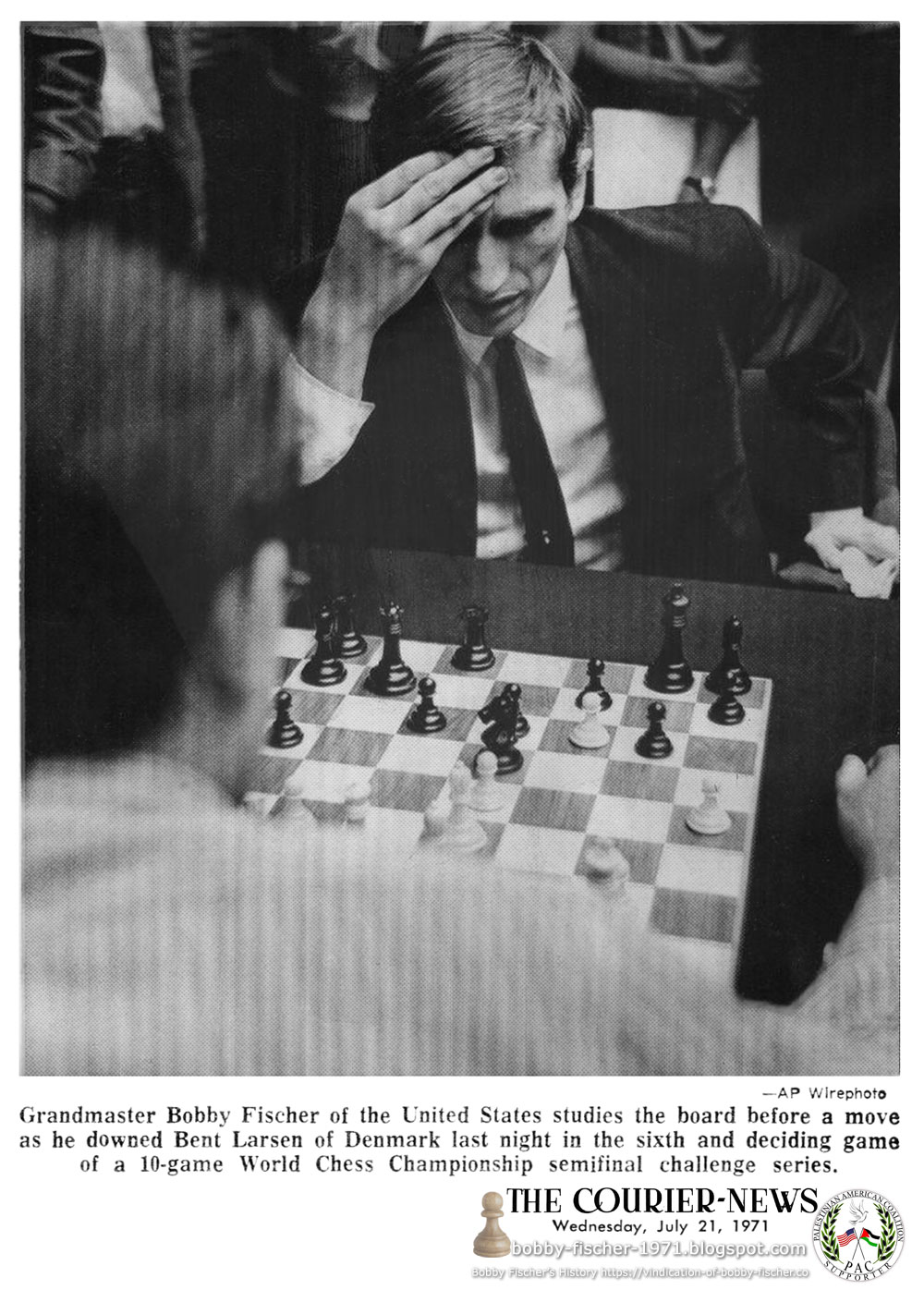
"Immediately after the match here, Fischer shook hands with his opponent. They chatted congenially and discussed the match for half an hour as reporters, spectators and television men mingled on the stage. Fischer appeared pleased and relaxed and even granted a television interview after the game."
New York Times, July 21th, 1971. (p.33).
Fischer won 6-0 and qualified to play Petrosian in the Candidates Final. He said of the match: "Really, I played quite well!".
Larsen explained his thoughts on the match:
Denver, Colorado has the warmest first half of July it had had in many years, which was just my bad luck. With daily maximum temperatures between 95 and 101 degrees Farinheit and very low humidity, I was not able to play. Maybe the altitude did not make it any better, but that was not what bothered me, it was the heat. I knew of this incapability to concentrate from the Havana Olympiad in 1966 and also from the Piatigorsky cup the same year. There is nothing to do. For the doctors, the main symptom is high blood pressure.
It does not make sense to study Fischer's play in this match in great detail. Who plays his best when he is many points ahead?
But I must say he did not show me how he could beat me in a single game if I played normally. Apart from game three where I blundered a pawn in the opening, I always got the better position or a clear draw.
It seems to me that Fischer's play is rather superficial, as if he doesn't even try to find the "truth" in many positions. Petrosian says Fischer played better chess many years ago and I understand what he means.
Now the Russian gets a chance to prove it. I consider the chances in that match about even, while I think Fischer could beat Korchnoi who gets into time pressure too much.
Many Americans believe the result of the Petrosian-Korchnoi match was "arranged" because Russian officials consider Petrosian the most dangerous opponent for Fischer. This is incredible nonsense for me!
Well I made a bad mistake in agreeing to play in the United States. I think FIDE ought to have some rules about the climate. It means much more than lighting and noisy spectators. The only game where I was not really sick was the first - although I had not slept well because the dry air had woke me up. This was probably the best game of the match.
Bent Larsen, August 1971, Chess Canada, (p. 17-18).
"Yes, it was an insufferable match... The organizers chose the wrong time for this match. I was languid with the heat and Fischer was better prepared for such exceptional circumstances... I saw chess pieces through a mist and, thus, my level of playing was not good. It was a nightmare that I will never forget! Fortune didn’t give me a single chance to win over him..."
Bent Larsen, 1998, Kasparov.com Interview
Q: How did you take your loss?
A: At first, I wasn’t very much disappointed – things happen! However, it’s very difficult to forget this and to start everything from the very beginning. I think that I haven’t managed to do this.
Bent Larsen, 1998, Kasparov.com Interview
1972 World Championship
Fischer beat Petrosian 6½-2½ in the Candidates Final to challenge World Champion Boris Spassky.
Larsen made his feelings known about Fischer's behaviour during the 1972 World Championship. Fischer no-showed game 2 after losing game 1 and almost quit the Championship. He then demanded to play in the ping-pong room during Game 3 and made numerous demands throughout the match. Fischer defeated Spassky 12½-8½ to become World Champion.
Larsen was a commentator at Iceland during the World Championship.
"People hard to get on with seems to come off best in this world to-day. FIDE had treated decent young men disgracefully but Fischer gets away with murder. There is no question that Spassky has been put off by Fischer's behaviour and that it has affected his play."
Bent Larsen, Source: thechesspedia
"The Fischer/Spassky match was not a bad match – although these title matches are never good. People forget that because they remember the best games."
Bent Larsen, January 1973, Profile of a Grandmaster, A Book of Chess (p.86-94), C.H.O’D. Alexander.
Larsen believed he would face Fischer in 1975:
"I should say that I am the most likely to face Fischer for the world championship in 3 years' time. I think I am better than Fischer and can beat him... if you ask why I lost to him 0-6 I will answer that after I lost 4 games, I did not bother to keep the draw in hand."
Bent Larsen, Source: thechesspedia
"‘In spite of my 6-0 defeat at Denver [against Fischer in 1971], I think that I would have a better chance than Spassky. It is true that I am a better tournament than match player, but I think that I am learning to play matches. At Denver it was very hot and dry, and this climate did not suit me. Yes, I think that I would have a chance in another match with Fischer; I do not think he is technically superior. After all, he is only 3-2 up against me in other games.’"
Bent Larsen, January 1973, Profile of a Grandmaster, A Book of Chess (p.86-94), C.H.O’D. Alexander.
"I'll say this in Fischer's favour... people have made more fuss about his demands, often, than was warranted... This story that he has a hypnotic effect on his opponents? Bull! Thanks to him, chess is now an important game in the U.S.A. even the Wall Street Journal gives half a column to chess!!"
Bent Larsen, Source: thechesspedia
Conclusion
Fischer and Larsen were the two best Western players of their time, and were serious threats to the Soviet chess empire.
The Fischer - Larsen Rivalry is often condensed to one phrase '6-0'. In 1976, Larsen won the Biel Interzonal. During the closing ceremony, some patzer decided to remind Larsen of what happened. Larsen reportedly said it was a 'traumatic experience like surviving an air crash'.
But Larsen was quite competitive with Fischer at times. Outside of the Candidates, it was 3-2 to Fischer in tournament games. Larsen also had more tournament successes during the 1967-1969 period.
Overall Fischer was the better player, but Larsen should not be underestimated and was a very strong player in his own right.
Their personal relationship was amicable. Larsen said they were on good terms with each other. "I was on good terms with him. We respected each other and nothing more... We had no choice – we did one business, and took part in the same tournaments."
The Fischer - Larsen rivalry was one of fire. In the 14 games they played they only had one draw. This was because they were both dynamic and fighting players.
They brought joy to the world through their beautiful games. We will always remember them.
Sources
Fischer - Larsen Games Chessgames.com
Bobby Fischer Wikipedia
Bent Larsen Wikipedia
Edward Winter Chess Notes, Bent Larsen
Chess Review, October 1958
A game against Larsen and a simul: Fischer's visit to Copenhagen 1962, 2020, Chessbase, Tom Skovgaard
Chess Life, August 1964
Interzonal Sousse 1967, Walter Kühnle-Woods (Provided by Chessgames.com)
USSR vs Rest of the World: Belgrade 1970 Olimpbase
Sports Illustrated, April 20, 1970, Larry Evans (Provided by Chessgames.com)
When Pieces Come Alive, 1983, Mikhail Tal (Provided by Spektrowski)
Bobby Fischer, November 1970, Greatest Chess Players In History, CHESS Magazine
Bobby Fischer News Articles (Provided by bobby-fischer-1971.blogspot.com)
Before the New Difficult Battles, 1971, 64 Magazine, Vasily Panov (Provided by Spektrowski)
Europe Echecs, Fischer vs Larsen Denver 1971, Georges Bertola
Chess Life & Review, September 1971
Fischer Spassky 1972, Thechesspedia
Bent Larsen Interview, 1998, Kasparov.com
You may also like
 FM MathiCasa
Chess Football: A Fun and Creative Variant
Where chess pieces become "players" and the traditional chessboard turns into a soccer field thibault
How I started building Lichess
I get this question sometimes. How did you decide to make a chess server? The truth is, I didn't. RuyLopez1000
Does Stockfish Dream of Electric Knights?
Could Stockfish be Conscious? ChessMonitor_Stats
Where do Grandmasters play Chess? - Lichess vs. Chess.com
This is the first large-scale analysis of Grandmaster activity across Chess.com and Lichess from 200… RuyLopez1000
Hourly Rapid Arena - 4th Place!
My Hourly Rapid Arena Adventure. CM HGabor