
What “Talent” Actually Means in Chess (It’s Not What You Think)
Talent exists but it's not what's holding you back.A while back, GM Daniil Dubov made headlines when he called Fabiano Caruana “arguably the least talented player in the top 20-30.” It caused a stir in the chess world and everybody had their own take on whether Dubov was being disrespectful, insightful or just provocative. But honestly, the most interesting part of the whole debate wasn’t whether Dubov was right or wrong about Caruana. It was that nobody could actually agree on what “talent” even means.
Some people defined it as raw intuition and speed of pattern recognition. Others pointed to calculation depth. Some argued that the ability to work incredibly hard is itself a talent. Caruana’s own response was probably the most grounded take of all: once you reach a certain level, talent becomes a meaningless word because it’s your skills, your results and your accomplishments that define you.
This whole debate got me thinking about my own experience as a chess coach. After almost 12 years of working with students at all levels, I’ve heard the word “talent” come up more times than I can count. And almost every time, it comes up as an excuse.
“I’m just not talented enough.”
That’s what students say when they’re frustrated, when improvement feels slow and when they’re comparing themselves to someone who seems to be progressing faster. And my gut reaction every single time is the same: talent shouldn’t matter. Not for you. Not at this stage. Not for the goals you’re trying to accomplish.
I’m not saying talent doesn’t exist. It does. But it’s wildly overrated as an explanation for why most chess players succeed or fail at improving.
Talent Is Real (But It’s Probably Not Your Problem)
Let me be clear about what I actually believe. I do think talent exists in chess. Some people pick up patterns faster. Some kids seem to have an intuitive feel for positions that other kids at the same age don’t have. Some players visualize more easily or calculate more naturally. These differences are real and I’m not going to pretend otherwise.
But here’s what I’ve observed after coaching hundreds of students: talent mainly shows up in two ways. First, it acts as an accelerator for the speed of improvement. A more talented player might pick up a concept in one lesson while a less talented player might need three lessons to get the same idea down. Second, talent might play a role in the ultimate ceiling of how good someone can become.
Both of those things sound like they matter a lot, and at the very highest levels of chess they probably do. But for the vast majority of players, talent is almost never the actual bottleneck.
Think of it this way. Imagine you’re driving a car and you’re going 30 miles per hour. Would you be worried about whether your car’s top speed is 150 or 180? Of course not. You’re nowhere near either limit. The thing holding you back from going faster isn’t the car’s maximum capability. It’s how hard you’re pressing the gas pedal.

That’s the situation most chess players are in. They’re worried about their ceiling when they haven’t come close to reaching it. The gap between where they are now and where they could be is filled entirely with trainable skills and better habits. Not with talent they either have or don’t have.
What Actually Separates the Students Who Improve
If talent isn’t the main factor, then what is? I can answer this pretty confidently because I’ve seen the pattern play out over and over across more than a decade of coaching.
I have several adult students who have improved hundreds of rating points over the years we’ve worked together. When I look at what they all have in common, it’s not that they’re particularly gifted at chess. Some of them would probably describe themselves as average in terms of natural ability. But what they all share is this: they play the game a ton, they take their games seriously and they really work hard to improve outside of just playing games.
That’s three behaviors. All of them are controllable. None of them have anything to do with innate gift.
On the other hand, I’ve had students who I thought were genuinely talented. They picked things up quickly, saw patterns fast and had good instincts. But they didn’t improve much because they didn’t take the game seriously enough. One student in particular improved very slowly at first even though I could see the natural ability was there. The issue was simply that he wasn’t putting in the work. Later on, he started taking the game more seriously and has improved a lot in the more recent years. The talent was sitting there dormant the whole time. It only started producing results once the commitment showed up.
Talent without effort is just potential that goes nowhere.
The “Talented Kid” Illusion
One of the places where the talent conversation gets most distorted is when people look at young prodigies and assume it’s all natural gift. A 12-year-old gains 500 rating points in a year and everyone says “wow, what a talented kid.” And sure, maybe the kid is talented. But there’s a lot more going on than just natural ability.
Kids have a ton of free time. They have very few responsibilities. Their brains are still developing rapidly which means they’re wired to absorb new information faster than adults. They often become borderline addicted to the game in a way that means they’re playing and studying constantly. And perhaps most importantly, kids tend to have very little fear of failure. They’ll throw themselves into sharp positions, try crazy tactics and not worry about their rating dropping because they don’t carry the same emotional baggage around results that adults do.
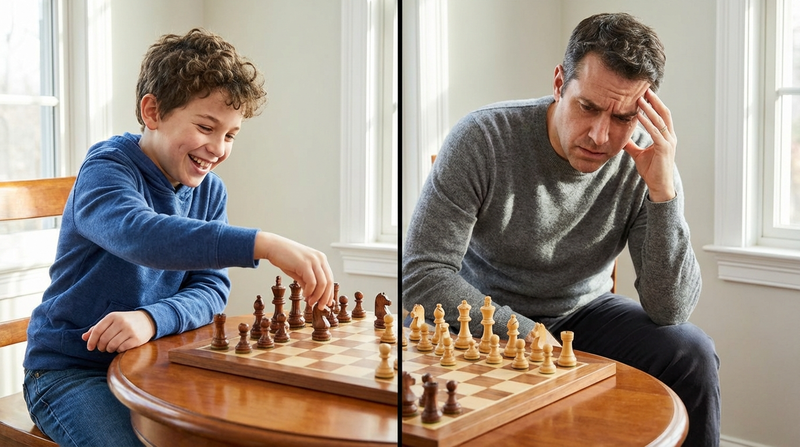
When you add all of that up, a kid who goes from 800 to 1800 in two years isn’t necessarily more gifted than an adult who goes from 800 to 1400 in the same time period. The kid just has the environment, the time and the brain plasticity working massively in their favor.
If you’re an adult improver comparing your rate of progress to a junior and feeling bad about yourself, stop. You’re comparing circumstances, not talent.
Everything They Call “Talent” Is Trainable
When people talk about chess talent, they tend to point to a few specific abilities: fast pattern recognition, strong visualization, intuitive feel for positions and good memory. These are the things people assume you either have or you don’t.
But every single one of them has a training path.
Intuitive feel for positions? You can develop this by playing through a large volume of master-level games and absorbing the patterns over time. It’s exposure and repetition, not magic.
Pattern recognition? This is heavily tied to how many patterns you’ve actually seen. Go through large amounts of tactical and positional patterns and your recognition speed will improve. This is exactly what puzzle training does when done correctly.
Visualization? This one does require serious work and it’s probably the hardest to train of the bunch. But it absolutely can be improved through dedicated practice (and this is one of the reasons I recommend king and pawn endgame puzzles, which I wrote about in a previous article, because they force deep visualization): https://chesschatter.substack.com/p/the-best-tactic-theme-to-train-to
Memory? This is probably the ability with the largest innate component. Some people just seem to remember positions and variations more easily. But even memory improves with active engagement and structured repetition. And honestly, memory isn’t as huge of a factor in improvement as most people think it is, especially compared to things like thinking process and pattern recognition.
The point is that none of these abilities are locked behind a genetic gate. Some are harder to develop than others but all of them respond to training. The common thread across almost all of them is volume. Playing through lots of games, seeing lots of patterns, doing lots of deep work. Which brings us back to the same conclusion: the students who improve most are the ones who put in the most serious work.
My Own Relationship with Talent
I’ll be honest about my own chess journey because I think it helps illustrate the point.
I do think I’m talented at chess. Improvement came relatively easily for me up to my current level and I’ve generally had a pretty smooth path compared to some players. But over the past several years, my improvement has slowed down. My USCF rating has been in roughly the same range for a long time. I wrote more about my recent and past journey here: https://chesschatter.substack.com/p/2025-chess-year-community
Now, if I wanted to use the talent excuse, I could say “well, I’ve probably reached my ceiling.” But if I’m being truly honest with myself, that’s not what’s going on. Aside from playing a lot of blitz games, analyzing them and studying openings, I don’t study or train chess as much as I’d like to. If I seriously want to break through to the next level, I need to put in a lot more hard work and be more disciplined about my training.
So even as someone who would be considered “talented,” I’m still limited by the same thing that limits everyone else: how much serious work I’m actually willing to do. The talent got me to where I am relatively easily but it’s not going to carry me any further without real effort behind it. I’m essentially my own case study for the argument I’m making in this article. There are a lot of dots on my score sheet when it comes to where I could be putting in more work.
The Real Problem: When Desire Doesn’t Match Effort
Here’s what I really want readers to take away from all of this.
The problem isn’t talent. The problem is when your desires don’t align with the work you’re putting in.
If you want to get much, much better at chess, you will need to put in much, much more work. That’s just the reality. And if someone doesn’t have as strong of a drive to improve and they’re relatively happy with where they are or only want to improve a bit relative to the amount of work they’re willing to put in, that is totally fine too. There’s nothing wrong with playing chess casually and enjoying the game without grinding for rating points.
The frustration and the self-doubt tend to creep in when there’s a mismatch. When you want 2000-level results but you’re putting in 1400-level effort.

When that gap exists, it’s tempting to blame talent because it lets you off the hook. It turns the problem into something outside of your control. But in reality, the problem is almost always that the work isn’t matching the ambition.
Being truly self-aware about your own circumstances, your goals, and how much work you’re actually putting in (not how much you think you’re putting in) is one of the most important things you can do as a chess player. It’s also one of the hardest. One tool that can help with this kind of honest self-reflection is chessalyz.ai, which my co-founder and I built specifically for this purpose. Instead of just showing you the engine’s best move, it identifies the critical moments in your games and asks you what you were actually thinking. Then it gives you personalized feedback based on your real reasoning. It’s guided self-analysis and it’s designed to build exactly the kind of self-awareness that separates players who improve from players who stay stuck.
Comparison Is the Thief of Joy
One more thing before I wrap up. If there’s a single habit that fuels the talent insecurity more than anything else, it’s comparing yourself to other players.
“That kid improved faster than me.” “My friend hit 1800 before I did.” “How is that person already a National Master when they started after me?”
None of that matters. The only comparison that matters is your current self versus your past self. If you’re doing better than you were six months ago, that’s progress. If you’re not, then it usually has something to do with your own effort and approach rather than anything talent-related.
Comparing your journey to someone else’s is pointless because you don’t know their circumstances. You don’t know how many hours they study, what resources they have, what their life situation looks like or what their starting baseline was. All you can control is your own process and your own consistency.
Have Faith in Your Potential
At the end of the day, I want people to have more faith in their potential and stop worrying so much about talent or why they’re not improving as fast as they’d like. In almost 12 years of coaching, I can count on one hand the number of times I’ve genuinely felt like a student was approaching their ceiling. It’s incredibly rare. Almost everyone can improve a lot more than they think they can.
Talent exists but it’s not what’s holding you back. Your habits, your discipline, your willingness to do the boring work, your emotional resilience after tough losses and your honesty with yourself about how much effort you’re truly putting in are what determine how far you go. Every one of those things is trainable.
So the next time you catch yourself thinking “I’m just not talented enough,” flip the question. Ask yourself instead: “Am I working hard enough for the goals I have?” That’s the question that actually leads somewhere.
In my coaching sessions, when a student tells me they’re not talented enough, I don’t argue with them about whether talent exists. Instead, I ask them five specific questions. By the end of the conversation, the student almost always realizes the issue was never talent in the first place. Below, I’ll walk you through those exact five questions, explain why I ask each one and what they typically reveal. Paid subscribers also get access to a downloadable “Talent vs. Effort Self-Audit” worksheet so you can run yourself through the same diagnostic on your own. Finally, paid subscribers also get access to all the other perks in the Chess Chatter Resources Hub here: https://chesschatter.substack.com/p/resource-hub
Paid subscribers can scroll to the bottom of this article to find the five questions and "Talent vs Effort Self-Audit": https://chesschatter.substack.com/p/talent-in-chess
You may also like
 ChessMonitor_Stats
Where do Grandmasters play Chess? - Lichess vs. Chess.com
This is the first large-scale analysis of Grandmaster activity across Chess.com and Lichess from 200… FM MattyDPerrine
You Asked, We Built: What's New in Chessalyz (Spring 2026 Updates)
Dark mode, coach sharing, more free analyses, and a bunch of bug fixes thibault
How I started building Lichess
I get this question sometimes. How did you decide to make a chess server? The truth is, I didn't. IM datajunkie
Why you overthink in chess (and how to stop)
It took me 25 years to realise this FM MattyDPerrine
Chessalyz Update: Flashcards Are Here (+ Full Mobile Support)
A walkthrough of our biggest update yet, including spaced repetition flashcards, full mobile browser… CM HGabor