
No risk, no reward
He who does not take risks does not drink champagne.“He who does not take risks does not drink champagne” is a Russian saying that conveys the idea that success requires taking risks. And, here I thought the Russian drink of choice was ‘vodka’. lol Then again, I’m sure some Russians drink vodka like some Americans drink water. So, when they celebrate, they celebrate with champagne instead. I digress.
I don’t consider myself to be a risk-averse individual. In life, I honestly believe in the saying, “no risk, no reward”. Having said that, it doesn’t mean I take ‘unnecessary’ or ‘foolish’ risks. My risks are normally minimal, as are the rewards. And, I’m okay with that. I’m retired now. I’d say that I’ve had a successful working career and successful retirement investment portfolio with that philosophy.
However, it seems that when I play chess, I tend to be a bit more risk averse. My moves are more cautious than they are risky. That’s not to say I don’t like to play aggressively. Because in chess, I honestly believe it’s, “attack or be attacked”. That doesn’t mean to attack with reckless abandon; it means to attack with a well thought out strategy/plan. And, to attack only if you have the pieces to support the attack.
In chess, they (experts) say that choosing the "less risky" move often indicates a focus on positional safety and avoiding potential blunders. I agree. I think the primary reasons for choosing the “less risky” move are twofold: 1. Fear of making mistakes and 2. Lack of experience.
Let’s discuss the first. Fear of making mistakes can lead players to play overly cautiously, avoiding risky tactics (like piece sacrifices) or strategic choices that could potentially lead to a blunder. The fear of making mistakes can also be tied to a player’s ego, where they feel judged by their performance and worried about appearing incompetent if they blunder.
The second reason is lack of experience. Inexperienced players might not be comfortable (or familiar) with complex calculations, so they opt for moves that clearly maintain piece safety and avoid obvious threats. Without experience in recognizing tactical patterns and calculating variations, players are more inclined to choose moves with minimal risk of falling into a trap.
Here’s a good example of playing a less risky move in a game. I just played this game last night (against Lichess SF5) where I thought I was playing well, right up until the time I blundered. I blundered because I made the less risky candidate move. I was playing the Catalan Opening (white pieces) which is a relatively new opening for me. I played the opening well. That is, I did everything I wanted to do: I controlled the center, I developed my pieces, I castled, etc. On my 21st move, I made the move: 21. Nd6?? I remember it being 1 of 3 candidate moves I considered making. My thinking was to defend against a potential battery by black on the d-file and to protect the b5 square- as I was anticipating black making the move: 21...b5. I wasn’t crazy about black’s bishop pair on that side of the board either and figured if there was an exchange, I’d be able to capture black’s light squared bishop with my knight. One of my other candidate moves, that I failed to make, which obviously was the best move was: 21. Nf6+. This move forks the black queen and king. To save the queen, black’s only response is to capture the knight with their g-file pawn. 21...gxf6. Yes, there was a risk where I would have had to sacrifice my knight, but look at the reward. On the next move, I would have captured with my rook: 22. Rxf6. From there, I would have captured the h-file pawn, etc. With my supporting pieces (queen, rook, bishop) I would have most likely threatened checkmate soon thereafter.
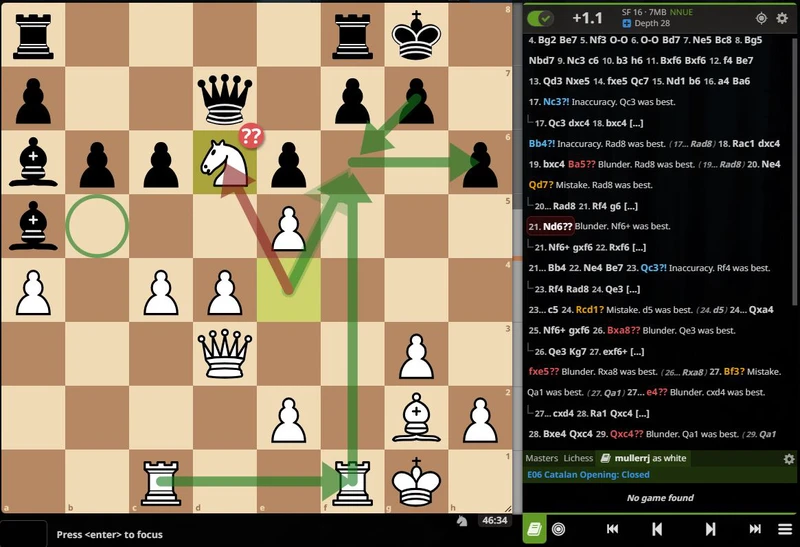
Here's the game file if you wanted to follow more closely:
What’s the moral of the story? I chose the less risky candidate move. Why? Probably for the same reasons I just mentioned: fear of making a mistake and lack of experience. BTW, I consider an ‘experienced’ chess player to be ‘expert’ level or an approximate Elo of 2000. I’m not quite there yet.
So, how do you/I overcome a tendency to play too safe? I think there are two good ways: 1. Study tactics. You do this by solving many chess puzzles regularly to help improve your ability to recognize and exploit tactical opportunities. Solving puzzles will also help build confidence in taking calculated risks. 2. Analyze your games. Just like I did, in the example above, analyze your games and identify where you could have played more aggressively. Understand the benefits and risks involved in each move. Learn from your mistakes.
If you have other/better ways to overcome a tendency to play too safe, let me know in the comments.
Remember, no risk no reward. Or, as the Russians say, “He who does not take risks does not drink champagne”. To my Russian friends, "Za vashe zdorovye".
You may also like
 mullerrj
How often do you blunder...and why?
Blunders occur at any point in a game and can be made by players of all skill levels mullerrj
3 easy steps to help analyze your games
Playing without reviewing and analyzing your games is the slowest path to improvement. mullerrj
What percent of the time are you making the 'best' move? (2 of 2)
How to improve your best move percentage. mullerrj
Post-game Computer Analysis
Learning from your mistakes mullerrj
Imbalances
What are they and how they'll hep you create a detailed plan mullerrj