
3 easy steps to help analyze your games
Playing without reviewing and analyzing your games is the slowest path to improvement.Reviewing and analyzing your games is considered the fastest way to improve because it transforms a fleeting experience into a permanent lesson. Without post-game analysis, players often repeat the same mistakes indefinitely without realizing they have a specific weakness.
Analysis reveals specifically what you don't know- whether it’s a lack of tactical vision, poor endgame technique, or a misunderstanding of an opening. It allows you to discover common mistakes, take steps to eliminate them, and then track your progress in future games.
Reviewing helps you see not just what move was bad, but why you thought it was good at the time, allowing you to correct flawed logic. Reviewing wins is just as important as reviewing losses; it reinforces good habits and helps you understand why certain strategies actually worked.
Here are my 3 easy steps to help review and analyze your games:
STEP 1, Self Analysis- First, review the game yourself without Stockfish (computer analysis). When I review a game, I ask myself where I felt uncomfortable in the game. i.e. unsure of what move to make or where I think or know I made a dubious move or mistake.
In this first example (game), I’m playing a Classical game, white pieces, and decided to play the Catalan Opening since I haven’t played it in a while. By the way, when I train/practice I want to train my weaknesses NOT my strengths. I’d say the Catalan is a weakness for me as I’m not that familiar with the Opening variations. If I want to play my strengths, like when I want to beat someone OTB at my local club, I’ll normally play the English Opening or London System as I’m more familiar with these Openings and there variations.
Here's the game so you can follow along:
The first move I felt uncomfortable making was on move 5. b3? Again, I admit I’m not familiar with the Catalan Opening especially when my opponent plays 1...f5 the Dutch Defense. The other moves I was unsure of were 6. Bg5, 12. a3, 15. Nc3 and 18. f4. These were moves I most likely rushed, making the first move I saw, or moves that I thought were prophylactic and would help my board position.
The move I know I blundered was 20. Nb5. When black made the move 20...c6 I knew I had just lost my knight....and probably the game. I know I rushed this move..in hindsight. What surprised me however, were the multiple chances I had to get back into the game (even strength) and I missed them. Specifically after black’s blunder moves: 34...Qf6??, 37...Bh5?? and 49. Qd1?? in the End Game. I didn’t realize this until I performed a Stockfish Computer Analysis (see STEP 2 below) which revealed black’s blunders.
STEP 2, Computer Analysis- After my self-analysis I perform a Computer Analysis with Stockfish. Stockfish displays a nice graph and identifies the inaccuracies, mistakes and blunders in your game. If/when you click on each heading, Stockfish will show where they occur on the graph. Here, I clicked on the ‘Blunders’ heading to reveal my 8 blunders. Yes, eight. What can I say? Not a good game for me.
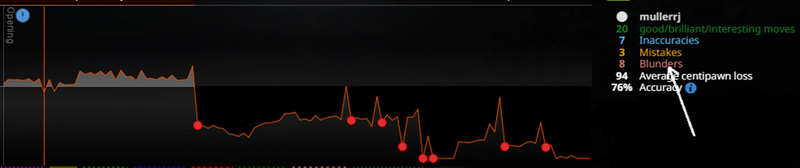
You’ll be able to recognize the blunders on the analysis/evaluation graph, by the steep drops/rises- and of course the red dots above and red circles below. When you look at a graph, focus on the big swings (drops/rises) in the graph. Notice any turning points or momentum changes. You can clearly see the momentum change after my blunder on move 20. Nb5 (the first red circle in the graph above). My SF evaluation changed from a +1.4 advantage to a -3.1 deficit after that move. That was a total swing of 4.5 pawns. Not only did I lose material (a knight worth 3 pawns) but I also lost 1.5 pawns in board position. If you have a 4.5 pawn advantage in the middle game you have (roughly) a 90% + probability of winning. For now, ignore the small drops/rises as they’re not as significant. I’ll talk about them more later on.
You can also see that I never recovered after my initial blunder. Black took control of the game and never relinquished it.
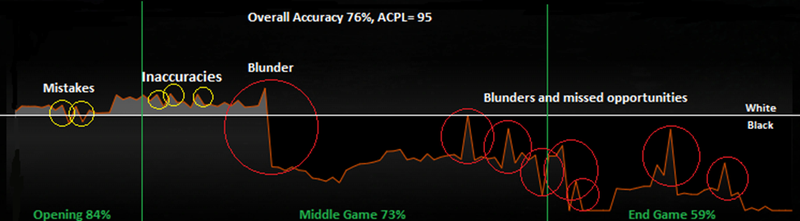
In the graph, you can also see my mistakes and inaccuracies (yellow circles) and my blunders (red circles) above. The white horizontal line is the even strength line. You can also see where my opponent blundered and my missed opportunities (spikes in the red circles). I call them ‘missed opportunities’ because I had the opportunity/chance to get the game back to even strength after my opponent blundered. What did I do after my opponent blundered? I blundered too. Ha. I had no idea until I performed the Computer Analysis. In fact, I had three missed opportunities to get back in this game...and I missed them all. I was right in this game smack in the middle of the End Game. And, here, I thought I had no chance after my initial blunder. This is a good reason to NEVER GIVE UP even though you’re down and think you're out.
Go to every big spike or jump in the graph and mark the move. These are the most important training moments. You want to identify why the mistake, inaccuracy or blunder move was made and/or missed. Was it a tactical error? Did you rush and miss it? Did you consider other candidate moves? Was it just an impulse move? Did you not see or consider your opponent’s move or plan?
STEP 3, Review the Metrics- Take a look at some of the other metrics that Stockfish and Lichess Tools provides. By the way, if you don’t have the Lichess Tools add-on- get it NOW. I wouldn’t use Lichess if it wasn’t for Lichess Tools. It’s that good. Here’s the link to [Lichess Tools](STEP 3, Review the Metrics- Take a look at some of the other metrics that Stockfish and Lichess Tools provides. By the way, if you don’t have the Lichess Tools add-on- get it NOW. I wouldn’t use Lichess if it wasn’t for Lichess Tools. It’s that good. Here’s the link: https://chromewebstore.google.com/detail/lichess-tools-by-siderite/langlhlcknngldkeliapahbhbcmlcbcj?hl=en&pli=1).
I don’t get carried away with the metrics or numbers. I only use them to compare my games against similar opponents. My opponent in this game was Lichess Stockfish Level 5 which plays to approximately a 1700-1800 Elo. Historically, when I play Stockfish Level 5 (on Lichess) I play with an overall average accuracy of 85% with an Average Centipawn Loss (ACPL) of 35. I normally only make a blunder or two, with a couple mistakes and few inaccuracies.
So, you can see from the metrics below I played well below my average in this example game.
| Metric | Oppenent (SF5) | Me |
|---|---|---|
| Overall Accuracy | 82% | 76% |
| ACPL | 76 | 95 |
| Inaccuracies | 9 | 7 |
| Mistakes | 2 | 3 |
| Blunders | 6 | 8 |
Before I continue, let me explain/define Accuracy and Average Centipawn Loss (ACPL) metrics and the differences between the two. I ALWAYS look at these two metrics after my game(s). I know a lot of people don't believe these metrics are very meaningful but I like looking at them.
Average Centipawn Loss (ACPL)= represents the average "value" a player loses per move compared to the engine's best move. If every move you make is the best move (according to the chess engine), you’d have an ACPL of 0.
ACPL by Skill Level (estimate only)
| Skill Level | ACPL range |
|---|---|
| Beginner (1200-1800 Elo) | 100-150+ |
| Intermediate (1200-1800) | 50-100 |
| Expert (1800-2200) | 30-50 |
| Master (2200-2500) | 20-30 |
| Grandmaster (2500-2700) | 15-20 |
| Super Grandmaster (2700+) | 5-15 |
Accuracy= how close my moves were to the chess engines best moves. Accuracy converts Centipawn loss into a more ‘human readable’ or relatable percentage.
Accuracy by Elo rating (estimate only)
| Elo rating | Accuracy |
|---|---|
| 400-800 | 55-70% |
| 800-1200 | 65-75% |
| 1200-1600 | 70-82% |
| 1600-1900 | 75-88% |
| 1900-2200 | 80-92% |
| 2200-2500 | 85-96% |
| 2500+ | 90-98% |
PLEASE NOTE: Your Accuracy and ACPL are highly dependent upon who you are playing. While both metrics measures how closely your moves match an engine's top choices, the difficulty of finding those moves is dictated by your opponent’s play. For example, if your opponent blunders early in the game the "best" moves become obvious and easy to find, which naturally inflates your Accuracy and lowers your ACPL. Conversely, if your opponent plays strong, creating complex positions that put you under tactical pressure, finding the best engine move is signficantly harder, often causing your Accuracy to drop and your ACPL to rise. Additionally, both Accuracy and ACPL are dependent upon the time control, phase of the game and complexity of the position.
The other metric I take a quick look at is my Accuracy in each phase of the game: Opening, Middle Game and End Game. Lichess Tools provides this information:
| Accuracy | Opponent (SF5) | Me |
|---|---|---|
| Opening | 82% | 84% |
| Middle Game | 81% | 73% |
| End Game | 69% | 59% |
Note: I normally score between 85-95 percent accuracy during the Opening, between 65-85 percent accuracy for the Middle Game, and between 75-95 percent accuracy for the End game. I believe most club players, like me, have similar accuracy percentages with the Middle Game having the lowest accuracy percentage of the three phases of the game. That’s usually because of Middle Game tactical miscalculations.
You may be wondering why i always compare my metrics to my opponents. That's because I want my opponent to play the best game they can possibly play, and I win. If my opponent blunders often, and I have a high accuracy and low ACPL it's not as fulfilling/rewarding as if my opponent has zero blunders or mistakes and I have a high accuracy and low ACPL. I don't even care who wins...as long as I play well.
The last thing I do, when analyzing my games, is to identify where my blunders, mistakes and inaccuracies occurred during my game- i.e. which phase.
Opening phase: 2 inaccuracies, 0 mistakes and 0 blunders
Middle Game phase: 4 inaccuracies, 0 mistakes and 4 blunders
End Game phase: 1 inaccuracy, 3 mistakes and 4 blunders
As you can see, this is consistent with the Accuracy scores for each phase.
Of the two metrics (Accuracy and ACPL), I think ACPL is the more useful one. Accuracy just gives an overall game performance score but it doesn’t tell you where you made your mistakes.
What’s the best way to lower your ACPL?
The best/fastest way to lower your ACPL is to eliminate blunders. Don’t hang a piece, miss a tactic or overlook counter-attacks like I did in my example game. Secondly, stop playing the first good move you see. I admit, I’m guilty of this. Instead, find other candidate moves and then compare them. Make the ‘best’ move instead of the ‘first’ move. Thirdly, improve your evaluation, not just calculation. ACPL will drop when evaluation improves. Lastly, spend more time calculating and evaluating before making moves during the Middle Game phase as this phase is more tactically complex than the other phases and where your ACPL will rise the most.
So you don’t think/believe I’m a patzer, I’ve included another recent game I played against the same opponent as the last game- Lichess Stockfish Level 5. If you don’t know what a patzer is, it’s a slang term for a casual, amateurish, or poor chess player. It is often used to describe someone who blunders frequently in chess or lacks a deep understanding of the game's complexities. Also, as I said at the beginning of the blog, it's not only good to review/analyze games you lose but one's you win as well.
Here's the game so you can follow along:
Here’s the computer analysis graph for the game. Again, I’m playing the white pieces, same opponent, and also played the same Catalan Opening as my last example game (or at least I tried to play it). You can see by the graph I took complete control of this game (after my opponent SF5 blundered in the opening) and I never relinquished control. I had an Overall Accuracy of 97% and an ACPL of 21.
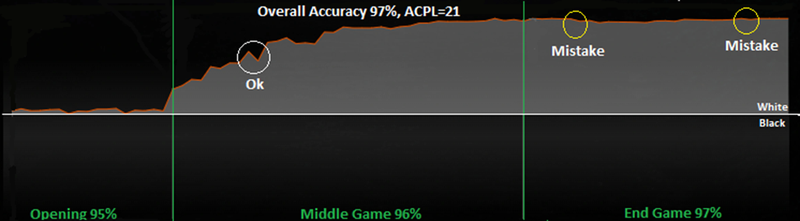
Here's all the metrics associated with the game:
| Metric | Opponent (SF5) | Me |
|---|---|---|
| Opening Accuracy | 84% | 96% |
| Middle Game Accuracy | 82% | 97% |
| End Game Accuracy | 96% | 96% |
| Overall Accuracy | 90% | 97% |
| ACPL | 43 | 21 |
| Inaccuracies | 4 | 0 |
| Mistakes | 4 | 2 |
| Blunders | 0 | 0 |
So, you can see I played MUCH better than the first game- and so did my opponent.
Remember earlier, how I said to ignore the small drops/rises as they’re not as significant? In the graph above you can’t even see drops/rises identifying my mistakes. I’ve highlighted them in yellow circles on the graph (above) so you could see. In the first mistake, move 30. Qd6+ my evaluation dropped from +15.9 to +10.1, a 5.8 pawn loss. That’s a big drop. Had that occurred in the Opening Phase I’m sure Stockfish would have labeled it a ‘blunder’ instead of a ‘mistake’. In the second mistake, move 40. Bg4+ although my evaluation didn’t drop, Stockfish said that I lost my forced checkmate sequence.
Also, where I thought I made a mistake in the Middle Game, identified by a spike in the graph (see white circle labeled Ok), upon further investigation the move 14. Bc2 only resulted in an evaluation drop from +3.9 to +3.4 (a net 0.5 drop) Stockfish didn’t even identify it as an inaccuracy. I’m not sure why.
So, the point is, even though you may not be able to visually identify a drop, or spike, on the graph, it’s always a good idea to click on the inaccuracy, mistake and blunder header so it can help identify them on the graph.
That’s it, 3 easy steps to analyze your game(s). It’s important to analyze your game(s) as soon as you can- after you play. Why? Because when you perform Step 1- Self Analysis, you’ll better remember your thought process when you played- which will help identify why you made a mistake. i.e. Did you feel rushed? Did you make the first move you saw? Did you not see your opponent’s plan or threat?, etc.
Although it may seem time consuming to perform these 3 easy steps, I accomplish them within 5-10 minutes. If you don’t spend the time to review and analyze your games, and learn from your mistakes, you’re NEVER going to improve.
Oh, one thing I forgot to mention is that both of these games (I used for examples) were played a day a part. How can I play one of my worst games one day and one of my better games a day later? Against the same opponent! Is it just me, or does that happen to you too? It’s kind of like my golf game. I’ll shoot 78 one day, then shoot 88 the next day at the same course, with the same people, under the same conditions, etc. I don’t get it. Mystery of life I guess.
You may also like
 mullerrj
Checks, Captures & Threats: What is it and why is it important?
Checks, Captures & Threats- a simple checklist before making your next move ChessMonitor_Stats
Where do Grandmasters play Chess? - Lichess vs. Chess.com
This is the first large-scale analysis of Grandmaster activity across Chess.com and Lichess from 200… thibault
How I started building Lichess
I get this question sometimes. How did you decide to make a chess server? The truth is, I didn't. mullerrj
Avoid burnout- play Chess960!
Are you burning out in standard chess? If so, have you played Chess960? mullerrj
Imbalances
What are they and how they'll hep you create a detailed plan FM MathiCasa