
Avoid burnout- play Chess960!
Are you burning out in standard chess? If so, have you played Chess960?Chess burnout
What’s chess burnout? Before I discuss ‘chess burnout’, and the reasons why some player’s burnout, I think it’s important to know what ‘burnout’ (in general) means as it relates to sports (and a game like chess).
Burnout is a comprehensive mental and emotional shutdown. In sports, when an athlete burns out their motivation is gone, and they often walk away from the game/sport entirely. Sports psychologists note that burnout is heavily tied to "expectations repeatedly not meeting reality." If you played as many sports as I have in life, you’ll know that ‘burnout’ is real- it happens to almost all passionate/ hard-working athletes in all sports at one time or another.
In chess, there are many reasons for burnout- at any level. However, I think the top two reasons are:
1. Too Much Study, Not Enough Enjoyment- For many players, they turn chess into a job. They spend countless hours memorizing openings, grinding through endless puzzles, practicing endgame techniques, analyzing their games too much, building huge repertoires aimed at one specific opponent, etc. Magnus Carlsen has repeatedly said that one of the main reasons he stepped away from the World Championship cycle and refuses to play in the Candidates Tournament is the enormous amount of preparation required.
2. Rating Obsession- Many players begin measuring every chess session by rating gains, rating losses, tournament results, club wins/losses, etc. When self-worth becomes tied to a rating, chess can become emotionally exhausting.
What these two reasons have in common for beginner through advanced intermediate players are ‘unrealistic improvement expectations”. That is, a lot of players expect improvements to be steady/consistent and fast. The reality of chess is that it can sometimes take months of little to no progress, followed by a sudden breakthrough. For some, it may take years of little progress. Players get frustrated because they study hard but yet make the same mistakes and end up losing to players- some with lower ratings. Or, that their rating doesn’t increase at the rate they’re expecting. Many players unfortunately quit during these plateaus when they’re actually improving underneath the surface.
As a kids chess coach, I teach after-school chess at least 2-3 times per week throughout the school year. Then, in the summer’s, I teach four 1-week chess camps. When I’m not teaching I’m playing at least 2-3 ‘classical’ chess games per day. Yes, ‘classical’ games not ‘blitz’ games. My classical games normally last between 45 minutes to 1 hour long- at most. And, I always analyze these games after I play them. When I’m not teaching or playing, I’m always learning new openings. When I’m not learning new openings, I’m doing chess puzzles ad-nauseum.
So, for me, chess turned into a job. It is/was still fun to play chess but I just wasn’t getting enough enjoyment out of it. I didn’t burn out completely, but I was burning out. There’s no doubt about it.
To get some of the enjoyment back in chess, I started playing ‘blitz’ games a while back. I really liked playing blitz chess. In fact, at one point, I was obsessed. It was convenient, fast and fun! I played 3+2 blitz format the most. There are a lot of benefits of playing blitz chess- even for classical chess players like me. The benefits are:
1. Pattern Recognition- This is probably the biggest benefit. When you play lots of blitz, you see: tactical motifs, mating patterns, opening structures and endgame ideas. Eventually, many positions become familiar, and you can recognize good moves much faster in classical games.
2. Calculation Speed- Blitz forces you to: calculate efficiently, identify candidate moves quickly and make decisions under pressure. In classical chess, you have more time, but being able to quickly eliminate bad moves leaves more time for critical positions. Strong classical players often aren't calculating more deeply on every move—they're spending their time where it matters.
3. Opening Familiarity- Blitz gives you many repetitions of your opening repertoire. You start recognizing: typical plans, tactical tricks, and recurring pawn structures.
4. Time Management- Blitz games teaches you time management much better and faster than classical games.
Blitz, however, can also create bad habits if it becomes your entire chess diet. Blitz chess encourages making impulsive moves, calculating superficially, relying on tactics, neglecting deep positional thinking and playing too fast. These are precisely the skills that often decide classical games.
For me, Blitz started hurting my classical game play. I was playing much too fast when I went back to playing Classical games. Prior to playing Blitz, as I said before, my Classical games lasted between 45 minutes to 1 hour long (total time). After playing a steady diet of Blitz, my Classical games lasted no more than 30 minutes total. The worst part was, I didn’t even realize I was playing faster. But, what I did realize (when I went back to playing Classical Chess) is that I was making more tactical mistakes during the middle game than I ever had before. For that reason, I stopped playing Blitz.
If you’re a Classical chess player (like me), I’m not saying you shouldn’t play Blitz chess. I just wouldn’t play a steady diet of it like I did. I’d mix Blitz chess games in with Classical chess games. I’d say no more than 1 Blitz game for every 5 Classical games. I really should start playing Blitz again. This time, adhering to my own advice of playing 1:5 Blitz games to Classical games.
Chess960
They (experts) say that Chess960 is considered one of the best cures for chess burnout. What is Chess960? Chess960 (also called Fischer Random Chess) is a chess variant invented by the late Bobby Fischer to reduce the importance of opening memorization and emphasize pure chess skill. Personally, I believe the ‘real’ reason for inventing it was to stave off burnout. I think Bobby was becoming bored with studying and playing Classical Chess. You may also here Chess960 referred to as 'freestyle' chess. The two terms are effectively synonymous.
In Chess960, the pieces on the back rank are shuffled before the game starts. Instead of the normal setup: Rook, Knight, Bishop, Queen, King, Bishop, Knight and Rook, the back rank pieces are shuffled where there are 960 possible legal starting positions, hence the name Chess960.
The setup must satisfy three conditions: 1. The King starts somewhere between the two rooks 2. The Bishops must be on opposite-colored squares and 3. White and Black start with identical piece placement. The Pawns remain in their normal positions. If you play Chess960 online, like Lichess or Chess.com, the software will automatically set the board up for both sides. If you play Chess960 over the board (OTB), you're going to need an App for your smartphone that generates the position for you. There are a few to choose from.
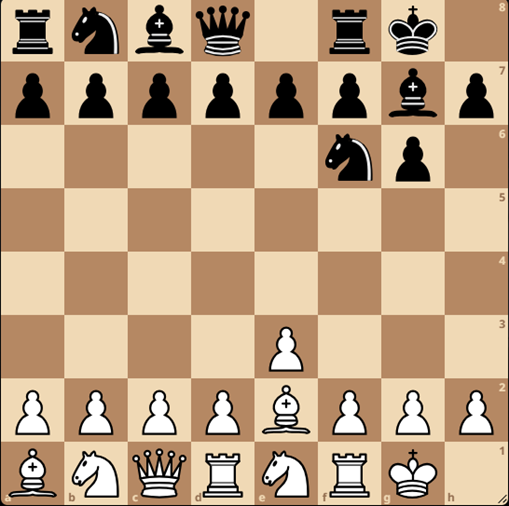
The only thing that’s kind of puzzling with Chess960 is Castling. At least for me it was when I first started playing. Castling works a little differently but ends in the same final position as standard chess. After castling kingside, the King resides on the g1 square for white (g8 for black) and the rook resides on the f1 square for white (f8 for black). When castling queenside, the King resides on the c1 square for white (c8 for black) and the rook resides on the d1 square for white (d8 for black).
Take a look at the setup of a Chess960 game below. Notice where the King's are positioned on each side of the board.
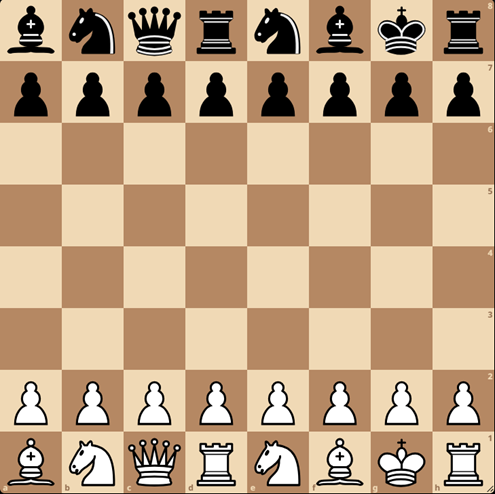
If I Castled kingside for White and Black, this is what it would look like (below):
A queenside castle would look like this (below):
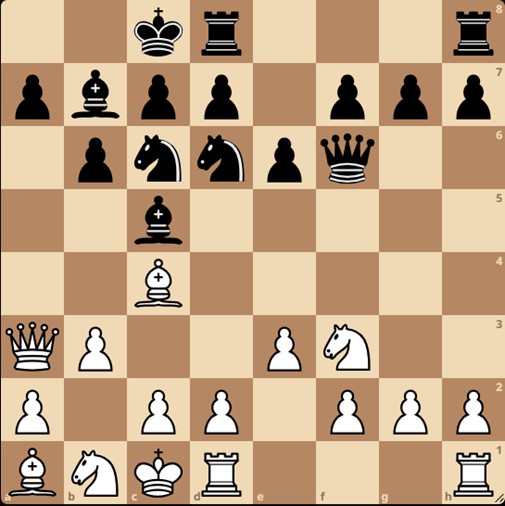
I hope I have this (castling position) right. If I don’t, someone please correct me. See, I told you it was puzzling. All of the five conditions for castling in standard chess apply to Chess960. That is: the King or Rook could not have moved previously, there can be no pieces in-between the King and the Rook, you can’t Castle ‘in’ Check, you can’t Castle ‘through’ Check and you can’t Castle ‘’into check.
Note: On Lichess, unlike standard chess, you castle by dragging the King and dropping it directly on top of the Rook you want to castle with.
As I said previously, Fischer felt that modern chess was becoming too dependent on memorized opening theory. He wanted a game that got rid of opening preparation and makes players think from move one.
In Chess 960 Opening principles of standard chess still apply and matter. That is, controlling the center, developing pieces and castling for King safety are still important. In Chess960 there is less opening memorization required. Players don’t have to rely on prepared opening files, engine lines or deep theoretical knowledge. Because of that, more creativity is required. Players must evaluate positions themselves, find plans and adapt quickly. Chess960 rewards calculation, tactical awareness, positional understanding and adaptability.
I have to admit, to this day, some Chess960 Openings look bizarre to me. Some starting setups not only look bizarre, they just seem ‘weird’ to play. I can honestly say that I’ve had some Chess960 Openings and Middle Game positions on the board I’ve never seen before in any of my Classical Chess games.
Chess960 definitely helps stave off burnout for me- because it’s new/different and fun. But, is it good training? Many Grandmasters and experts think so. I think so too. I’ll tell you why. In most Classical Chess games the Opening is somewhat ‘automatic’. That is, the first 10-15 moves can be made without even thinking- just relying on memorization. There is little to no tactics in the Opening. It’s the reason why I average close to 93% accuracy in the Opening Phase of a Classical Chess game- even when playing highly rated opponents. The Middle Game Phase of a Classical game, however, is where my accuracy is the lowest (of the 3 Phases). I think I average only 82% accuracy in the Middle Game. That’s because the Middle Game is more complex than the other 2 Phases because of the highly complex tactics involved. In Chess960, tactics arise almost instantaneously and without warning in the Opening Phase.
So, for me, other than staving off burnout, that’s a good reason alone to play Chess960- to improve Middle Game tactics. Also, since the starting positions are completely weird and unfamiliar, you cannot play on autopilot. You are forced to sit, calculate lines, and weigh consequences from move one. That’s exactly what you must do in a Classical game. Chess960 also breaks the impulsive urge to rush. Since you do not recognize the position, your brain naturally slows down to analyze the board through first principles (king safety, piece harmony, pawn structures). Unlike Blitz, I can’t think of any disadvantage of playing Chess960.
Now, that I’ve hopefully sold you on playing Chess960 (if you don’t play already), here’s a couple quick tips for playing Chess960 the first time. I’ll give you a more comprehensive checklist at the end of this blog:
1. Analyze the starting position immediately. The first thing you want to do is identify any unprotected pawns. You can have an initial setup in Chess960 where an opposing Bishop or Queen can capture a pawn on their 2nd move. Or worse, after they capture a pawn, they can capture an undefended piece behind it. Next, you want to locate your King and check its safety. Check how many moves you need to make to Castle and make the King safe- or safer. Next locate the Rooks. Are they in good positions? What is their position after Castling? Next locate the Bishops. You want to open their diagonals sooner than later. Beware of your opponent’s sniper Bishops. The sniper Bishops are the ones in the corner on the longest diagonals. I’ve lost Chess960 games in the first 10 moves because of ‘sniper’ Bishops. Now, locate the Knights. If you have a Knight or Knights in the corner, get them closer to the center of the board.
2. Apply Classical Opening Objectives/Principles. Just like in Classical Chess you want to Control the Center, Develop your Pieces and Castle (to safeguard the King) early. Avoid early Queen moves. You want to keep your Queen safe until the minor pieces are developed.
Here’s an example of the first couple moves of a Chess960 game to help you get a better understanding of how it’s played, and recommended moves to play.
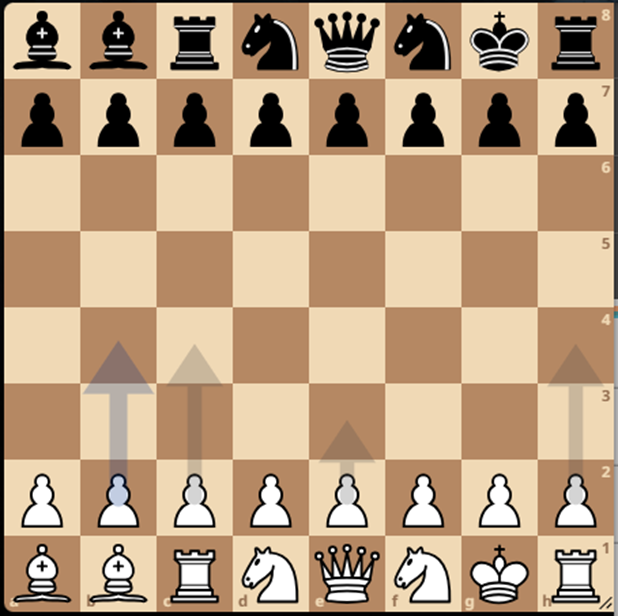
So, what move would you play if you’re white? You can see Lichess’s recommended moves (grey arrows). The best opening move for white, according to Lichess, is the move 1. b4. (By the way, 1. b3 is also a good move). This is an excellent move because it unleashes the sniper Bishop on a1. The Bishop is now staring down the long diagonal toward the g7 pawn (protected only by the King) and the h8 rook behind it. After 1. b4, black may mirror the same idea with 1...b6. Or, they make the move 1...g6 to block the Bishop’s deadly diagonal.
On the following moves you’ll want to control the center with the c-file, d-file and/or e-file pawns. Keep in mind, you want to keep the Bishop diagonals open to help control the center and continue threatening. You’ll also want to bring out the knights toward the center. Lastly, you want to look at castling. For white, the King is already on its final destination square. You’d have to move the Knight on f1 before you can Castle kingside. Castling kingside will activate the rook where it’s currently blocked in the corner.
How about a good 2nd move for White? What move would you make?
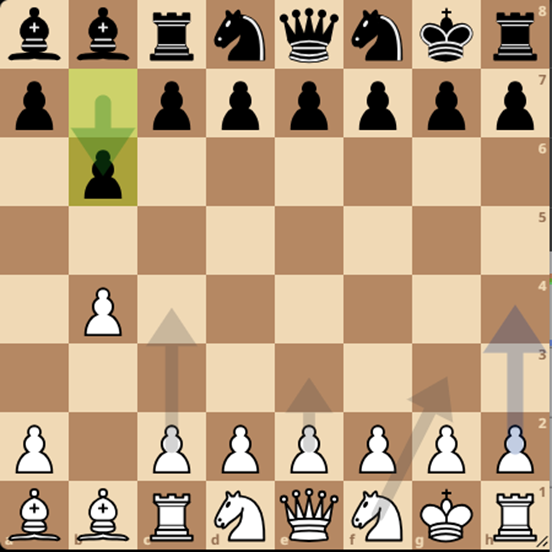
You can see Lichess’ recommended 2nd moves. It likes h4 best. I’m not so sure I’d make that move. At first glance, I would have played 2. c4 to open up the diagonal for my 2nd sniper bishop on b1. But, I can see why Lichess likes h4. It not only helps activate the h1 Rook without castling (w/ a rook lift), but it threatens to push 3. h5 and 4. h6 to smash right into black’s Kingside and wreak havoc. The h-file pawn is also supported by the Bishops on a1 and b1 and the Rook on h1. Now, the more I look at it, I can definitely see where I’d want to change my 2nd move from 2. c4 to 2. h4.
Also, because Black's King starts on g8 and finishes on g8 when castling short, their King is essentially trapped on that side of the board. By marching the h-file pawn forward early, you make it terrifyingly unsafe for Black to leave their King over there, forcing them to completely rethink their development.
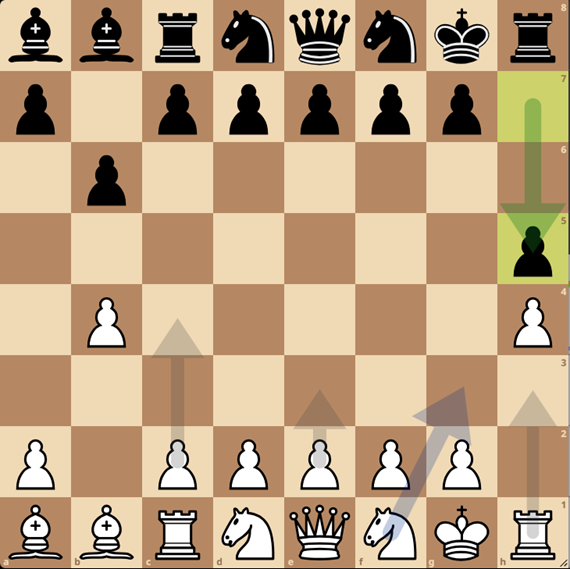
You can see (above) black makes a smart move by cutting off White’s h-file pawn with the move 2...h5. So, hopefully, you get an idea of what to look for in the Opening of a Chess960 game. If you want a more comprehensive look at Chess960, there's a good 5 part blog on Chess.com. Here is a link to part 1: https://www.chess.com/blog/Vicariously-I/guide-to-chess-960-part-1-opening-principles
Here is a good Top 10 Checklist to scan and follow during the first few moves of any Chess960 game to avoid early blunders and get an edge:
-
Identify Unprotected Pawns Immediately. In Chess960, naked, undefended pawns can start anywhere. Spot your undefended pawns to defend them and find your opponent’s to attack them.
-
Locate the "Sniper" Corner Bishops. Check if any Bishops start in the corners. These pieces control the longest diagonals on the board from move one, so you must open their pathways immediately or block your opponent's line of sight.
-
Trace the King’s Castling Route. Locate your King and count how many pieces block it from its final destination squares. Plan your piece development specifically to clear this traffic out of the way.
-
Unleash Your Trapped Rooks. Rooks buried in the middle of the back rank (like on d1 or e1 for White) cannot move until neighboring pieces step away.
-
Reposition Edge Knights Fast. Knights starting on the a1 or h1 squares (for White) are severely restricted and cover very few squares. Prioritize maneuvering them toward the center within your first three moves to maximize their power.
-
Dominate the Center with Pawns. Do not get so distracted by the weird piece setups that you forget chess basics. Push your central pawns early to claim space and restrict enemy pieces.
-
Think Deeply on Move One. There is no opening book or autopilot memory to save you time. Spend at least 1-2 minutes analyzing the unique layout before making your very first move. By the way, I only play Chess960 with Classical time controls (usually 30-60 minutes).
-
Keep Your Queen Safe Early. Because the back rank is highly disorganized, early Queen moves are incredibly risky and easily trapped. Keep your Queen tucked away until your minor pieces are active.
-
Treat Flank Pawns with Caution. Pushing flank pawns (a2 and h2 for White, and a7 and h7 for black) can instantly open devastating lines for your opponent's long-range pieces. Only push them if you have a concrete tactical purpose, like in our example (above) where we made the move 2. h4.
-
Drag King on Top of Rook to Castle. When playing online (Lichess or Chess.com), always execute castling by dragging your King directly on top of the Rook. Do not try to move the King two squares, as destination squares vary based on the starting setup. It took me a while to figure this out on my own.
Let me know what you think of Chess960 in the comments below. Do you think it staves off burnout? Do you think it’s good training for Classical chess? Do any of you play Chess960 exclusively?
You may also like
 IM datajunkie
You’re studying chess openings the wrong way (do this instead)
If memorising opening lines made you stronger, many club players would be masters. IM theScot
Chess Stubbornness
A post about how chess lends itself to stubborn moves; on and off the board. mullerrj
Checks, Captures & Threats: What is it and why is it important?
Checks, Captures & Threats- a simple checklist before making your next move IM Fins
What I Learned from Spending 1,000+ Hours Writing an Opening Course
Reflections on a 2+ year journey (and 25+ year career) with the 3...Qa5 Scandinavian thibault
How I started building Lichess
I get this question sometimes. How did you decide to make a chess server? The truth is, I didn't. mullerrj