
Learn chess notation in less than 20 moves!
Chess notation lets you review your games later.Disclaimer: this blog is intended for beginner to intermediate players.
I stopped by the end of a local scholastic chess tournament this weekend. I wanted to see how some of the elementary school kids (I teach chess) performed in the tournament. Before the awards were given out to the winning players, the Tournament Director (TD) made a few announcements. One of them was his recommendation, or rather plea, for all scholastic players to learn ‘chess notation’.
I didn’t think much about what he said until I was driving home. Then, I started thinking. I know why he recommended chess notation. I’ll bet it’s because of the many claims/disputes/complaints he had during the tournament games. Normally, if there is a dispute between players regarding a particular rule, the player disputing the rule must show proof the rule was breached. And, the best way to do that is by keeping score with chess notation. (Keeping score in chess means writing down your moves- and your opponent’s moves.) For example, if a player claims a draw by the 50 move rule (or 25 move rule for local scholastic tournaments), they need to show proof with a score sheet. The same if someone claims a draw by threefold repetition. You need to show proof with a score sheet. By the way, score sheets and pencils are almost always available (for free) in the tournament playing room- at least at scholastic tournaments they are.
That’s just one reason or benefit of keeping score with chess notation. If I had to recommend the single most important key aspect to improving in chess, it would be keeping score (with chess notation) while you play and reviewing/analyzing your game afterwards. Obviously, if you play online, the chess engine software will keep the score sheet for you. But, if you play Over-the-Board (OTB), however, either at a local chess club or during a tournament, you’re going to want to keep score.
The reason for keeping score in chess is similar to keeping score while playing golf. After you play, you can review your game and see where you need to improve. For the golfer, maybe you didn’t realize you 3-putted 7 holes, suggesting you may need to spend some more time practicing putting. (I know some players that keep track of the number of putts on their scorecard for each hole.) Or, maybe you hit your tee shot out of bounds on 4 holes, suggesting you might need to go to the driving range to work on hitting your driver straighter. Or perhaps, you hit your ball into 3 bunkers and it took you 2 shots to get out of each one, suggesting you might need to practice from a sand trap. A golf scorecard is also proof that you shot the score you did- good or bad.
Here are some of the benefits of keeping score on a score sheet when you play OTB chess games:
· Identifies trends and recognize recurring patterns- you can analyze what went wrong- specifically what stage of the game (Opening, Middle Game or End Game) things went wrong, what specifically went wrong (i.e. mistakes, blunders, etc.) and why (i.e. lack of concentration, distraction, rushing, etc.). If you analyze enough games, you might start to see trends. This is how you improve, learning from your mistakes...so you don’t repeat them.
· Compare games- you can compare your games, particularly Openings, to that of Grandmasters.
· Coach review- you can have your Chess Coach review your games and recommend areas for improvement.
· Tournaments- in some Classical Chess tournaments, keeping score is required. More importantly, if a dispute arises your scoresheet is proof. Maybe you’re trying to claim a draw by threefold repetition. If so, you’re going to need proof. Otherwise, it’s your word versus your opponents and that’s not good enough.
· Helps focus and concentration during play- if you keep score, you generally focus and concentrate more before you write the move down on your score sheet.
Here’s how to keep score with chess notation in less than 20 moves:
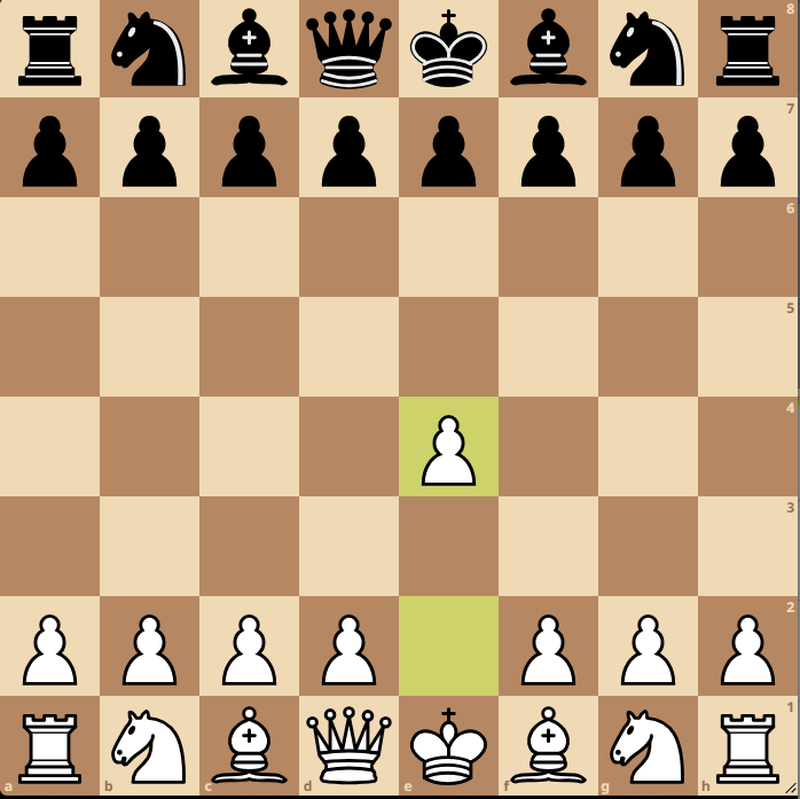
Chess notation or algebraic notation is the standard way to record chess moves during a game. With algebraic notation, every square is a coordinate based on white’s perspective. The bottom left corner square is a1, when setting up the white pieces. (see below) This is vitally important!
Thus, if a white pawn moves from the e2 square to the e4 square (as shown below), on the Opening move, we say, “pawn to e4” or just "e4", and its move is recorded as ‘e4’ on a score sheet. Since it is white’s first move, it would be written 1. e4. Remember, you identify the piece first then its destination square.
When referencing a piece, the abbreviation is always ‘capitalized’. Here are the pieces and their abbreviation:
King= K
Queen= Q
Bishop= B
Knight= N (because K is already used by the King)
Rook= R
Pawn= (the pawn is the only piece that does not have an abbreviation)
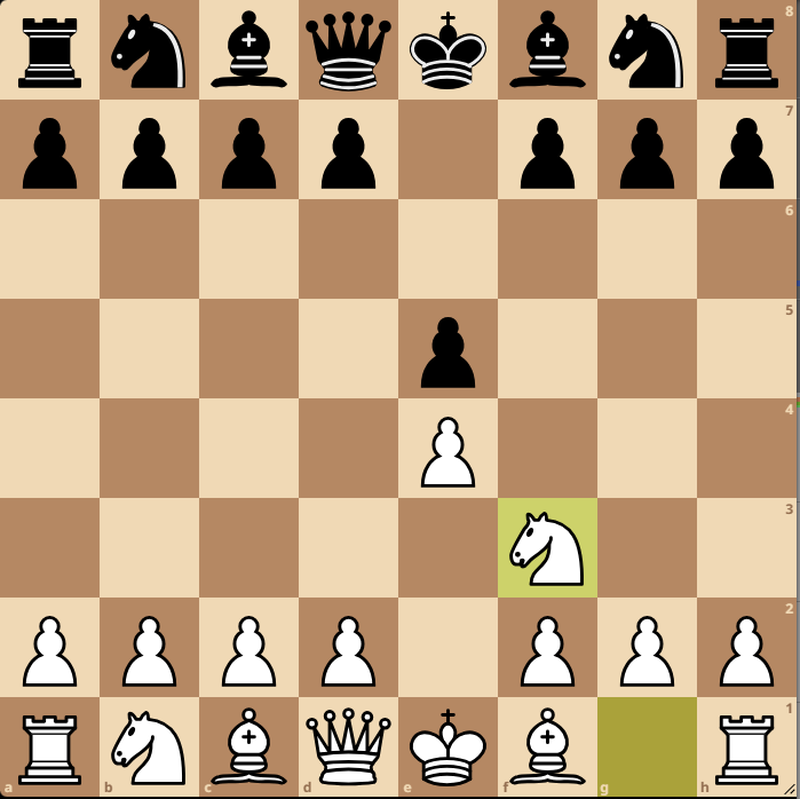
In this diagram (above), white has made the move 1. e4, then black made the move 1...e5, then white made the move 2. Nf3. It would be written like this on an official tournament score sheet (see below).
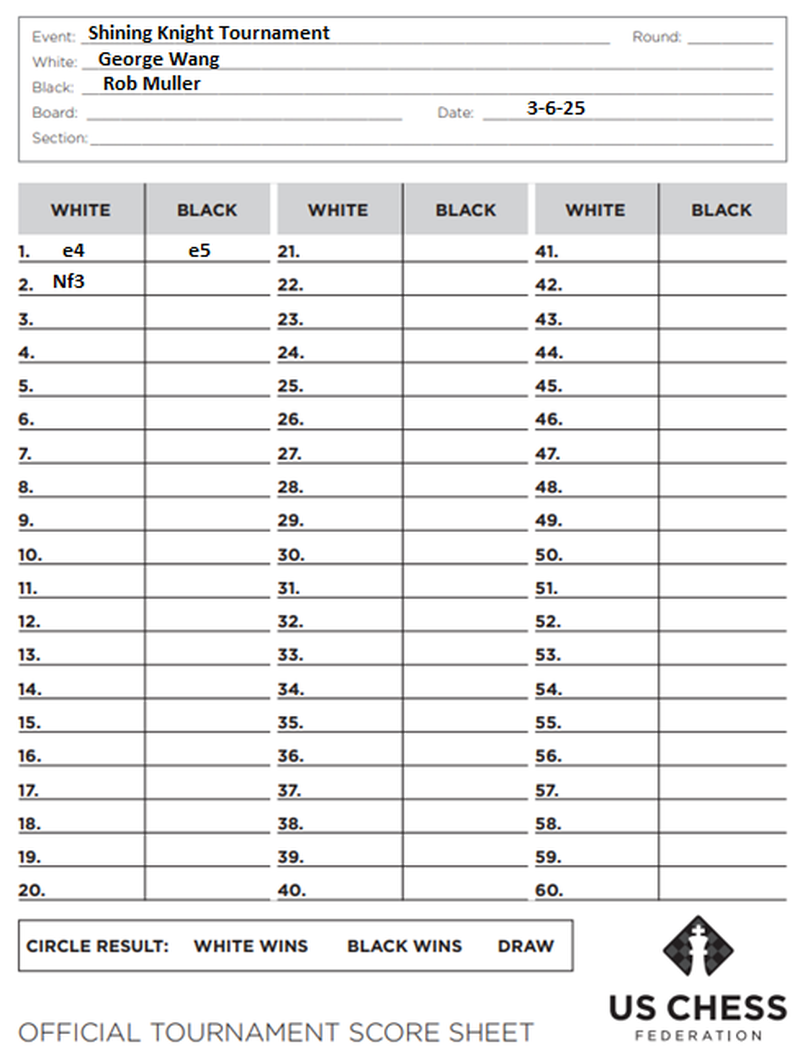
Note: write down the move on the score sheet immediately after you or your opponent makes their move. If you’re also using a chess clock, make the move, stop the clock then write the move down.
You can see that chess notation is simply written as the piece you’re moving and the destination square the piece moves to. For example, a knight move to f3 is written: Nf3.
Remember, the pieces use capital letters and the squares they move to use lower case letters. Now, let’s say that the white Bishop wants to capture the black Knight on the c6 square on its next move. (see below). We would notate that as: Bxc6. The ‘x’ sign is used to designate a take or a capture. It is said, “Bishop takes (or captures) the Knight on c6”.
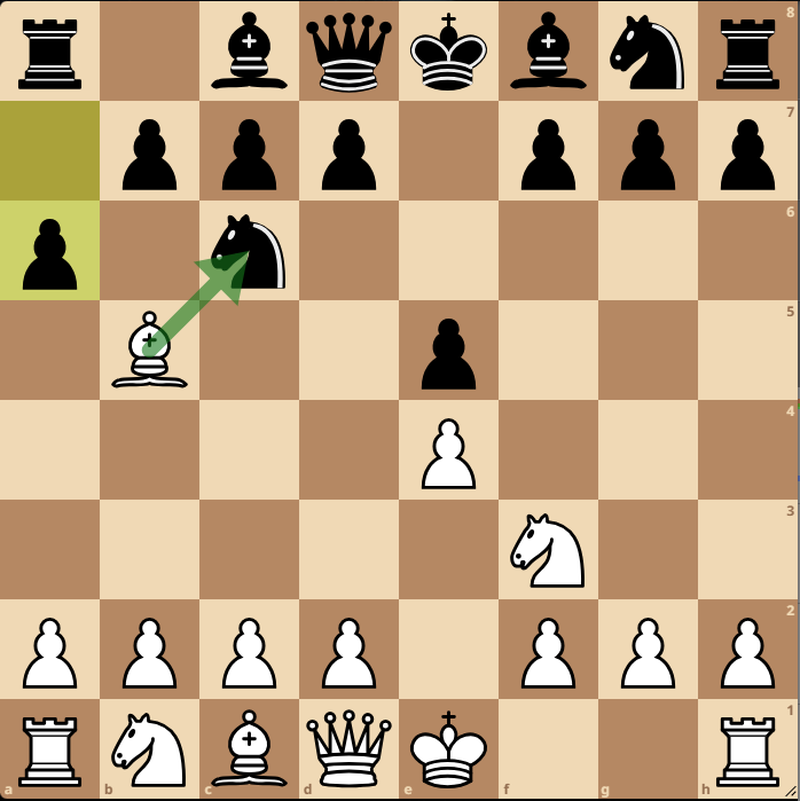
The chess notation up to this point would be written as:
1. e4 e5
2. Nf3 Nc6
3. Bb5 a6
4. Bxc6
Next, white wants to castle Kingside. We notate that as: 0-0 or O-O (zeros or capital O’s). Queenside castling would be notated as: 0-0-0 or O-O-O.
The chess notation to this point would be:
1. e4 e5
2. Nf3 Nc6
3. Bb5 a6
4. Bxc6 dxc6
5. 0-0
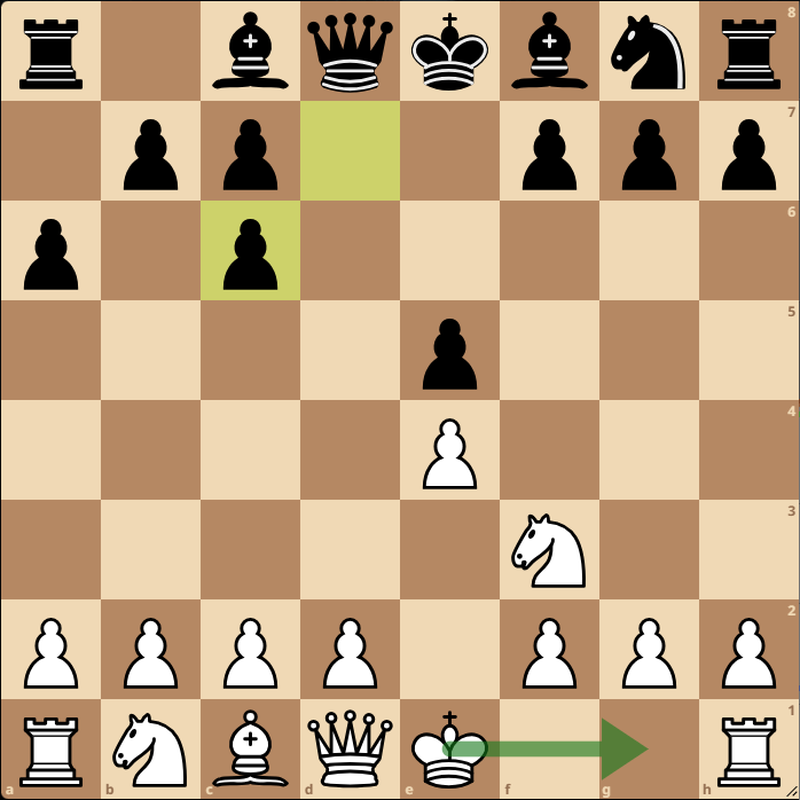
Do you know what popular chess opening this is? That’s right, it’s the Ruy Lopez Opening, specifically the exchange variation, one of the oldest Openings in chess. In fact, at a recent Rapid Chess Tournament, played by Grandmasters, the Ruy Lopez was the 2nd most popular Opening played. The Sicilian Opening was the most popular, with almost twice as many Grandmasters playing the Sicilian vs. the Ruy Lopez.
After 5...Bg4 6. d3 Qf6, white wants to move the knight to the d2 square. (see below). But, you can see that both knights can move to the d2 square. So, to differentiate the knights, we write the file the knight originated on, then to the d2 square. In our example, we want the knight on the b2 square to move to the d2 square. So, we write that as: Nbd2. If we moved Nfd2, white loses their queen.
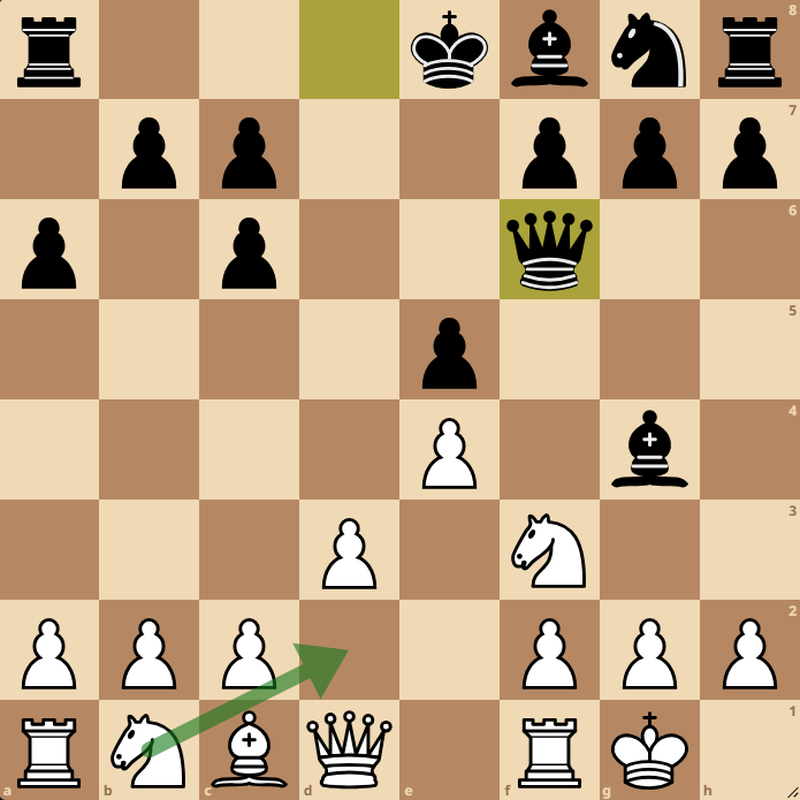
Our chess notation to this point is:
1. e4 e5
2. Nf3 Nc6
3. Bb5 a6
4. Bxc6 dxc6
5. 0-0 Bg4
6. d3 Qf6
7. Nbd2
Black wants to castle queenside on its next move: 7...0-0-0
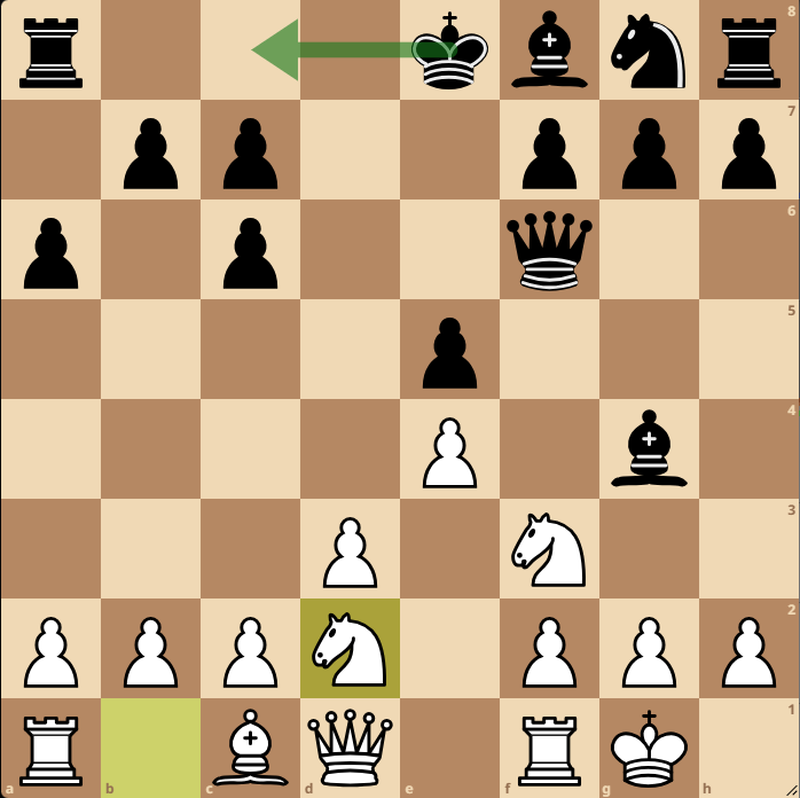
Let’s fast forward to this position:
1. e4 e5
2. Nf3 Nc6
3. Bb5 a6
4. Bxc6 dxc6
5. 0-0 Bg4
6. d3 Qf6
7. Nbd2 0-0-0
8. h3 Bh5
9. Qe1 a5
10. a3 a4
White makes the move: 11. b4. Black wants to capture ‘en-passant’. Therefore, it’s written, 11...axb3. That is, black’s a-file pawn captures white’s b-file pawn en-passant. (see below)
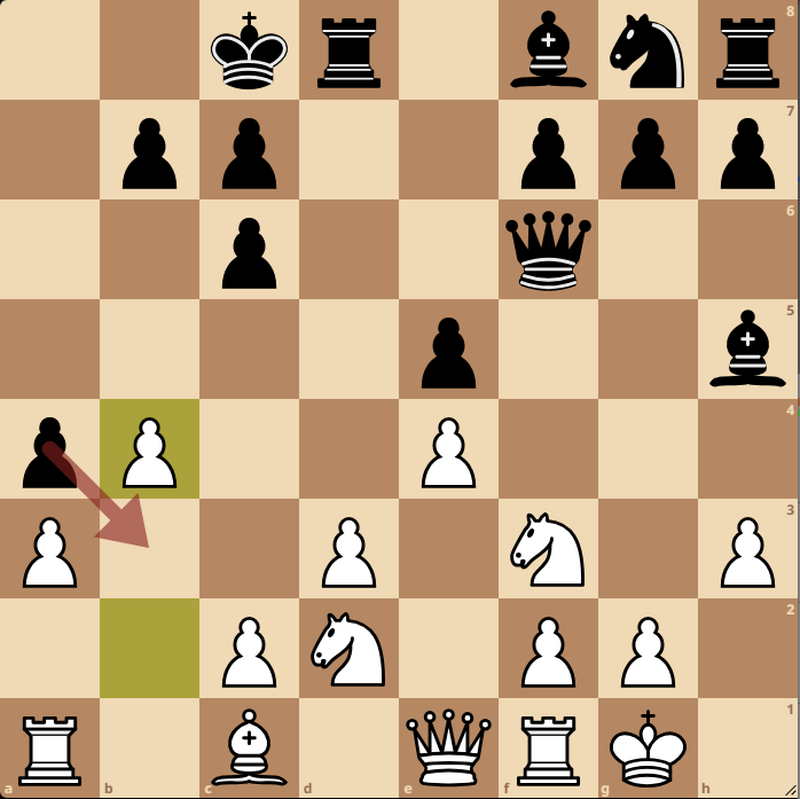
Again, fast-forwarding to this position:
1. e4 e5
2. Nf3 Nc6
3. Bb5 a6
4. Bxc6 dxc6
5. 0-0 Bg4
6. d3 Qf6
7. Nbd2 0-0-0
8. h3 Bh5
9. Qe1 a5
10. a3 a4
11. b4 axb3
12. cxb3 b5
13. Bb2 b4
14. a4 c5
15. a5 Ne7
16. a6 Nc6
17. a7 Kb7
Now, white wants to promote the a-file pawn to a queen. How would we write that? It’s written, 18. a8=Q. Also note that the new white queen is putting the black king in check, so we add the “+” sign, 18. a8=Q+.
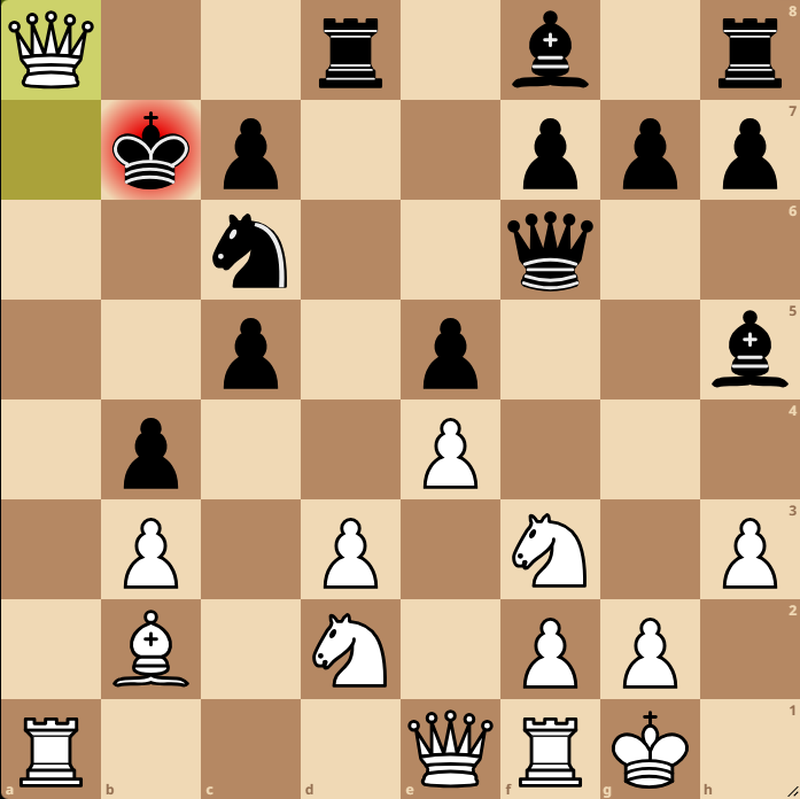
If the black rook wasn’t on d8. The black king would be forced to move: 18...Kb6. Then, on the next move, white would checkmate the king. 19. Qa6# (checkmate) where the “#” sign means checkmate.
One last thing, if you have two knights on the same file (f-file in the diagram below) you use the rank number to differentiate between the two. For example, if I want to notate the knight on f5 moving to h4, rather than the knight on f3, I would write: N5h4.
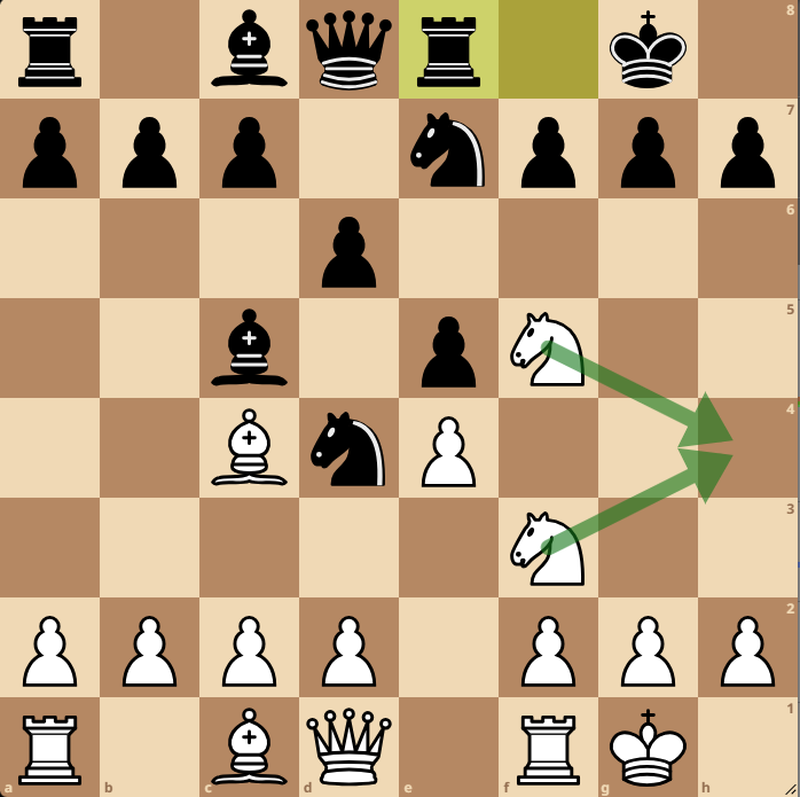
That’s it, pretty easy huh? You just learned chess notation in less than 20 moves!
Here’s a review of the Chess Notation Symbols:
K= king
Q= queen
R= rook
B= bishop
N= knight
= pawn
Nf3= knight moves to f3
bxc3= b-file pawn captures the piece on c3
x= to take or capture
+= check
++= double check
#= checkmate
= pawn promotion, ex. a8=Q where a pawn on a8 is promoted to a queen
0-0= castle kingside
0-0-0= castle queenside
1-0= white wins
0-1= black wins
½-½= draw
white resigns= black wins
black resigns= white wins
In addition to these chess notation symbols, you’ll see these common symbols used for evaluating the merits of a particular move. These most common symbols are written after the move:
??= blunder (A blunder is a critically bad mistake)
?= mistake
?!= inaccuracy or doubtful move
!?= interesting move
!= good move
!!= brilliant move
And these symbols are used to show the strategic balance of the position of the game:
= the position is equal
+/= slight advantage for white
=/+ slight advantage for black
+/- clear advantage for white
-/+ clear advantage for black
+- white is clearly winning
-+ black is clearly winning
+2.9 white is winning by almost 3 pawns
-1.9 black is winning by almost 2 pawns
You may also like
 achja
achjaMy 2025 "immortal" game
I did it! I played my most fun game so far in 2025. I can hardly believe it! mullerrj
Avoid burnout- play Chess960!
Are you burning out in standard chess? If so, have you played Chess960? ChessMonitor_Stats
Where do Grandmasters play Chess? - Lichess vs. Chess.com
This is the first large-scale analysis of Grandmaster activity across Chess.com and Lichess from 200… mullerrj
3 easy steps to help analyze your games
Playing without reviewing and analyzing your games is the slowest path to improvement. mullerrj
Checks, Captures & Threats: What is it and why is it important?
Checks, Captures & Threats- a simple checklist before making your next move CM HGabor