
Image: Levy Rozman (Gotham Chess)
Don’t ‘memorize’ your chess openings, ‘learn’ them instead!
6 easy steps to ‘learning’ your Openings.Disclaimer: This blog is intended for beginner to intermediate players.
One could argue that there’s no single "most important" phase in Chess. Each phase (Opening, Middlegame, and Endgame) serves a unique purpose. But, I do believe the Opening is the most ‘crucial’ phase of the Chess game. That’s because if you make a mistake in the Opening phase, you may never reach the Middle Game or Endgame phase. The game will be over before you know it. I think this is especially true at the higher levels. I’ve lost many games in the Opening phase although continuing through the Middle Game and End Game phases. And, of those losses I can attribute many of them to not knowing the Opening as well as maybe I should.
For beginners just starting out, I think it’s more important to learn the Opening principles, or ‘objectives’ as I call them, which are: control the center, develop your pieces and castle (to safeguard your king). But, even as a beginner I think you should know/learn the first 4 or 5 moves of at least one Opening, either the Italian, Spanish or Scotch Opening for white, and the first 4 or 5 moves of either the Caro-Kann, Sicilian or King’s Indian Defense for black. All of these popular openings adhere to the opening principles of chess.
Since I believe the Opening Phase is the most crucial I also believe it’s paramount to know/learn your Openings. Do you need to memorize your chess Openings? I don’t think you should ‘memorize’ Chess Openings at any level. I think you should ‘learn’ them. You learn them by practicing and playing them continually. I think if you learn something you’ll remember it longer than if you try to memorize something. Here are my recommended 6 Steps for learning Openings:
STEP 1- LEARN THE GOALS AND OBJECTIVES OF THE OPENING
I think the first step in remembering Openings are to learn/understand the goals and objective of the Opening and learn the most popular ones that fit your style. What’s nice about the most popular Openings is that they already follow good opening principles such as: controlling the center, developing your pieces and safeguarding your king. I think when you understand the goals/objectives of an Opening it’s easier to remember the moves.
The quickest (and cheapest) way to find the goals/objectives of a particular Opening is to do a Google Search. Just type, for example, “What are the goals and objectives of the Caro-Kann Defense?”. I did a ChatGPT search, similar to Google search, and this is what it said:
The Caro-Kann Defense (1. e4 c6) is a solid, resilient, and strategic defense for Black. It is known for its strong pawn structure, piece coordination, and long-term counterplay, making it a favorite of positional players like Anatoly Karpov and even aggressive players like Mikhail Tal, who used it in an attacking style.
Goals & Objectives of the Caro-Kann Defense
1. Strong & Solid Pawn Structure
- The move 1...c6 prepares 2...d5, allowing Black to challenge White’s center without weakening their position (unlike the French Defense, which locks in the light-squared bishop).
- Black’s pawn structure remains healthy, reducing weaknesses and making it harder for White to create early attacking chances.
2. Long-Term Strategic Play
- The Caro-Kann is not an immediate counterattacking defense like the Sicilian or King’s Indian but absorbs White’s pressure first, then strikes back later.
- Black exchanges minor pieces and aims for a superior endgame, where their pawn structure is an advantage.
3. Development Without Major Weaknesses
- Unlike the French Defense, where the light-squared bishop is often stuck, in the Caro-Kann, Black can develop their bishop actively to f5 or g4 before playing ...e6.
- Black avoids immediate weaknesses and prepares for a stable middlegame.
4. Counterplay and Breaks
- Black plays for pawn breaks to activate their position, usually:
- ...c5 (striking at White’s center)
- ...f6 (challenging e4 in the Advance Variation)
- These breaks ensure Black doesn’t remain passive and can take control later.
Common Caro-Kann Setups & Plans
- Classical (3. Nc3 dxe4 4. Nxe4 Bf5) – Solid with active piece play.
- Advance (3. e5 Bf5 or ...c5 plan) – White gains space, but Black counterattacks.
- Exchange (3. exd5 cxd5) – Leads to a symmetrical structure with a strong endgame for Black.
- Fantasy Variation (3. f3?!) – An aggressive approach by White, but Black can counter if prepared.
Is the Caro-Kann Right for You?
- If you want solid, strategic play with strong defense, the Caro-Kann is a great choice.
- If you prefer aggressive, sharp counterattacks, it might feel too slow compared to the Sicilian or King’s Indian.
- There are aggressive lines within the Caro-Kann, such as the Bronstein-Larsen Variation (with ...gxf6 in the Classical), or the Shirov Attack against the Advance Variation.
So you can see ChatGPT gives you quite a bit of information on the goals and objectives of the Caro-Kann Defense Opening. Naturally, if you want more detailed information on the Caro-Kann, you can buy a book on it. There are hundreds sold on the Caro-Kann Defense alone. If you want a good comprehensive one, that won’t break the bank, I recommend: Opening Repertoire, The Caro-Kann by Jovanska Houska. You can pick it up at Amazon for around $20.
It’s good to look at the goals and objectives of an Opening before you start to learn it. Who knows, you may not like. No sense wasting time on an Opening that you don’t like or fits your style of play.
STEP 2- WATCH AN OPENING VIDEO BY AN IM, FM or GM
Pick a favorite chess instructor/teacher- preferably an IM, FM or GM. I like Levy Rozman’s (Gotham Chess) chess opening videos. Here’s a short and sweet 10 minute video on the Caro-Kann Defense and its variations: https://www.youtube.com/watch?v=rmbU97iftC8&t=526s If you want a video that’s a little bit more in depth on the Caro-Kann, here’s another one by Levy: https://www.youtube.com/watch?v=ebfzL_GwiIE&t=13s I like videos because I can remember the Openings better than if I read them in a book. And, don’t just watch one video, watch a few by other IMs or GMs. Most every instructor will reinforce the goal/objective of each Opening Variant that you learned in STEP 1.
STEP 3- WATCH GMs PLAY THE OPENING
After watching a video (or two) of the Caro Kann Opening, I like to watch the GMs play the Opening. You can do that with the Lichess Analysis Board. Just run through the first couple moves of the Caro Kann on the Analysis Board. After running through the first two moves: 1. e4 c6 2. d4 d5 of the Caro Kann, select Top Games. In this example, I’ve chosen a game between Ding Liren and Magnus Carlsen (see red box below).
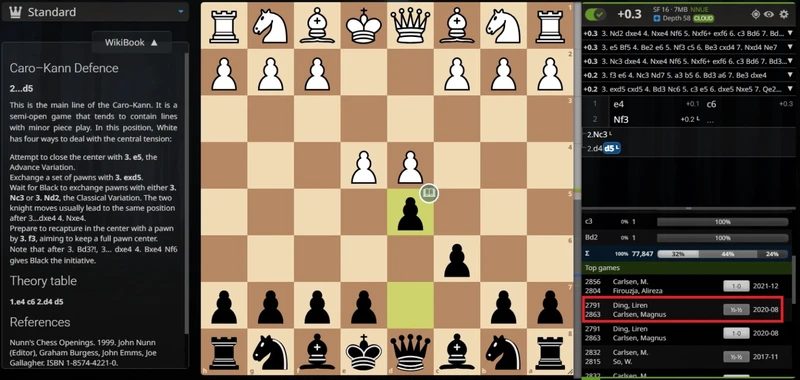
Here, Ding and Magnus play the Caro-Kann, Exchange Variation, to a draw: https://lichess.org/b2Xfc6Wq/black#6 Just like videos, I like watching GMs play because I can remember their Opening moves better/longer than if I read or try to follow them in a book. When you watch the GM’s play, try to understand why they’re making the moves they are. It may take some time, but you’ll get it. If not, ask a friend at a local chess club or ask on the Lichess forum. https://lichess.org/forum
STEP 4- WRITE DOWN THE OPENING VARIATIONS
After watching a video (or two), and watching the GMs play the Caro-Kann Opening, write down the first 4 or 5 moves of the most popular or common variations. You can do this in chess notation on a blank page in Microsoft Word and save it as your Opening Repertoire document. Sometimes, when you write things down you can remember them better/longer. In Levy’s 10 minute video, he only covered 3 of the most common Caro-Kann variations after the moves 1. e4 c6 2. d4 d5. That’s why I recommend watching other videos of Openings as well. In the Caro-Kann, there are actually 5 common variations after the moves 1. e4 c6 2. d4 d5. They are:
1. Exchange variation: 1. e4 c6 2. d4 d5 3. exd5 cxd5 4. c4 Nf6
2. Advance variation: 1. e4 c6 2. d4 d5 3. e5 Bf5 4. Nf3 e6 5. Be2 c5
3. Classical variation: 1. e4 c6 2. d4 d5 3. Nc3 dxe4 4. Nxe4 Bf5 5. Ng3 Bg6
4. Modern variation: 1. e4 c6 2. d4 d5 3. Nd2 dxe4 4. Nxe4 Bf5
5. Fantasy variation: 1. e4 c6 2. d4 d5 3. f3 Qb6 4. Nc3 e6
Instead of playing 2. d4, white could play either 2. Nf3 or 2. Nc3 in the Caro-Kann Defense. These however, are not as popular as 2. d4 which is why I’m not covering them in this blog. In either case, black’s next best move is 2...d5.
A good way to find the top 5 variations (of any Opening) is to use Lichess’ Analysis Board and change the engine settings (gear icon that the red arrow is pointing to) to select and show the top 5 lines/variations. You can see in the red box (below) each of the Caro-Kann lines/variations. Granted, for the Caro-Kann Opening, you have to know that the Main Line starts out: 1. e4 c6 2. d4 d5. The different variations, from the Main Line, start on the 3rd move.
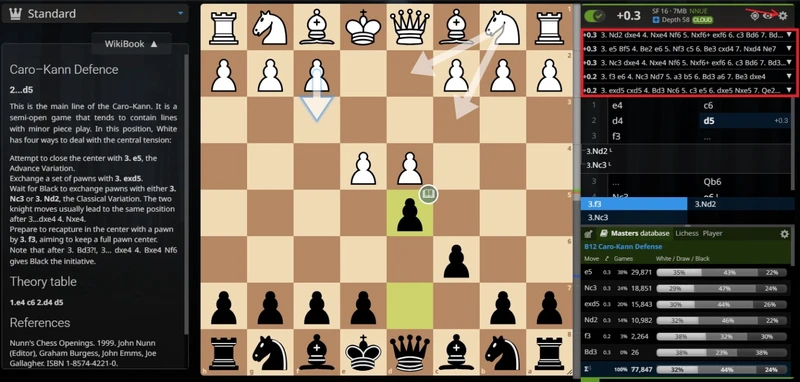
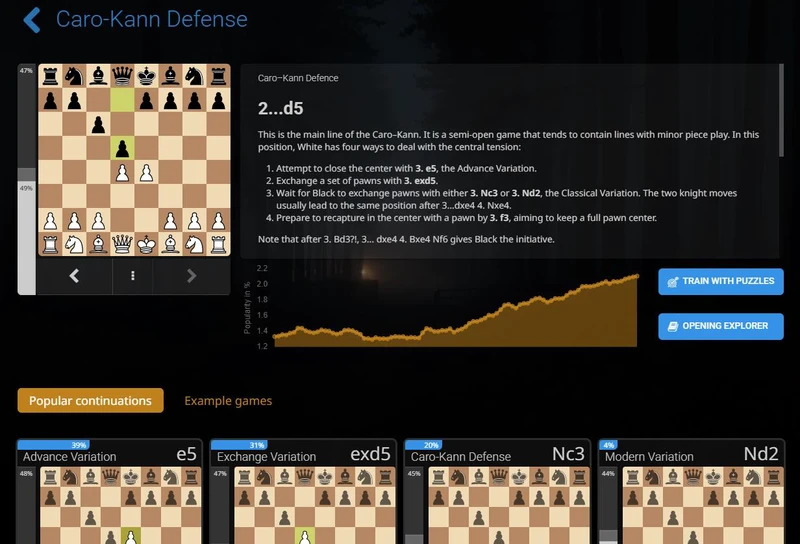
If you’re unsure how the Caro-Kann Main Line starts, or any Opening for that matter, you can always go to the Lichess’ menu and choose Openings. https://lichess.org/opening Then, type in: ‘Caro-Kann Defense Main Line’ in the search box. You’ll see the top variations. What’s really neat about this view is that you can see how popular each of the variations are. You can see that the ‘Advance Variation’ has 39% popularity, ‘Exchange Variation’ has 31% popularity, ‘Classical Variation’ has 20% popularity, ‘Modern Variation’ has 4%, etc. I’m not sure if the popularity is ‘Lichess player’ popularity or ‘Master player’ popularity. If I had to guess, I’d say it’s ‘Lichess player’ popularity. If anyone knows for sure, please reply/comment below.
STEP 5 – PRACTICE
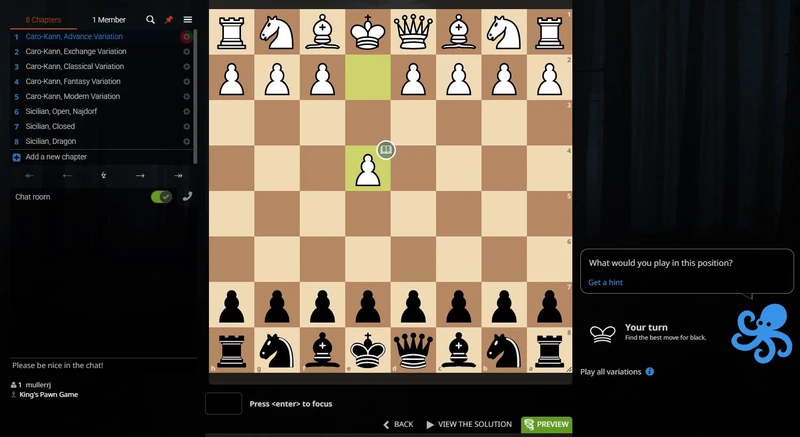
After you’ve watched a video course (or two) on the Opening, watched GMs play, you’ve identified the most common lines/variations and wrote down the first 4-5 moves of each variation, you need to practice them. What I like to do is create a Private Study (in Lichess) of each of my Opening Variants. After I set them up in Lichess Study, https://lichess.org/study , I drill each Opening Variant until I become proficient in each one. I just cut/paste the Opening moves from the Microsoft Word document I created during STEP 4 right into Lichess Study. Once I set up the study, I increase each line/variation to the first 10 moves instead of just 4. I think learning/knowing lines/variations out to 10 moves is sufficient to get me through most Openings in good shape.
Practice, practice, practice your Opening variations! Practice them regularly.
STEP 6 – PLAY
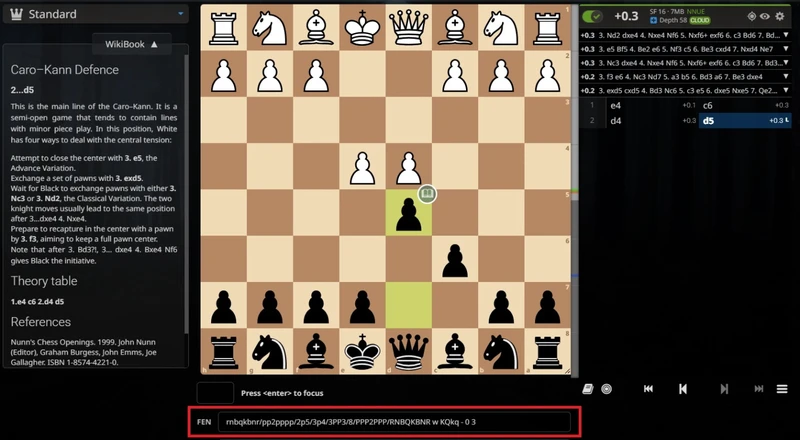
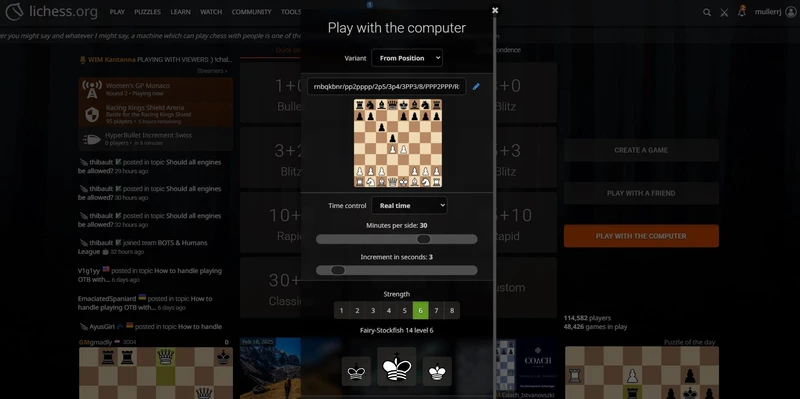
After I’ve practiced/drilled each of the variants, I play against the computer. I like to play against Lichess Stockfish Level 6. It’s a good level for me. Actually, it’s probably a bit too difficult for me, but I like it that way. To ensure the computer plays the Caro-Kann, I copy the FEN position from the Analysis Board (see red box below) and I paste it into the ‘Play with the Computer Settings”.
In the ‘Play with the computer’ settings choose ‘From Position’ in the Variant box. Then, paste the FEN in the FEN box. Choose your time control, the strength, and the color pieces you want to play. I choose the black pieces. And, away you go. After the game, make sure you perform a Computer Analysis of your game so you can see where you made your mistakes. Make sure you learn from your mistakes so you don’t make the same mistakes again. That’s how you improve.
Here’s a game I recently played against Lichess Stockfish Level 6: https://lichess.org/Wf9xpsij/black#42 We played the Caro-Kann, Classical variation. I eventually lost because I made a few mistakes in the Endgame. But, at least I played well through the (Caro-Kann) Opening which allowed me to be in a good shape in the Middle Game and give me a chance of winning in the Endgame. Stockfish Level 6 played flawlessly so I don’t feel so bad about the loss. It played with 96% accuracy, an ACPL of 14, no blunders, zero mistakes and only 1 inaccuracy. Hard to beat SF6 when it plays like that. At least at my level it is. But, that’s why I play it. I want it to play its best game, so if/when I do win (which is rarely), I know I played a great game against a great opponent.
I believe the key to remembering Opening variations is not to blindly memorize the chess moves but to learn and understand them. You do that by following this 6 easy-step method.
This 6 easy-step method will take some time to learn, especially with a complex Opening, but I think you’ll remember the Opening variations longer if you do. It’s all about maximizing the limited time you/we have to become a better chess player.
Remember, don’t ‘memorize’ your chess openings, ‘learn’ them instead!
You may also like
 mullerrj
Attack or be attacked
“Only the player with the initiative has the right to attack.” — Wilhelm Steinitz NDpatzer
Science of Chess: Can you tell a human opponent from a machine?
Do chess engines pass the Turing Test? mullerrj
Slow down, you move too fast...
A man who is a master of patience is master of everything else. mullerrj
Imbalances
What are they and how they'll hep you create a detailed plan mullerrj
3 easy steps to help analyze your games
Playing without reviewing and analyzing your games is the slowest path to improvement. mullerrj