
Dancing with myself
Ignoring your opponent’s plan is the #1 source of middlegame blundersThis blog is intended for beginner through intermediate players.
In chess, "Dancing with myself" refers to a common amateur mistake where a player makes moves based only on their own plan(s), without considering their opponent's best possible responses or plan(s).
Every time I see “Dancing with myself” it reminds me of the 1981 hit song by Billy Idol with the same title. https://www.youtube.com/watch?v=FG1NrQYXjLU It's one of my favorites of the time. I digress.
Did you know that ignoring your opponent’s plan is the #1 source of middlegame blunders- for amateur players? Well, you do now!
When I play chess, I never ‘completely’ ignore my opponent’s plan. I always have a good idea what my opponent’s plan is and what they’re trying to do. My problem, however, is that I don’t normally pay as much attention to their plan(s) as perhaps I should. That is, I don’t think their plan is any better than mine or poses an immediate threat. I don’t think they can execute it before mine either. There’s no doubt, I underestimate their plan at times. And, when I do, I end up blundering a piece away and lose.
Here’s a game (below) where I was ‘Dancing with myself’ and focusing solely on what I wanted to do (my plan) rather than my opponent’s plan. I’m playing the white pieces. The center was tied up and no immediate threats- at least I didn’t see any. Black’s pieces were inactive for the most part, except for the light squared bishop, queen, and rook. I should have taken black’s kingside pawn storm more seriously too- specifically the f-file pawn. Regardless, the position was equal after the 16th move (according to Stockfish). My blunder, Qe1?? (shown below) was the 17th move.
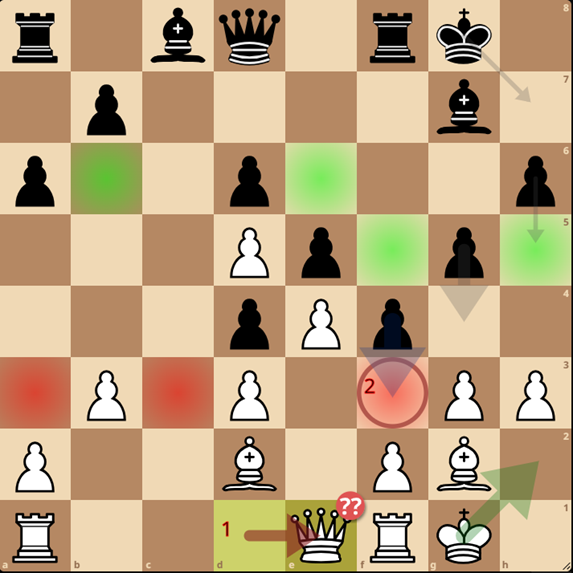
I forgot my queen on d1 was helping protect the f3 square along with my bishop on g2 (see red circle). I don’t know why I just didn’t move my bishop to Bg3 to stop the advance of black’s f-file pawn. Well, I do, that wasn’t my plan.
After 17. Qe1, my plan was to move 18. Ba5 and start threatening the black queen. Then, I was going to move 19. Rc1 (to the open c-file) and try to wreak some havoc. It wasn’t a great plan, but a plan nonetheless. I did NOT see, however, the (pawn break) move 17...f3 (by my opponent) on their next move- a threatening move. I did see it but I thought I could just retreat my bishop to Bh1 and eliminate the threat. I completely ignored my opponent’s plan of attack.
Here’s what happened: 17. Qe1?? f3 18. Kg2 I knew if I moved 18. Bh1 instead, black’s next move would have been 18...Bxh3 capturing my pawn. On their next move, it would have been 19...Bxf1 and I would have lost my rook since it was trapped.
I could have continued playing but I resigned. I was -2.4 down against a strong opponent. I was so just so disgusted that I blundered and ignored my opponent’s plan.
Here’s another game (below) where I was ‘Dancing with myself’ and just focusing on my plan. I’m playing the black pieces. The position was equal (according to Stockfish). On the 16th move, white moves: 16. Bd6 threatening my rook on f8. So, I moved: 16...Rf6. My thinking here is that on my next move I could move 17...e5 advancing the e-file pawn and taking more control of the center and simultaneously attacking the bishop. I blundered. I saw it 2 seconds after I let go of the rook. That’s 17. Rxd7. No takebacks. I didn’t see white’s future move Qb5 either- attacking both of my knights.
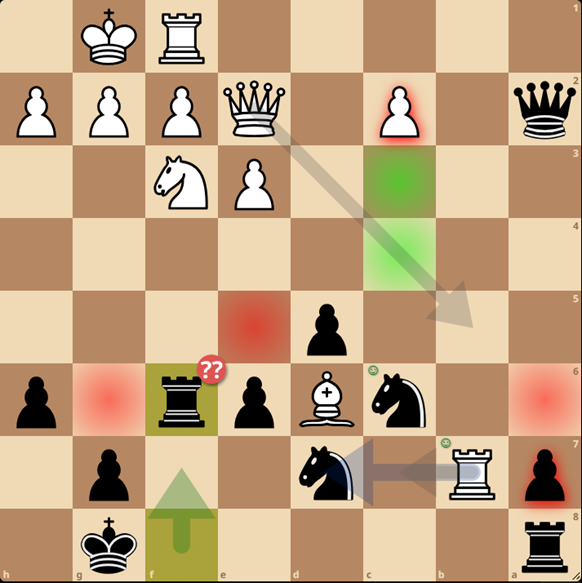
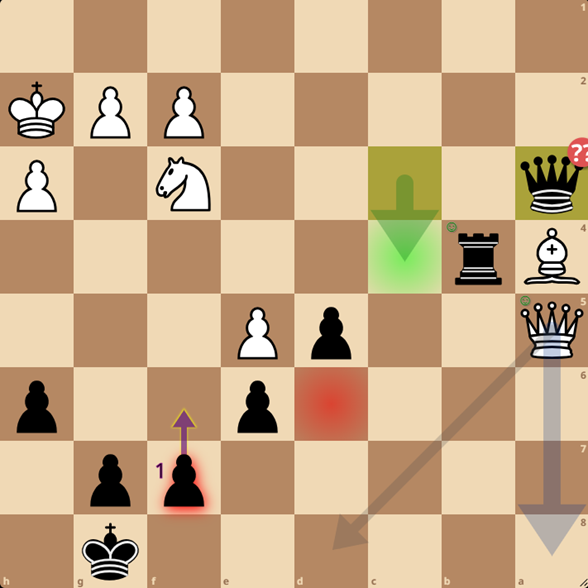
And yet another game (below) where I just flat out underestimated the threat and miscalculated. Again, like the other games, an equal position (according to Stockfish). I was playing the black pieces. I blundered on move 30...Qa3. My plan was to double-up with my rook on the attack of white’s bishop on a4. I saw white’s queen threat 31. Qa8+ on the next move. I figured I’d just move my king to 31... h7. If the white bishop moved 32. Bc2+, I would just block with my pawn 32...g6. Problem is, white’s bishop move was a discovered check, which left my queen hanging. I overlooked my opponent’s plan. Game over! Bleh.
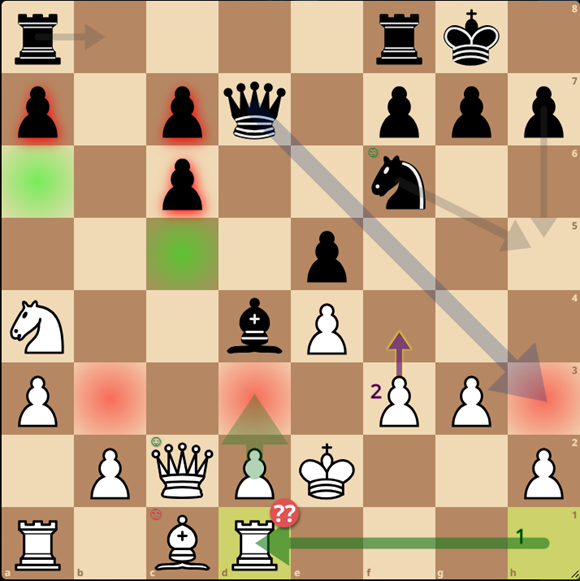
And lastly, I was ‘Dancing with myself’ in this game (below) and blundered while ignoring my opponent’s plan. I was playing the white pieces. I moved my rook to a semi-open file that my opposing queen was sitting on: 14. Rd1. I, however, neglected black’s next move: 14...Qh3 threatening to check my king on the next move and capture my h-file pawn.
In all of these games, I wasn’t playing a human opponent that had a plan. I was playing against a chess computer. Chess computers don't play with a "plan" in the human sense; instead, they use calculations to choose the move that results in the best score for the board position, a process that often appears strategic but is rooted in tactical calculation. Computer chess engines build a tree of possible moves and analyze the outcomes to find the one with the highest evaluation score, considering factors like material, king safety, and pawn structure.
I was playing against a strong computer BOT on Lichess (Maia). Maia chess engine is specifically designed to play in a more human-like style than traditional chess BOTS like Stockfish. Unlike engines optimized for the best possible move, Maia is trained on millions of human games to replicate human decision-making, including common mistakes and biases.
Maia plays with a plan, but its "planning" differs fundamentally from traditional chess engines like Stockfish. While a traditional engine uses deep calculation to find a mathematically winning path, Maia's strategic depth comes from mimicking human-style intentionality learned from millions of real games.
Regardless, I ignored or underestimated my opponent’s threat (or plan) in each of these games and I paid the price.
In every one of these games I was in an equal or near equal position (according to Stockfish) before I blundered. And, in all 4 games, I was in the middlegame phase.
So, what can I/we do to help eliminate these middlegame blunders as a result of ignoring our opponent’s plan? Here’s 6 things you/I can do that I think will help:
1. Stop attacks/threats before they become deadly. You may have to hold up or delay on your own attack and diffuse your opponent’s attack/threat first.
2. Keep your attack going. As long are you’re attacking, your opponent will be reacting and they won’t have time to attack or pose a threat. If you’re not attacking, beware of your opponent’s attack.
3. Captures, Threats and Threats. Most of you know about CCT, but how many of you actually use this 3-step safety plan when you play? Before you make your next move, pause and scan the board and ask yourself: a. are there any checks my opponent can make on my king on their next move? b. Can my opponent capture any of my pieces on their next move? and c. Are there any threats my opponent can create on their next move. Do not move until you check all three.
4. Don’t play ‘hope chess’. Don’t assume your opponent will miss things. Always assume your opponent will play the best move or at least see simple tactics. Never underestimate your opponent’s play, especially a lower rated opponent.
5. Spend more time thinking during the middlegame. I know from experience, that if I do blunder, most of my blunders occur during the middlegame. Knowing this, this is the phase of the game to be more alert on what my opponent is planning and to spend more time thinking about the board position. Also, ensure you allot more time during the middlegame especially if you play shorter/faster time controls.
6. Guess your opponent’s next move. Visualize the board from your opponent's perspective. Try to guess your opponent’s next move; most of the time I can- if I try. When you do this, you’re paying attention to your opponent’s plan.
Summary
Ignoring your opponent’s plan is like playing with blind spots- your attack may be strong, but you’ll lose to threats you never saw coming. Even the best idea you have (a sacrifice, an attack, a tactic you want to set up) can instantly fail if your opponent is about to create a bigger threat.
I’ll leave you with a great quote from former world champion Emanuel Lasker whose influences still shows up in top-level play today, where he believed that ***understanding your opponent’s mindset ***is as important as finding the ‘best’ computer move.
He said, quote: “The hardest opponent to face is the one who knows what you want and stops it”- E. Lasker
You may also like
 mullerrj
Imbalances
What are they and how they'll hep you create a detailed plan NM VoicelessFeather
Squeezing Water from a Stone
How to build up towards an impossible result GM Avetik_ChessMood
10 Things to Give Up to Enjoy Chess Fully
Discover how embracing a lighter mindset can help you enjoy chess again and achieve better results. CM HGabor
How titled players lie to you
This post is a word of warning for the average club player. As the chess world is becoming increasin… ChessMonitor_Stats
Where do Grandmasters play Chess? - Lichess vs. Chess.com
This is the first large-scale analysis of Grandmaster activity across Chess.com and Lichess from 200… mullerrj