
Aleksandar Randjelovic
Which Openings Actually Make Sense for Beginners?

If we don't understand the key term we want to discuss, or we don't take the actual player's level into account, we are basically giving bad advice.
To me, a beginner is someone whose chess understanding is built mostly on basic principles.
From that point on, the list of suitable openings narrows down quite a bit.
But, again, the important thing is that we are not starting from the opening, but from the player (and what they actually understand).
Authority bias: Choosing an opening based on reputation
One very common reason beginners choose openings is reputation.
They hear that the Sicilian is great, the King's Indian is aggressive, or that Carlsen plays a certain system, and suddenly that opening becomes attractive.
If the strongest players in the world use something, it must be good, right?
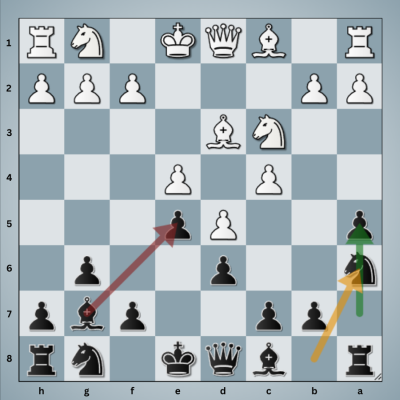
(Diagram: How can a beginner understand the point of playing a move with a pawn on the rim - ...a5, or placing the knight on the rim - ...Na6, or combining the bishop on g7 and own pawn on e5?)
The problem is that this logic skips one important step. It doesn't ask whether YOU understand what is going on. The real question should be - will I actually understand the position that comes out of this opening? Or even more basic - do I know what these opening moves are trying to achieve?
And this is something I've seen many times as a chess coach. The opening looks correct, but the player has no real connection to the position. It's not really chess understanding - it’s more like memorized choreography.
Choosing an opening as a quick fix
The second reason is completely different. It's not about copying strong players, it's about wanting results fast. Beginners are often looking for a quick fix. A way to get better rating without putting effort and wasting time.
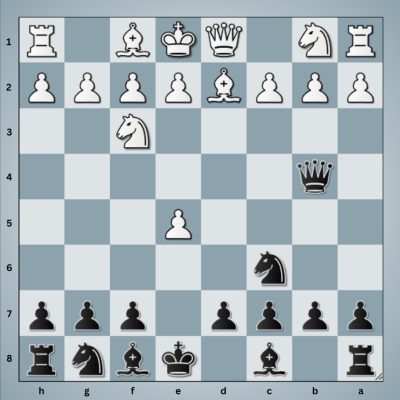
(Diagram: Playing against the basic principles, only to score if the opponent blunders. A terrible habit for a beginner.)
Five months ago I published a YouTube video on this exact topic. At the time of writing, it has around 3500 views. And I think that number is actually interesting. Not because it's good or bad, but because it probably says something about how people approach chess.
Most players are not really searching for openings that help them understand the game. They are searching for openings that promise results, quick wins, traps, quick attacks... Something that works immediately.
But sooner or later the opponent doesn't fall for the trick, the opening theory is over, and you actually have to play chess.
Using basic chess logic instead
Most beginners understand basic chess ideas - develop, control and fight for the center, improve your pieces, use open files, attack weaknesses...
The problem starts when an opening requires much more than that.
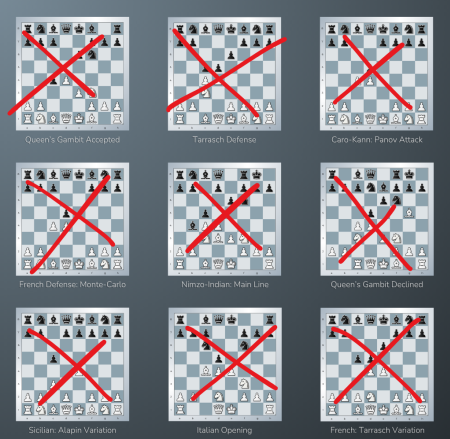
(Diagram: Openings where an IQP most likely happens. Beginners don't (and shouldn't) know what that even is.)
Some openings ask you to give space and rely on later counterplay. Others are built around slow strategic maneuvering, or some long-term material compensation.
Strong players enjoy that kind of complexity, but beginners usually don't really know what is going on there.
So I ended up with a surprisingly boring conclusion: the best openings for beginners are - the simplest ones!
Against 1.e4 - 1...e5! The development is natural, center is easy to understand, and most of the positions are asking for basic chess ideas in action.
Against 1.d4 my choice would be the Queen's Gambit Declined. It's not flashy or something you show off with. But it teaches meaningful, real chess. And, more importantly, it constantly keeps you in positions where chess logic works.
So in the end, you don't really need an opening that gives you an advantage on move five. You need an opening that keeps teaching you the value of playing logical chess from move 1.
And if you want to see how I went through different openings and looked at them from a beginner’s perspective, how complex they are and how suitable they really are, you can find the video here: How to Build an Opening Repertoire as a Beginner.
Let me know what you think.
You may also like
 CM HGabor
How titled players lie to you
This post is a word of warning for the average club player. As the chess world is becoming increasin… FM mizant83
My Favorite Anti-London Weapon
If you’ve ever found yourself half-asleep playing against the London System, you are here for a good… GM Avetik_ChessMood
10 Things to Give Up to Enjoy Chess Fully
Discover how embracing a lighter mindset can help you enjoy chess again and achieve better results. FM mizant83
Pawn chains and direction
A look at how pawn chains influence where to attack in closed positions. FM mizant83
What Beginners Get Wrong About Learning Chess
This post may be interesting primarily to complete beginners, or to those who are just starting thei… ChessMonitor_Stats