
The complicated case of FIDE's fluctuating ratings
Analyzing historical inflation and deflation within the FIDE ecosystem
It's no secret to anyone that FIDE ratings have risen over the past few decades, at least at the highest level. A 2700 just fifty years ago would be an almost-automatic world champion contender, while most 2700s today don't even make the Candidates.
This process of rating ballooning across a player pool over time without objective improvement, also known as ELO inflation, is exactly what I'll be investigating today.
Why has FIDE inflation happened at the master level?
Exploding player pool
FIDE has obviously experienced massive growth over the years. In 1970, FIDE's first official rating list featured only 582 members. Today's numbers absolutely dwarf that figure, with a pool of over 1.5 million active players.
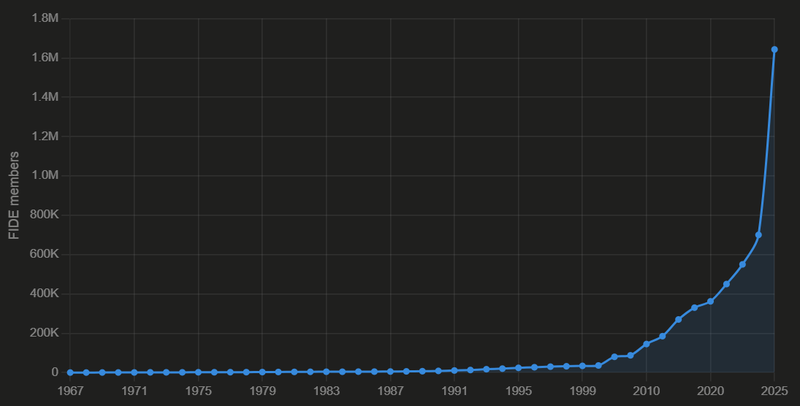
This massive player count has major implications on ELO inflation. A vast majority of new FIDE members are beginners. These beginners feed points to intermediates, intermediates to advanced players, and so on.
When this process occurs at an almost-constant rate, you end up with more rating accumulating at the highest level, resulting in higher ELOs for the players at the top of the ecosystem.
Increased skill levels
A much more straightforward contributor to inflation is the fact that we're just getting better at chess. Engines have helped players better understand and optimize their chess games and repertoires, leading to them becoming much stronger over time.
FIDE's ELO system
Finally, FIDE has established an ELO calculation system that is just begging for master-level inflation. The organization has put in place...
- a high K-factor of 40 for U18 players, allowing them to gain a huge amount of rating in a short amount of time and feed that rating upwards through the ecosystem
- a huge ELO boost for <2000 players in March 2024
- a floor of 1400 ELO, significantly increasing beginners' ratings
By now, it should be clear to see that inflation has pretty much been a constant at the highest level. However, the situation for FIDE's overall player base is a completely different story.
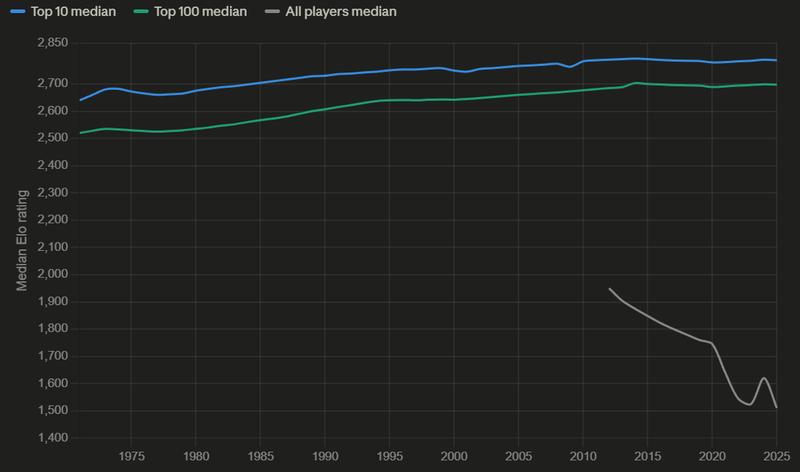
As you can see, the median classical FIDE rating has significantly dropped over the past few years.
You could blame the sharp median decrease in 2021-2023 on COVID. Many underrated players, many of whom were young, had their ratings "frozen" because barely anyone could play OTB tournaments at the time. When these young players returned en masse to over-the-board chess in the years following 2020, they caused a net drain in the FIDE ecosystem.
Basically, juniors' sharp rise further dispersed the already-spreading FIDE player pool, driving the median FIDE rating down significantly.
Wait, what's that spike on the graph after the pandemic?
That bump you see around 2024 was a time of major systemic change within FIDE. As I mentioned before, FIDE that year...
- raised the floor from 1000 to 1400
- raised U2000 player ratings by 0.40 × (2000 − current rating)
- reinstalled the 400-point rule, which was later limited to <2650 players
These changes were initially proposed by chess statistician Jeff Sonas in July 2023. According to Sonas, these measures would compress the widely-dispersed U2000 player pool without changing the actual order of the players themselves. On paper, these changes would work, but why did they fail to have any meaningful impact on deflation just one year later?
International arbiter Otto Milvang has explained this failure best. "The proposal from [Sonas] does not solve the [underlying] problem. We will still have talented young players that climb up the rating at the expense of established players."
Basically, Milvang states that this proposal will only be a temporary fix to the root causes of FIDE ELO deflation.
This hypothesis has been strongly supported by 2025 data. The median rating fell sharply from the low 1600s in 2024 down to ~1510 the next year.
What can be done to solve FIDE deflation?
Now, I'm no data statistician, as you can probably tell by now. However, FIDE needs to undergo major systematic change if it wants to curb rating deflation across its player pool. That may come in a sweeping change in rating calculation methods favoring lower-rated players, further alterations to existing ELOs, or other more drastic measures.
Finding a proper solution to deflation would definitely make for a really cool blog idea, but it's outside of what I can personally cover as someone who's just entering the world of statistics.
Thanks for reading, and hope you found this blog helpful or insightful!
You may also like
 Vlad_G92
FIDE Ratings Revisited
Do they offer the full picture, or can improvements still be made? RuyLopez1000
AI Slop is Invading the Chess World
Claiming that AI can teach chess is the latest fad flash3s
Analyzing blitz ELO inflation among major chess websites
A statistical review and in-depth analysis of inflation in blitz ratings within the two largest onli… thibault
How I started building Lichess
I get this question sometimes. How did you decide to make a chess server? The truth is, I didn't. flash3s
Take a walk. That's literally it.
A great way to bounce back when you're having a bad start to your tournament Bosburp