Your network blocks the Lichess assets!

lichess.org
Donate

Have FIDE ratings actually inflated over time?

@flash3s Thanks for the blog. I'll share some sources and info.


Point One

This process of rating ballooning across a player pool over time, also known as ELO inflation

Rating inflation means that a increase in rating is not due to a increase in strength. Rating deflation means that a decrease in rating is not due to a decrease in strength. It is the idea that a rating in the present is not worth the same rating in the past in terms of strength.


Point Two

FIDE has obviously experienced massive growth over the years.
This massive player count has major implications on ELO inflation. A vast majority of new FIDE members are beginners. These beginners feed points to intermediates, intermediates to advanced players, and so on. When this process occurs at an almost-constant rate, you end up with more rating accumulating at the highest level, resulting in higher ELOs for the players at the top of the ecosystem.

"Deflation becomes more acute with a greater percentage of new and improving players in the pool and with their entry into rated competition earlier in their careers. The junior players, who can improve dramatically even between two tournaments, are principally responsible for the deflation generally found in national applications of the rating system."

Arpad Elo, The Rating of Chessplayers, Past and Present, Second Edition, 1986, (p.48)


Point Three

it should be clear to see that inflation has pretty much been a constant at the highest level.

The graph shows highest level player ratings increasing until 2013, when it flattens out.


Appendix

Finding a proper solution to deflation would definitely make for a really cool blog idea, but it's outside of what I can personally cover as someone who's just entering the world of statistics.

Vlad_G92 - FIDE rating changes: Are they working so far? 2024
Vlad_G92 - FIDE Ratings Revisited 2025

@flash3s Thanks for the blog. I'll share some sources and info. --- **Point One** >This process of rating ballooning across a player pool over time, also known as ELO inflation Rating inflation means that a increase in rating is not due to a increase in strength. Rating deflation means that a decrease in rating is not due to a decrease in strength. It is the idea that a rating in the present is not worth the same rating in the past in terms of strength. --- **Point Two** >FIDE has obviously experienced massive growth over the years. >This massive player count has major implications on ELO inflation. A vast majority of new FIDE members are beginners. These beginners feed points to intermediates, intermediates to advanced players, and so on. When this process occurs at an almost-constant rate, you end up with more rating accumulating at the highest level, resulting in higher ELOs for the players at the top of the ecosystem. "Deflation becomes more acute with a greater percentage of new and improving players in the pool and with their entry into rated competition earlier in their careers. The junior players, who can improve dramatically even between two tournaments, are principally responsible for the deflation generally found in national applications of the rating system." Arpad Elo, The Rating of Chessplayers, Past and Present, Second Edition, 1986, (p.48) --- **Point Three** >it should be clear to see that inflation has pretty much been a constant at the highest level. The graph shows highest level player *ratings increasing until 2013*, when it flattens out. --- **Appendix** >Finding a proper solution to deflation would definitely make for a really cool blog idea, but it's outside of what I can personally cover as someone who's just entering the world of statistics. [Vlad_G92 - FIDE rating changes: Are they working so far? 2024](https://lichess.org/@/Vlad_G92/blog/fide-rating-changes-are-they-working-so-far/oJPRC8KP) [Vlad_G92 - FIDE Ratings Revisited 2025](https://lichess.org/@/Vlad_G92/blog/fide-ratings-revisited/BN89yF7d)

I agree with you on Point 1. I simplified the definition quite a bit. Will change it there.

On Point 2, I was discussing the inflation of those at the highest level in the first section, not necessarily for the whole player pool. This large player pool is indeed a contributor to deflation at the lowest level.

On Point 3, by "almost a constant," I meant to represent the constant gradual increase of ELOs at the highest level since 1970. I added almost to account for this flatlining at around 2013.

Thanks for pointing this out!

I agree with you on Point 1. I simplified the definition quite a bit. Will change it there. On Point 2, I was discussing the inflation of those at the highest level in the first section, not necessarily for the whole player pool. This large player pool is indeed a contributor to deflation at the lowest level. On Point 3, by "almost a constant," I meant to represent the constant gradual increase of ELOs at the highest level since 1970. I added almost to account for this flatlining at around 2013. Thanks for pointing this out!

@flash3s said ^

On Point 2, I was discussing the inflation of those at the highest level in the first section, not necessarily for the whole player pool. This large player pool is indeed a contributor to deflation at the lowest level.

I believe that the deflation occurs across the whole player pool (including those at the highest level).

I believe this for three reasons:


1. Jeff Sonas' analysis demonstrates that rating deflation is occurring, across the whole player pool:

Jeff Sonas 2023: "Everything I just described about "rating deflation" has really happened, during the past decade, to the FIDE Standard Elo rating system. New players have entered the system, hundreds of thousands of new players, many of them entering with a large deficiency of rating points, and their overall impact has been to pull down ratings of the established rating pool."

"We should also acknowledge that this effect is not happening only among weaker players, or only among stronger players. Rather, it is present throughout the entire rating pool. We can double-check this by constructing a "summary crosstable" spanning several entire years of data."

Sonas Proposal: Repairing the FIDE Standard Elo rating system
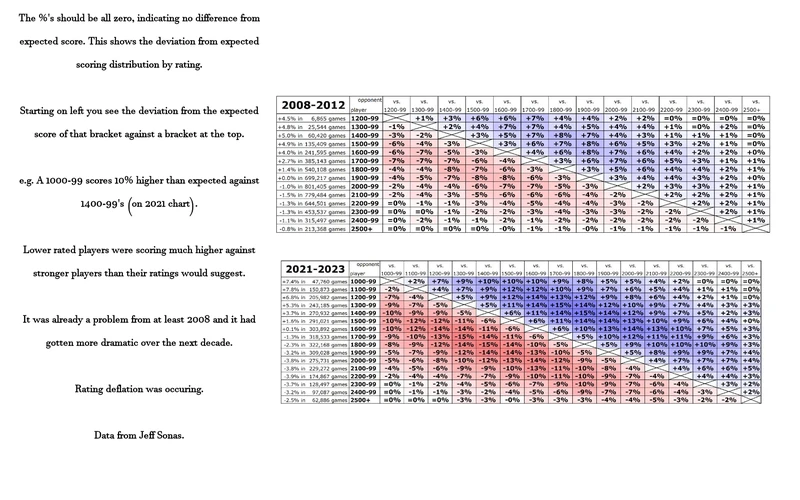
image.png

The win rates of 2400-2499 players are 2% larger then they should be against 2500+ players in the 2021-2023 period (this is just above the bottom right corner of the 2021-2023 table). The reason the deflation is smaller at the top levels is because the deflation is like a shockwave that ripples up the player pool, or dominos which fall in succession towards the top players. Jeff Sonas' table shows this effect, the disparity in win rates is reduced as rating increases. But the deflation is still there at the top levels, and there is definitely not inflation.


2. The graph (in the blog) shows highest level player ratings increasing until 2013, when it flattens out. The flattening out represents deflation, not inflation.


3. Professor Elo, inventor of Elo indicates that larger player pools leads to deflation, not inflation.

@flash3s said [^](/forum/redirect/post/wmWGN9oi) > On Point 2, I was discussing the inflation of those at the highest level in the first section, not necessarily for the whole player pool. This large player pool is indeed a contributor to deflation at the lowest level. **I believe that the deflation occurs across the whole player pool (including those at the highest level).** I believe this for three reasons: --- **1. Jeff Sonas' analysis demonstrates that rating deflation is occurring, across the whole player pool:** Jeff Sonas 2023: "Everything I just described about "rating deflation" has really happened, during the past decade, to the FIDE Standard Elo rating system. New players have entered the system, hundreds of thousands of new players, many of them entering with a large deficiency of rating points, and their overall impact has been to pull down ratings of the established rating pool." "We should also acknowledge that this effect is not happening only among weaker players, or only among stronger players. Rather, it is present throughout the entire rating pool. We can double-check this by constructing a "summary crosstable" spanning several entire years of data." [Sonas Proposal: Repairing the FIDE Standard Elo rating system](https://www.fide.com/docs/presentations/Sonas%20Proposal%20-%20Repairing%20the%20FIDE%20Standard%20Elo%20Rating%20System.pdf) ![image.png](https://image.lichess1.org/display?fmt=webp&h=0&op=resize&path=aU8EIm4G3GxO.jpg&w=800&sig=d1b34590e7b6431b68984c094c49e727ce11e201) The win rates of 2400-2499 players are 2% larger then they should be against 2500+ players in the 2021-2023 period (this is just above the bottom right corner of the 2021-2023 table). The reason the deflation is smaller at the top levels is because the deflation is like a shockwave that ripples up the player pool, or dominos which fall in succession towards the top players. Jeff Sonas' table shows this effect, the disparity in win rates is reduced as rating increases. But the deflation is still there at the top levels, and there is definitely not inflation. --- **2. The graph (in the blog) shows highest level player ratings increasing until 2013, when it flattens out. The flattening out represents deflation, not inflation.** --- **3. Professor Elo, inventor of Elo indicates that larger player pools leads to deflation, not inflation.**

I'm pretty sure ratings are deflated and I can give two big reasons for that.

  1. K Factor does impose quite a lot of rating drag, especially among players who don't often play in FIDE rated events. For example imagine a player is FIDE rated at 1400 and then doesn't play in FIDE events for a while and returns with a playing strength of 1800. During the time they're going from 1400 to 1800 they're deflating rating system.

  2. Players often quit chess (e.g. death, retirement) at a higher rating than they began. So if a player has a first rating of 1400 and then finishes at 2000 they've deflated rating system by 600 points. Each time a new player is added to rating system with less than average rating it's deflationary.

Then for inflation you've got 2 factors that can contribute

  1. Juniors with a K factor of 40 beating opponents with a K factor of 20. This increases points in ecosystem

  2. People getting a first rating stronger than their real strength, although this can also be deflationary if they mess up their first event.

Overall I think big problem is that FIDE rating are too slow to adjust to people's new strength so their old strength gets too much weight and then it reinforces problem as opponents are underrated giving more deflation. In my national federation rating system we have a 200 up rule where a rapidly improving player's rating is recalculated from scratch and then new calculated rating is used instead of old one. Unless there's a structural shift I don't think deflation is going away.

I'm pretty sure ratings are deflated and I can give two big reasons for that. 1. K Factor does impose quite a lot of rating drag, especially among players who don't often play in FIDE rated events. For example imagine a player is FIDE rated at 1400 and then doesn't play in FIDE events for a while and returns with a playing strength of 1800. During the time they're going from 1400 to 1800 they're deflating rating system. 2. Players often quit chess (e.g. death, retirement) at a higher rating than they began. So if a player has a first rating of 1400 and then finishes at 2000 they've deflated rating system by 600 points. Each time a new player is added to rating system with less than average rating it's deflationary. Then for inflation you've got 2 factors that can contribute 1. Juniors with a K factor of 40 beating opponents with a K factor of 20. This increases points in ecosystem 2. People getting a first rating stronger than their real strength, although this can also be deflationary if they mess up their first event. Overall I think big problem is that FIDE rating are too slow to adjust to people's new strength so their old strength gets too much weight and then it reinforces problem as opponents are underrated giving more deflation. In my national federation rating system we have a 200 up rule where a rapidly improving player's rating is recalculated from scratch and then new calculated rating is used instead of old one. Unless there's a structural shift I don't think deflation is going away.

Deflation at the top of the rating list started in 2015 and continues since then. Compare the ratings of Magnus Carlsen back then and now, the ratings of top 50 or top 100 players then and now. The deflation is apparent.

Deflation at the top of the rating list started in 2015 and continues since then. Compare the ratings of Magnus Carlsen back then and now, the ratings of top 50 or top 100 players then and now. The deflation is apparent.

Ah, the famous chess ladder effect. Ranking vs rating plateau conversions.

Ah, the famous chess ladder effect. Ranking vs rating plateau conversions.

@ILikeBlitz said ^

Deflation at the top of the rating list started in 2015 and continues since then. Compare the ratings of Magnus Carlsen back then and now, the ratings of top 50 or top 100 players then and now. The deflation is apparent.

Deflation is indeed actually happening at the top recently, and I forgot to address that in my blog. I was mainly covering historical causes of inflation up until this 2010-2015ish mark to give a general picture.

Thanks for pointing this out!

@ILikeBlitz said [^](/forum/redirect/post/yrB1Uwbl) > Deflation at the top of the rating list started in 2015 and continues since then. Compare the ratings of Magnus Carlsen back then and now, the ratings of top 50 or top 100 players then and now. The deflation is apparent. Deflation is indeed actually happening at the top recently, and I forgot to address that in my blog. I was mainly covering historical causes of inflation up until this 2010-2015ish mark to give a general picture. Thanks for pointing this out!

Well if looking long term actually thing I think had biggest impact was lowering the rating floor.

From what I saw (not checked) in 1971 when it was first introduced the floor was 2200. Then in 1993 it was lowered to 2000 and stayed at that level for quite a long time.

Then FIDE decided to get more players obtaining FIDE ratings and floor was reduced all the way to 1000 and then it was increased to 1400.

I'm unsure on exact dates where floor was lowered but I think you'll find good correlation between rating floor being lowered and deflation

Well if looking long term actually thing I think had biggest impact was lowering the rating floor. From what I saw (not checked) in 1971 when it was first introduced the floor was 2200. Then in 1993 it was lowered to 2000 and stayed at that level for quite a long time. Then FIDE decided to get more players obtaining FIDE ratings and floor was reduced all the way to 1000 and then it was increased to 1400. I'm unsure on exact dates where floor was lowered but I think you'll find good correlation between rating floor being lowered and deflation

"The median rating fell sharply from the low 1600s in 2024 down to ~1510 the next year."

That is very big news and I never saw somebody mentioning this earlier. 100 points drop in 1 year is gigantic. Another 100 points drop would mean half of the fide-players becomes unrated as 1400 is the minimum to get a rating.

Can you show the data which you used to proof your claim? Can you point out the countries which impacted the most to this drop of the median rating?

I notice for this summer many tournaments in Europe will be flooded with Indian players. Many Europeans are dropping out. I don't think this is positive.

"The median rating fell sharply from the low 1600s in 2024 down to ~1510 the next year." That is very big news and I never saw somebody mentioning this earlier. 100 points drop in 1 year is gigantic. Another 100 points drop would mean half of the fide-players becomes unrated as 1400 is the minimum to get a rating. Can you show the data which you used to proof your claim? Can you point out the countries which impacted the most to this drop of the median rating? I notice for this summer many tournaments in Europe will be flooded with Indian players. Many Europeans are dropping out. I don't think this is positive.