
Freepik
Your Brainwaves Can Predict Whether You Win at Chess
Winners Adapt Their Theta Waves To Opponent Difficulty
You've heard of brainwaves. Brainwaves are so fascinating. Brainwaves stem from the co-ordinated electrical activity of neurons. They have the shape of repeating waves.
So why do brainwaves exist, that regular repeating pattern of electrical activity?
We'll first look at a study where people's brainwaves were recorded while playing chess.
People played against their engine counterparts. This engine was called 'Fritz'. It was the top engine in the 90s (it's still not too bad). Let us imagine that you're a participant in the study. So you show up and see a computer. You will play against Fritz on three settings. The first is Fritz set to 75% of your Elo. The second is Fritz at your level, and third is Fritz at 125% of your Elo.
So you are playing the engine at different levels, one below, one equal and one above your strength. Chess engines can be modified in this way to play at a certain strength by blocking some of its search pathways. This is how you can play Stockfish at different levels. But in this case you play the Fritz engine. Now the time control is 3+2, which has you feeling at home if you play this format.
But there's more. A lot more. You also have things attached to your head. Electrodes stuck on with gel connected to wires... ]
What is going on here :O
Well no need to be worried my test subject friend :) You see this is simply what we call EEG recording. We can record your brainwaves in real time while you play the game!
Huh...
Erm we told you about this no? Wait... Oh noes we didn't. That breaks our ethical requirements.
But wait why are you surprised? I mean we already connected the wires, shouldn't you have wondered earlier?
Answer to the riddle: this isn't a real experiment, I asked you to imagine it.
Your reaction: :I
Anyway back to the topic...
The reason there are wires connected to the participants heard is to record brainwaves using a EEG (electroencephalogram).
 The numbers and letters are locations of the brain. We are looking from a birds-eye perspective, (the thing at the top is the nose). On the sides are the ears. F=Frontal, T=Temporal, C=Central, P=Parietal, O=Occipital. The circles are the EEG channels which are electrodes.
You'll notice that 21 areas are covered in the standard paradigm, and these areas cover a large number of neurons. This means that the spatial location of signals are less precise. On the other hand, EEG can record with millisecond resolution allowing very precise timing information. That's good when you want to know detailed timing info. Also it's cheaper and easier to use EEG. We can also have more detailed EEG by adding more channels (256 is a high amount that has been used). But the standard way shown above is the 10-20 system (called that because the positions of the channels are based on the values of 10% and 20% of the skull distance).
The brainwaves are the summation of the electrical activity of a large amount of neurons. Electrical activity occurs when a neuron has an action potential. An action potential occurs when the neuron's membrane becomes depolarized after stimulation from other neurons, causing an electrical impulse to be sent down its axon. This then causes neurotransmitters to be released which bind onto another neuron which can influence whether the threshold will be decreased or increased for that neuron to fire. Neurons also exist in the spinal cord and the peripheral nervous system which allows muscles to be contracted and to relay sensory information.
The EEG doesn't measure the action potential directly. What the EEG measures is the postsynaptic potential of parallel pyramidal neurons. Pyramidal neurons are basically big neurons with long axons and there's a far greater proportion of them in humans compared to other animals. They allow long range communication between different areas of the brain. Areas of the brain with higher proportions of these pyramidal neurons have been postulated to form a 'global workspace' which allows integration of info from multiple sources which allows us to be human (have more abstract thoughts and behavior).
 Source: In vitro cell models merging circadian rhythms and brain waves for personalized neuromedicine. Pavan et al. 2022.
Now the different brainwaves can correlate with different things. One classic example is that when you close your eyes, alpha waves appear over the visual cortex. So it said that alpha waves reflect inhibition of neurons. This effect also occurs when closing your eyes in the dark, when the visual input is the same, but the alpha waves appear when the eyes are physically closed.
But the important thing is that brainwaves are not connected to one thing necessarily. A certain brainwave may have a different function in a different context. See the way it goes is people perform tasks and then researchers look at the brainwaves which appear in each area of the brain. And then they see that a certain brainwave is connected to a certain area for a task. And then they try to infer why.
Now brain waves do change consistently from sleep to wake. In NREM deep sleep the brainwaves are delta (1-4Hz). This is the lowest frequency, reflecting reducing neural activity. This is expected since we are far less active in sleep than in wake.
Abstractly speaking, brainwaves exist so that information in the brain can be co-ordinated. Brain waves are the synchronous activity of neurons. If the neurons weren't co-ordinated then it would be chaos.
Now back to the chess experiment where they had people play against Fritz chess engine at different levels. Here is a chart showing the amount of theta power based on difficulty of the computer. 'Power' refers to the intensity of neural activity for that brainwave. So higher theta power means the neural activity at the theta frequency is more intense.
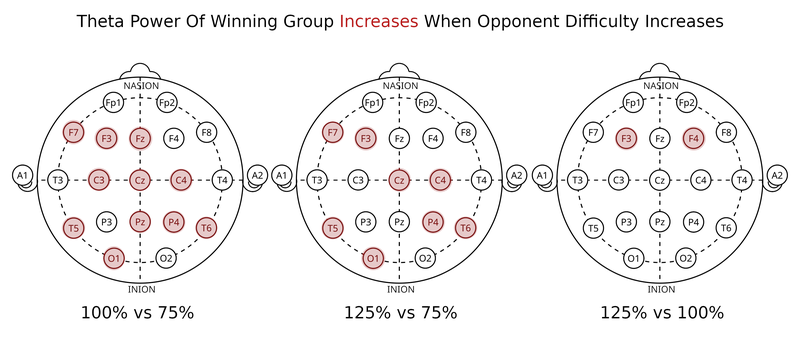
Red means that the area had higher theta power in the greater difficulty game. (100% vs 75% means the game played against their level vs an easier opponent at 75% of their level).
So the Theta power increased in the winning group when compared a more difficult opponent against an easier opponent. As the difficultly increased, so would the Theta power in channels. This effect did not occur in the losing group. The losing group did not increase Theta power in any channel when the difficulty of the game increased.
However, in the easier level game the losing group had higher theta power than the winning group (channels Pz, P4, T5, T6 and C3).
That seems paradoxical because isn't higher theta power good? The answer is that the level of theta power reflects the cognitive load, how difficult a task is. So the lower group had a higher level of theta because they had to put more effort.
The increase in theta power in the winning group reflects the fact that they are adapting to the difficulty of each level. Only needing to put in the effort that is needed.
Another study had a working memory task. There were two groups: low working memory and high working memory groups. The same pattern occurred where the higher working memory group's theta power increased as the memory task became more difficult. The low working memory showed no such pattern. Also the low working memory group had an initially higher level of theta, just in the chess study.
This fits with the neural efficiency hypothesis, which states that more proficient task performance is associated with less brain activation as less effort is needed for the task. You can feel that difficult tasks need more effort which requires more brain activation. While easier tasks are more automatic and easier, with the neural pathways being adapted for the task. This explains why the losing group had higher initial theta power.
 Blue indicates lower power in the more difficult game. Red indicates higher power in the more difficult game.
Alpha and Beta power decreased when the losing group played against against their level as opposed to playing against a weaker opponent. Reduction in Alpha and Beta power is associated with higher cognitive load. The alpha and beta power didn't reduce in the 125% vs 100 % game. This was hypothesized to be due to the higher level becoming too difficult, so that no more cognitive load was being imposed. Just like how an impossible chess puzzle results in a blank feeling due to not knowing how to even start finding the solution.
The Alpha power increases when the winning group played against a more difficult opponent. But this pattern didn't occur for the losing group. Why?
The winning group won, so the Alpha presumably helped when played against a more difficult opponent (125% of Elo) compared to a weaker opponent (75% of Elo). And the Alpha power is increased in the temporal channels (T3-T6) and the C3 channel. So what function did the Alpha play?
Remote Associations Test Question: Find the word which fits with these three words: dew comb bee (answer at bottom of blog).
Here's a clue for you: Alpha power in the right temporal was correlated with increased creativity. Applying alternating current at 10Hz (alpha range), over the right temporal lobe resulted in more uncommon associations being found in a Remote Associations Test when two of the words had misleading associations and also finding more unusual ideas in a divergent thinking task. Alpha power was also higher when finding uncommon associations with a obvious misleading association and coming up with more remote uses for an object.
The Alpha waves act as an inhibitor which supports creativity by suppressing obvious associations and allowing more remote associations which can support creativity. The higher the magnitude of alpha waves, the lower the neural firing rate. Creativity requires a combination of unique and useful ideas. Spreading activation theory says that semantic knowledge is retrieved in order of obviousness/commonality (represented by how strongly the nodes (neurons) are connected), with less common associations being being retrieved later in the chain. The function of alpha waves is to inhibit obvious associations to allow less obvious ideas to come to mind.
So the Winning Group could be showing increased creativity when the difficulty is higher.
Summary
1. The Winning Group had less Theta power and adapted their Theta power to match the opponent difficulty as they needed less mental effort and adapted their effort based on the opponent.
2. The Losing Group had less Alpha and Beta power (in the 100% level compared to 75% level) as their mental effort increased.
3. The Winning Group had increased Alpha power in the higher difficulty game which could represent increased creativity to deal with a more difficult opponent.
Find the word which fits with these three words: dew comb bee. Answer: Honey
My teams:
Visit Blog Creators Hangout for more featured blogs.
Visit Study Creators Hangout for more featured studies.
Recommended teams:
Visit Thinknoodles’ study fan club for more featured noodles.
Visit Study Creators & Friends for more featured studies.
Visit Study Resource Team for more featured studies.
Visit The Gambit of the Week for more featured gambits.
Recommended blogs:
The Moment of Commitment: A Training Exercise in Calculation and Control - @UncleRogerJr
Does Chess Really Make You Smarter - @SummerSandwich6789
The Gambit of the Week! - @FlamingHawk3000
You may also like
 RuyLopez1000
Why Are People Good At Chess?
The Rise and Fall of Chunks CM HGabor
How titled players lie to you
This post is a word of warning for the average club player. As the chess world is becoming increasin… TotalNoob69
The REAL value of chess pieces
... according to Stockfish RuyLopez1000
Does Stockfish Dream of Electric Knights?
Could Stockfish be Conscious? RuyLopez1000
AI Slop is Invading the Chess World
Claiming that AI can teach chess is the latest fad RuyLopez1000