
David's Chess Journey - Installment 29
This week's intro tracks Dojo progress (a lot of work this week!), reflects on Tunnel Vision Blunder Syndrome, recounts some key takeaways from my last lesson and shows my latest Lichess4545 League loss where my opponent outplayed me with 95% accuracy!Dojo Progress
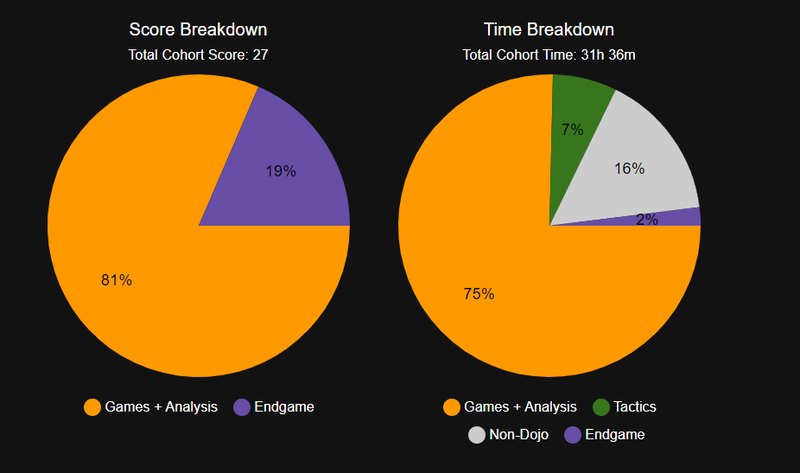
Here is my Dojo Progress for this week. Doing the math, that is around 23 hours of playing classical chess! Lots of games and lots of lost points, but lots of good lessons and painful growth.
Tunnel Vision Blunder Syndrome
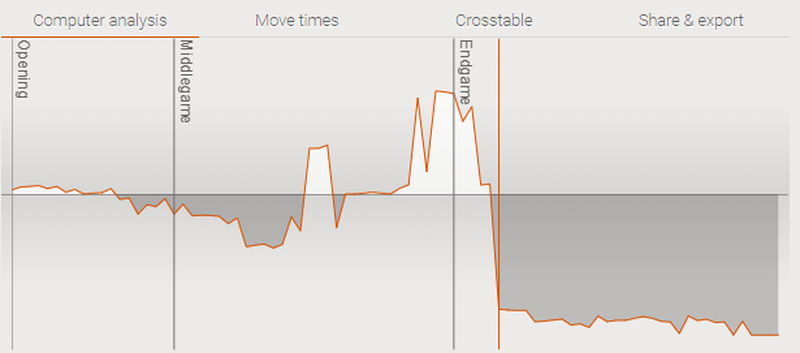
I over the last couple of weeks, I've dropped [around 70 points]. While some of the losses were good games where I was just outplayed by stronger opponents, several of the games were in situations where I was significantly better or winning and committed what I'm calling Tunnel Vision Blunders. I'm sure that someone already coined that term, but what is important is that it communicates the "why" behind the blunder. I am so so focused on what I am trying to accomplish that I don't take the time (even though I have plenty of time) to calculate the resources of my opponent or the consequences of my move through the 3-ply framework. In other words, quick moves that are not backed up by calculation and suffer a lack of board vision. Here are two painful examples from classical games this week that were part of my point bleed:
In this position, I didn't see the disaster that awaited me because of Qg5. I was focused on trying to convert my winning position and didn't see that I was walking into a death trap. The eval bar reflects the magnitude of the Tunnel Vision Blunder:
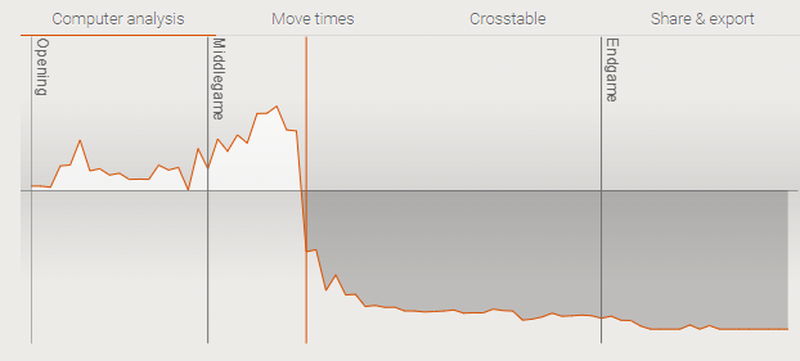
Here is a second Tunnel Vision Blunder where I don't notice that my Queen is hanging because I'm fascinated with the idea of taking the Bishop:
The eval bar tells the sad story here, as well:
The lessons from these Tunnel Vision Blunders are pretty clear - slow down, take time to calculate, understand what my opponent's move does to the position. Understand potential trouble caused by a move that I want to make using the 3-ply framework.
The more difficult aspect is the psychological aspect. How does a chess player forgive him/herself for committing such horrible blunders? I think the first step is to analyze the game where the horrible blunders occur to really sit with it. The benefit of doing that painful exercise is to see the strengths that the player exhibited in the game. In both of the games that I highlighted here, I had strong play before the blunder that evidences the hard work that I've been putting in. Obviously, there is more to go, but I'm not only defined by the Tunnel Vision Blunder, I just lost the game because of the blunder. But these are just games that are part of the journey to mastery. These are lessons to learn.
The other aspect is giving yourself grace. After my last Liches4545 loss, someone who was watching the game reached out with a very kind note. He complimented me on my play and reminded me that we need to be kind to ourselves as adult improvers because chess is hard and the journey is long. That note meant a lot to me and I wanted to pass along the truth of that statement here.
We have to be kind to ourselves as chess players because the game is hard and the journey is long.
But, it is a wonderful and enjoyable journey for those of us who stay on it. Stay encouraged, forgive yourself, and keep going! One of the reasons I put these embarrassing blunders out there for all to see (well, all 10 people who will read this:) is to let you know that you are not alone. We all do this at my level and even stronger levels.
Lesson Takeaways
I had a very instructive lesson with NoseKnowsAll this week. Here are some helpful takeaways worth sharing:
- When someone plays nonsense, play the most principled move available to punish the mistake.
- Pins are most problematic when the pinned piece is not defended by a pawn. When defended by a pawn, then the worst scenario is that you lose a pawn.
- When your opponents turn, don’t calculate (when no tactics (checks, captures, hanging pieces, etc.). Think generally about both sides. What are my best pieces? What are my worst pieces? How can I fix that. What are my opponents best pieces? What are my opponents worst pieces? How would they like to fix that?
Latest Liches4545 Loss
Here is my game from this week where I just flat got outplayed, but some instructive points:
Until the next installment!
You may also like
 Chessdad1979
David's Chess Journey-Installment 71
How Are Chess Lessons Like Marriage Counseling? Chessdad1979
David's Chess Journey - Installment 26
This week's update shares Dojo Progress, a return to OTB, insights from my last lesson and the launc… Chessdad1979
David's Dojo Journey - Installment 8
This week's update shows the best game of the journey to date, thoughts about having a coach, physic… Chessdad1979
David's Chess Journey - Installment 25
This weeks update reflects on Dojo Progress, the concept of Mastery, a milestone and shows a couple … Chessdad1979
David's Chess Journey - Installment 18
Time to Pivot. Chessdad1979