
David's Chess Journey - Installment 25
This weeks update reflects on Dojo Progress, the concept of Mastery, a milestone and shows a couple of interesting games.Dojo Progress
Here is a picture of this week's progress:
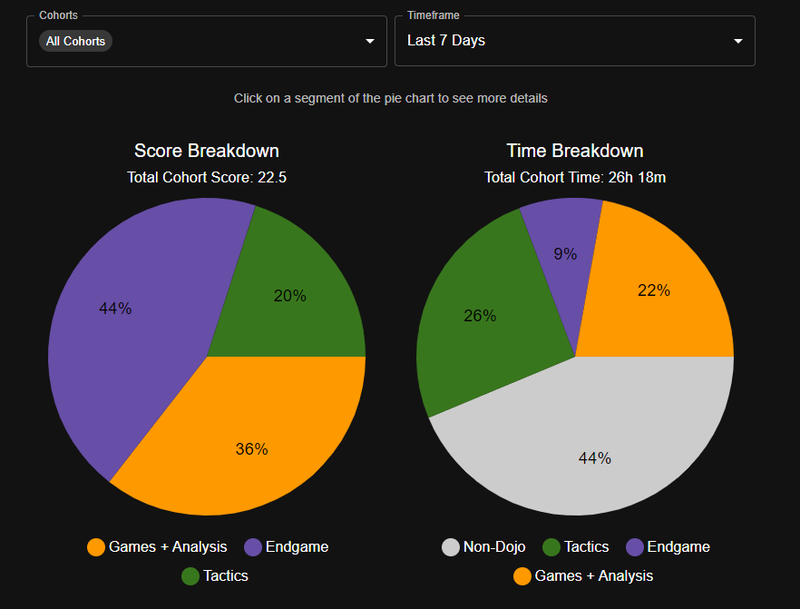
Here is a breakdown of my Non-Dojo time. I've started to capture the time that I spend on this blog (which I think is a very important part of the journey as it allows me to reflect and share with the hope of encouraging others on their respective journeys), time doing my blunder reflections on Anki (discussed below), time reviewing the opening repertoire that I built on ChessBook (discussed below) and time playing Rapid. All very valuable exercises, just not part of the program.
A couple of high points from training:
- I finished the Visualization 1 course by Benedictine. The last chapter required holding 7 move sequences in your head and then finding the right continuation. It was really challenging, but I was able to make real progress. It took me around 8 hours of hard work to get through the course, so I feel like it was a really nice accomplishment.
- I won several games this week and gained over 70 points!
- I caught the Dan Bock episode on Perpetual Chess (https://www.perpetualchesspod.com/new-blog/2024/5/21/ep-383-dan-bock-an-accomplished-adult-improver-on-how-he-leveled-up-in-his-40s) - definitely worth a listen! The episode was really encouraging and insightful. One takeaway that I added to my Non Dojo time was capturing all of the blunders in my game and incorporating them into Anki cards and reviewing the cards on the schedule outlined by Anki's space repetition algorithm. Dan has a great blog about how to use Anki cards that got me started: https://chessimprovementlab.substack.com/p/learn-first-remember-later. I have been wanting to do something like this for some time, but didn't really know the best way to do so.
- I've been putting a good amount of time into the endgame. I was finally able to crack the King+Knight v. King+Queen endgame against Stockfish, which took much longer than it should have. I'm also working through the Chessable version of Silman's Endgame manual and have found the videos to be a good compliment to the book.
- I have been putting some time into the opening, as well. I finished working through Gustaffson's Short & Sweet Chessable course building out a response to 1. e4. I'm not sure that is the best approach for my level. Another takeaway from Dan Bock's interview was ChessBook. I absolutely love the tool. I built out an entire repertoire for White and Black in 30 minutes and am now reviewing it based on spatial repetition. Amazing. If you haven't checked it out, I can't recommend it enough!
- This week saw more progress on the Polgar mates in 2. I'm 10 puzzles away from finishing the quota for my Cohort (1000) and have 10 completed Lichess studies and one in the works. Feel free to use them if they are helpful.
The Concept of Mastery
I was listening to GM Maurice Ashley's interview on the C-Squared podcast (definitely worth a listen - https://c2pod.com/episodes/maurice-ashley-improve-at-chess-build-a-strong-mindset-handle-pressure). In passing, GM Ashley mentioned a book that I recently finished and has influenced the way that I think about my chess journey - Mastery by George Leonard. The third part of the book wasn't really helpful for me, but the first two parts are definitely worth a read. Here are some key takeaways for me:
- Leonard frames the concept of mastery as a journey of consistent practice (for practice's sake) spent mostly on a plateau where manual processes become intuitive. A couple of key quotes for me related to this portion of the book:
- "How do you best move toward mastery? To put it simply, you practice diligently, but you practice primarily for the sake of practice itself. Rather than being frustrated while on the plateau, you learn to appreciate and enjoy it just as much as you do the upward surges." I found this quote to be crucial for an adult improver's chess journey. Most of the journey is likely going to be on a plateau. If joy can't be found there, then the adult improver should likely do something else with his or her free time.
- "Why does learning take place in spurts? Why can't we make steady upward progress on our way toward mastery? . . . Karl Pribram, professor of neuroscience and a pioneering brain researcher at Stanford University, explains it in terms of hypothetical brain-body systems. He starts with a "habitual behavior system" that operates at a level deeper than conscious thought. . . . This habitual system makes it possible for you to do things. . . without worrying just how you do them. When you start to learn a new skill, however, you do have to think about it, and you have to make an effort to replace old patterns of sensing, movement, and cognition with new. This brings into play what might be called a cognitive system . . . and an effort system. The cognitive and effort systems become subsets of the habitual system long enough to modify it, to teach it a new behavior. To put it another way, the cognitive and effort systems "click into" the habitual system and reprogram it. When the job is done, both systems withdraw. Then you don't have to stop and think about [the skill you are learning'. In this light, you can see that those upward surges on the mastery curve are by no means the only time anything significant or exciting is happening. Learning generally occurs in stages. A stage ends when the habitual system has been programmed to the new task, and the cognitive and effort systems have withdrawn. This means you can perform the task without making a special effort to think of its separate parts. At this point, there's an apparent spurt of learning. But this learning has been going on all along." While Leonard doesn't mention the word "chess" once in his book, this description resonated with me deeply as I think about my chess journey. Hard work and diligent practice makes manual processes automatic. A mate in 1 that used to take me a couple of minutes to see becomes automatic, etc.
- "The achievement of goals is important. But the real juice of life, whether it be sweet or bitter, is to be found not nearly so much in the products of our efforts as in the process of living itself, in how it feels to be alive."
- "If our life is a good one, a life of mastery, most of it will be spent on the plateau. If not, a large part of it may well be spent in restless, distracted, ultimately self-destructive attempts to escape the plateau." I listen to a lot of chess podcasts and plateaus are always spoken of in a negative light, something to be avoided, but this reframes that characterization. Plateaus are where the journey takes place. A place to be treasured and enjoyed, not avoided.
- "Recognition is often unsatisfying and fame is like sea-water for the thirsty. Love of your work, willingness to stay with it even in the absence of extrinsic reward, is good food and good drink."
- "Goals and contingencies, as I've said, are important. But they exist in the future and the past, beyond the pale of the sensory realm. Practice, the path of mastery, exists only in the present. You can see it, hear it, smell it, feel it. To love the plateau is to love the eternal now, to enjoy the inevitable spurts of progress and the fruits of accomplishment, then serenely to accept the new plateau that waits just beyond them. To love the plateau is to love what is most essential and enduring in your life."
- He then outlines 5 pillars of mastery:
- Pillar 1: Instruction
- "There are some skills you can learn on your own, and some you can try to learn, but if you intend to take the journey of mastery, the best thing you can do is to arrange for first-rate instruction." I have been helped by several great coaches in my journey to this point, but I am still looking for the right fit. For me, the Chess Dojo is my primary instructor at this point. Every coach that I have had the privilege to work with had particular strengths, but they also had weaknesses that prevented my continued engagement. I believe I will find the right long-term coach at the right point in my journey and belief that having a coach is absolutely essential for my journey.
- Pillar 2: Practice
- "A practice (as a noun) can be anything you practice on a regular basis as an integral party of your life-not in order to gain something else, but for its own sake." This really resonated with me as a lawyer, because our daily existence is referred to as a practice.
- "For a master, the rewards gained along the way are fine, but they are not the main reason for the journey. Ultimately, the master and the master's path are one. And if the traveler is fortunate-that is, if the path is complex and profound enough, the destination is two miles further away for every mile he or she travels."
- "There is another secret: The people we know as masters don't devote themselves to their particular skill just to get better at it. The truth is, they love to practice, and because of this they do get better. And then, to complete the circle, the better they get the more they enjoy performing the basic moves over and over again."
- "The master of any game is generally a master of practice."
- "To practice regularly, even when you seem to be getting nowhere, might at first seem onerous. But the day eventually comes when practicing becomes a treasured part of your life. You settle into it as if into your favorite easy chair, unaware of time and the turbulence of the world. It will still be there for you tomorrow. It will never go away."
- "Ultimately, practice is the path of mastery. If you stay on it long enough, you'll find it to be a vivid place, with its ups and downs, its challenges and comforts, its surprises, disappointments, and unconditional joys. You'll take your share of bumps and bruises while traveling, bruises of the ego as well as of the body, mind and spirit-but it might turn out to be the most reliable thing in your life."
- "What is mastery? At the heart of it, mastery is practice. Mastery is staying on the path."
- Pillar 3: Surrender
- If your mind immediately went to Karate Kid, then our minds think alike. And, in fact, Leonard does use the example in the book to illustrate the concept.
- "The courage of a master is measured by his or her willingness to surrender. This means surrendering to your teacher and to the demands of your discipline. It also means surrendering your own hard-won proficiency from time to time in order to reach a higher or different level of proficiency."
- The early stages of any significant new learning invoke the spirit of the fool. Its almost inevitable that you'll feel clumsy, that you'll take literal or figurative pratfalls. There's no ay around it. . . . After all, learning almost any significant skill involves certain indignities." Man is this true in learning and growing in chess! The indignities are legion!
- "The essence of boredom is to be found in the obsessive search for novelty. Satisfaction lies in mindful repetition, the discovery of endless richness in subtle variations on familiar themes."
- "Surrendering to your teacher and to the fundamentals of the art are only the beginning. There are times in almost every master's journey when it becomes necessary to give up some hard-won competence in order to advance to the next stage." If experienced this when I shifted from the English and Caro-Kann to 1. e4 and 1.e5 in order to learn how to play more open positions given my weak positional understanding.
- "Perhaps the best you can hope for on the master's journey-whether your art be management or marriage, badminton or ballet-is to cultivate the mind and heart of the beginning at every stage along the way. For the master, surrender means there are no experts. There are only learners."
- Pillar 4: Intentionality
- The last two pillars become significantly less concrete, so I will summarize what I understand the concept to mean at a high level rather than providing quotes/gems to meditate on. He begins the chapter by comparing the concept to "character, willpower, attitude, imaging and the mental game." Intentionality, with all of those ideas combined, is the ability to engage deeply (and increasingly so) on the mental plane in connection with one's discipline. That is, the ability to engage in one's discipline in a state of flow, clarity of mind, focused and intense calmness, deep belief and positivity. These are deep waters and my high-level summary doesn't do the chapter justice, so would be interested in everyone's take!
- Perhaps this quote is helpful: "Intentionality fuels the master's journey. Every master is a master of vision."
- Pillar 5: The Edge
- "The Edge" is also quite vague. I think this quote captures the essence: "Now we come, as come we must in anything of real consequence, to a seeming contradiction, a paradox. Almost without exception, those we know as masters are dedicated to the fundamentals of their calling. They are zealots of practice, connoisseurs of the small, incremental step. At the same time-and here's the paradox-these people, these masters, are precisely the ones who are likely to challenge previous limits, to take risks for the sake of higher performance, and even to become obsessive at times in that pursuit."
- "The trick here is not only to test the edges of the envelope, but also to walk the fine line between endless, goalless practice and those alluring goals that appear along the way."
- "Playing the edge is a balancing act. It demands the awareness to know when you're pushing yourself beyond safe limits. In this awareness, the man or woman on the path of mastery sometimes makes a conscious decision to do just that."
- Pillar 1: Instruction
- Finally, he provides some tips for those seeking the path of mastery (this is the part of the book that meanders beyond what I personally found helpful a good bit):
- "A human being is the kind of machine that wears out from lack of use. There are limits, of course, and we do need healthful rest and relaxation, but for the most part we gain energy by using energy. Often the best remedy for physical weariness is thirty minutes of aerobic exercise."
- "Before you can use your potential energy, you have to decide what you're going to do with it. And in making any choice, you face a monstrous fact: to move in one direction, you must forgo all others. To choose one goal is to forsake a very large number of other possible goals."
- "Indecision leads to inaction, which leads to low energy, depression, despair."
- "Ultimately, liberation comes through the acceptance of limits."
- "It's easy to get on the path of mastery. The real challenge lies in staying on it."
- "It's fine to have ambitious goals, but the best way of reaching them is to cultivate modest expectations at every step along the way. When you're climbing a mountain, in other words, be aware that the peak is ahead, but don't keep looking up at it. Keep your eyes on the path, And when you reach the top of the mountain, as the Zen saying goes, keep on climbing."
- "Perhaps we'll never know how far the path can go, how much a human being can truly achieve, until we realize that the ultimate reward is not a gold medal but the path itself."
- "Without laughter, the rough and rocky places on the path might be too painful to bear. Humor not only lightens your load, it also broadens your perspective. To be deadly serious is to suffer tunnel vision. To be able to laugh at yourself clears the vision."
- "Consistency of practice is the mark of the master."
- "We fail to realize that mastery is not about perfection. It's about process, a journey. The master is the one who stays on the path day after day, year after year. The master is the one who is willing to try, and fail, and try again, for as long as he or she lives."
Celebrating a Milestone
The journey can't be about rating, but celebrating moments of improvement and achievement are important. This week I crossed 1700 Lichess classical for the first time. Interestingly, the way I did it was winning the extremely back and forth game highlighted below.
It has been nice to get a couple of wins after a very bumpy return to classical time controls. I am still having a hard time using all my time, but I'm using a tip that Dan Bock shared to help those who get into time trouble (I'm just using it in reverse). The tip was to take how much time you have in your game and then divided it by 40 (the average number of moves in a game). Given that my time control is 45+30, I try to spend around 90 seconds per move (that reflects the increment).
Some Interesting Games
The first game was a very high accuracy game for me and a very poor game for my opponent that resulted in a thrashing:
The second game is a back and forth game where there were blunders all over the place, but where I came out on top and crossed 1700:
Until the next update!
You may also like
 Chessdad1979
David's Chess Journey - Installment 18
Time to Pivot. Chessdad1979
David's Chess Journey - Installment 72
Haters Are Going to Hate; Unique Insight from Casual Games; Bishop v. Knight; Petrov Insights Chessdad1979
David's Chess Journey-Installment 71
How Are Chess Lessons Like Marriage Counseling? Chessdad1979
David's Chess Journey - Installment 31
This week's update track's Dojo progress, reflects on my first Lichess4545 win, and reflects on how … Chessdad1979
David's Dojo Journey - Installment 13
This week's update summarizes my second week away from serious chess training and reflects on choosi… Chessdad1979