Comments on https://lichess.org/@/noelstuder/blog/small-changes--huge-results/UJ9lFApV

Really an amazing blog!
Regularity is a must! - THe most key lesson I learnt from it
Really an amazing blog!
Regularity is a must! - THe most key lesson I learnt from it

Love your blogs! Keep going :D
Love your blogs! Keep going :D

I listened, and while regularity matters, significant improvement requires significant effort. You know this.
On a lighter note:
https://youtu.be/zmeHRikJP74
I listened, and while regularity matters, significant improvement requires significant effort. You know this.
On a lighter note:
https://youtu.be/zmeHRikJP74
@Toadofsky said in #4:
I listened, and while regularity matters, significant improvement requires significant effort. You know this.
On a lighter note:
?
@Toadofsky said in #4:
> I listened, and while regularity matters, significant improvement requires significant effort. You know this.
>
> On a lighter note:
?
That is not how it works. For that formula to apply, you'd need to improve 37 time more on the 365th day than you did on your first day!
The formula you should apply is 1+0.01*365 = 4.65. So yes, you can be almost 5 times better in a year but not 37!
That is not how it works. For that formula to apply, you'd need to improve 37 time more on the 365th day than you did on your first day!
The formula you should apply is 1+0.01*365 = 4.65. So yes, you can be almost 5 times better in a year but not 37!
@mojo_jojo_1985 said in #6:
That is not how it works. For that formula to apply, you'd need to improve 37 time more on the 365th day than you did on your first day!
The formula you should apply is 1+0.01*365 = 4.65. So yes, you can be almost 5 times better in a year but not 37!
That's not true. You start with 1 at day 0. Day 1 of practise is the result of "1+10.01" which is 1.01.
Day 2 of practice starts with 1.01 and you get 1% better again: "1.01+1.010.01" = 1.0201.
Day 3 starts with 1.0201 and you get 1% better again: "1.0201+1.0201*0.01" = 1.030301.
You can check his formular. For day 1: "1.01^1" = 1.01
Day 2: "1.01^2" = 1.0201
Day 3 "1.01^3" = 1.030301
If you do this up until day 365 you indeed get "1.01^365"=37.783434333. That means you got approximately 37.78% better after 1 year (365 days).
@mojo_jojo_1985 said in #6:
> That is not how it works. For that formula to apply, you'd need to improve 37 time more on the 365th day than you did on your first day!
> The formula you should apply is 1+0.01*365 = 4.65. So yes, you can be almost 5 times better in a year but not 37!
That's not true. You start with 1 at day 0. Day 1 of practise is the result of "1+1*0.01" which is 1.01.
Day 2 of practice starts with 1.01 and you get 1% better again: "1.01+1.01*0.01" = 1.0201.
Day 3 starts with 1.0201 and you get 1% better again: "1.0201+1.0201*0.01" = 1.030301.
You can check his formular. For day 1: "1.01^1" = 1.01
Day 2: "1.01^2" = 1.0201
Day 3 "1.01^3" = 1.030301
If you do this up until day 365 you indeed get "1.01^365"=37.783434333. That means you got approximately 37.78% better after 1 year (365 days).
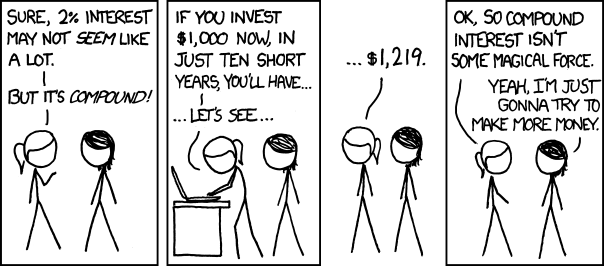
https://imgs.xkcd.com/comics/investing.png
@WorldOfBlunder : now look at the AMOUNT of improvement you get every day compared to the initial level.
On day one you get: 0.01 units - let's say you studied 23 seconds for this
On day 2: 0.0201 (which is a bit more than double the amount you got on the previous day) - you'd have to study at least 46 seconds
day 3: 0.030301 (a bit more than triple what you got on day 1, just 2 days ago) - at least 1 minute and 10 seconds study
....
day 365: 37.78 which is 3778 times more than on day 1! You'd have to study ALL of the 86400 seconds in that day (actually you'd need to borrow 500 more seconds from another day), no sleep, no eat, no toilet break!
Also, 37 is not 37% more than 1, it is 3700% more than 1 :)
@WorldOfBlunder : now look at the AMOUNT of improvement you get every day compared to the initial level.
On day one you get: 0.01 units - let's say you studied 23 seconds for this
On day 2: 0.0201 (which is a bit more than double the amount you got on the previous day) - you'd have to study at least 46 seconds
day 3: 0.030301 (a bit more than triple what you got on day 1, just 2 days ago) - at least 1 minute and 10 seconds study
....
day 365: 37.78 which is 3778 times more than on day 1! You'd have to study ALL of the 86400 seconds in that day (actually you'd need to borrow 500 more seconds from another day), no sleep, no eat, no toilet break!
Also, 37 is not 37% more than 1, it is 3700% more than 1 :)
@mojo_jojo_1985 said in #9:
@WorldOfBlunder : now look at the AMOUNT of improvement you get every day compared to the initial level.
On day one you get: 0.01 units - let's say you studied 23 seconds for this
On day 2: 0.0201 (which is a bit more than double the amount you got on the previous day) - you'd have to study at least 46 seconds
day 3: 0.030301 (a bit more than triple what you got on day 1, just 2 days ago) - at least 1 minute and 10 seconds study
....
day 365: 37.78 which is 3778 times more than on day 1! You'd have to study ALL of the 86400 seconds in that day (actually you'd need to borrow 500 more seconds from another day), no sleep, no eat, no toilet break!
Also, 37 is not 37% more than 1, it is 3700% more than 1 :)
But that's not how it works. If you practice e.g. with puzzles then becoming 1% better everyday means you can invest basically the same time every day. On day 1 your puzzle rating in quite low but you improve by one percent because of, say, 20 minutes of practice on that day.
On day 2 your puzzle rating is a bit higher, thus puzzles are a bit more difficult. Becoming 1% better now takes approximately 20 minutes too.
Of course a 37% gain per year is a theoretical concept. You will face difficulties on some days and on other days it'll just work and puzzles just make sense. Learning isn't a simple and easy to predict function like "1.01^365". You're actual learning gain might even fluctuate heavily. Neurons take multiple weeks to improve their coordination (if I remeber right it's 4-6 weeks). Everything you do needs time. But this function is more like a rough estimate to easily demonstrate the power of short, yet consistent training intervalls.
Imagine a 500 elo player learns the most basic principles (like "take as much center space as possible", "never move your night to the edge of the board", "develope as much pieces as you can in the opening" etc.). The improvement will be quite obvious and drastic. If you're already a 3000 elo player you'll most likely know most edge cases and standard theory. If you learn something new it'll be very marginal.
An adequate function would take into consideration a lot of important things: motivation, current knowledge about the target topic, individual learning speed, individual learning resources, all kinds of confounding variables like medication, diseases, genetic differences, learning environment, social support, stress, believe in your cognitive abilities, self worth, hours of quality sleep and many more. But such a function isn't only impossible to come up with but also impossible to apply for the general public.
@mojo_jojo_1985 said in #9:
> @WorldOfBlunder : now look at the AMOUNT of improvement you get every day compared to the initial level.
> On day one you get: 0.01 units - let's say you studied 23 seconds for this
> On day 2: 0.0201 (which is a bit more than double the amount you got on the previous day) - you'd have to study at least 46 seconds
> day 3: 0.030301 (a bit more than triple what you got on day 1, just 2 days ago) - at least 1 minute and 10 seconds study
> ....
> day 365: 37.78 which is 3778 times more than on day 1! You'd have to study ALL of the 86400 seconds in that day (actually you'd need to borrow 500 more seconds from another day), no sleep, no eat, no toilet break!
> Also, 37 is not 37% more than 1, it is 3700% more than 1 :)
But that's not how it works. If you practice e.g. with puzzles then becoming 1% better everyday means you can invest basically the same time every day. On day 1 your puzzle rating in quite low but you improve by one percent because of, say, 20 minutes of practice on that day.
On day 2 your puzzle rating is a bit higher, thus puzzles are a bit more difficult. Becoming 1% better now takes approximately 20 minutes too.
Of course a 37% gain per year is a theoretical concept. You will face difficulties on some days and on other days it'll just work and puzzles just make sense. Learning isn't a simple and easy to predict function like "1.01^365". You're actual learning gain might even fluctuate heavily. Neurons take multiple weeks to improve their coordination (if I remeber right it's 4-6 weeks). Everything you do needs time. But this function is more like a rough estimate to easily demonstrate the power of short, yet consistent training intervalls.
Imagine a 500 elo player learns the most basic principles (like "take as much center space as possible", "never move your night to the edge of the board", "develope as much pieces as you can in the opening" etc.). The improvement will be quite obvious and drastic. If you're already a 3000 elo player you'll most likely know most edge cases and standard theory. If you learn something new it'll be very marginal.
An adequate function would take into consideration a lot of important things: motivation, current knowledge about the target topic, individual learning speed, individual learning resources, all kinds of confounding variables like medication, diseases, genetic differences, learning environment, social support, stress, believe in your cognitive abilities, self worth, hours of quality sleep and many more. But such a function isn't only impossible to come up with but also impossible to apply for the general public.