
How have White's Responses to the Najdorf Changed over the Years?
Looking at popularity of white's 6th moves in the Najdorf variationOne thing I really enjoy about chess is that one can take a look back at games played over a hundred years ago and compare them to today’s games. Openings in particular can tell an interesting story, as our knowledge of the game has improved a lot.
In this post, I want to take a look how the Najdorf Defense has changed over the years. I chose this opening because white has many options on move 6, while not being as broad as the Italian or Spanish, where both players have multiple choices on multiple moves.
To see how popular different openings were, I looked at all classical games in my database, where the players were rated above 2400 (I included all games in the years before ratings were introduced, as there are way fewer amateur games from that time).
Replies to 1.e4
Before diving right into the data about the Najdorf, I thought it would be interesting to see how the trends in the moves leading up to the starting point of the Najdorf have changed.
The logical place to start is how players have responded to 1.e4 over the years.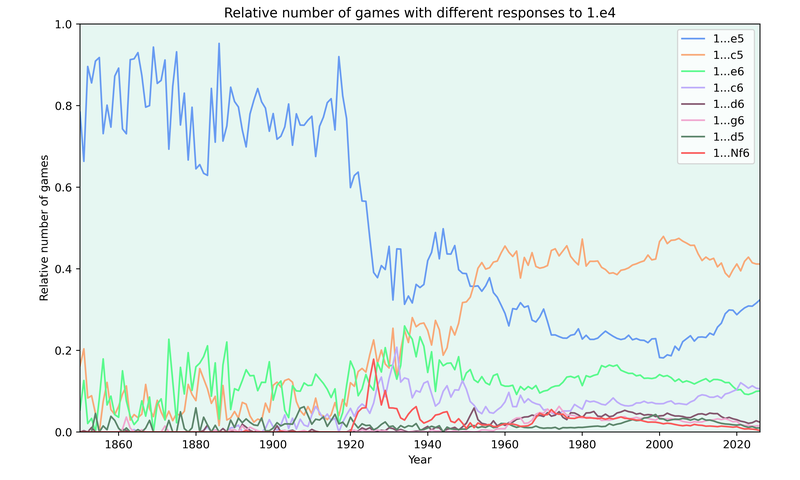
Until the 1910s, 1.e4 was answered by e5 in around 80% of games. But things started to shift around 1920 and one can clearly see that players were trying different approaches in the openings as the Alekhine (1.e4 Nf6) and Caro-Kann (1.e4 c6) gained in popularity.
The Sicilian Defense also started to get more popular in the 1920s and compared to the other minor responses to 1.e4, it managed to increase it’s popularity in the 1940s and 50s to overtake e5 as the most common response to white opening with the king’s pawn.
It’s also interesting to see that since 2000, 1.e4 e5 has again gained in popularity, maybe since the Berlin and Petroff defences got established as very solid options for black.
Different Sicilian variations
There are of course many ways white can respond to the Sicilian, so I also wanted to see how these have developed over the years.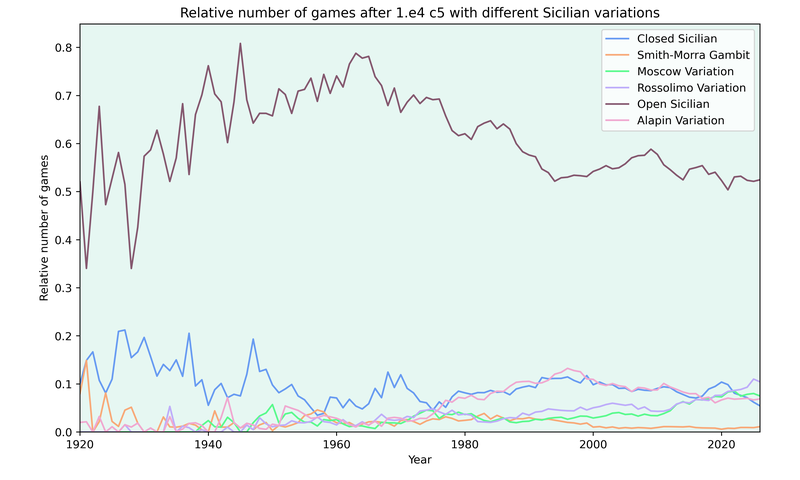
Since the Sicilian started to become popular, the open variations (1.e4 c5 2.Nf3 d6/Nc6/e6 3.d4) have been by far the most common way for white to handle the opening.
While the other lines never reached the popularity of the open variation, they still had phases where they were more common. The Alapin and Closed Sicilian started to get played more often in the 1980s, and the Rossolimo (1.e4 c5 2.Nf3 Nc6 3.Bb5) and Moscow (1.e4 c5 2.Nf3 d6 3.Bb5+) have been played more in the past 10 years.
Of course, there are many different open Sicilians, so it makes sense to also see how they compare to each other.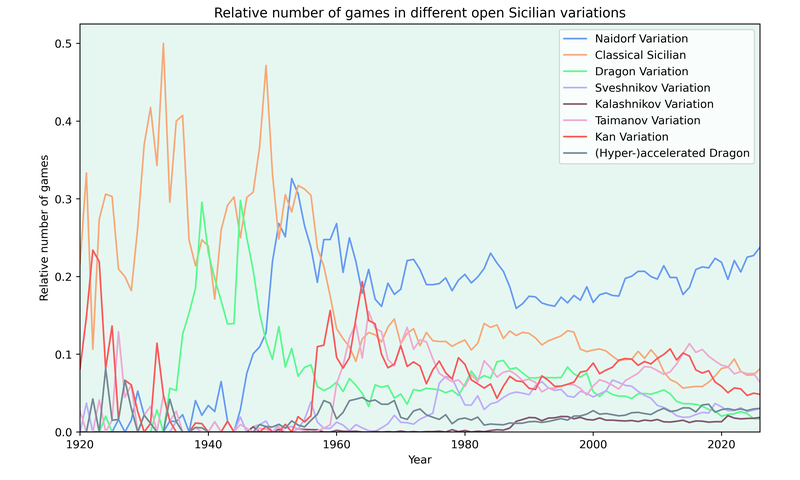
As the name suggests, the classical Sicilian used to be most popular open Sicilian, but the Najdorf overtook it shortly after it got popular, which also coincided with the general rise of Sicilian games. The Kan and Taimanov similarly got adopted very quickly, but they never were as popular as the Najdorf variation.
Nowadays it looks like the Najdorf is getting more popular again, which comes at the cost of the other open variations.
Najdorf variation
Finally, let’s take a look at the Najdorf variation in particular.
The reason why I was interested in this opening in particular is that there are many different options for white on the 6th move. Especially in recent years, it felt like there were always new ideas for white.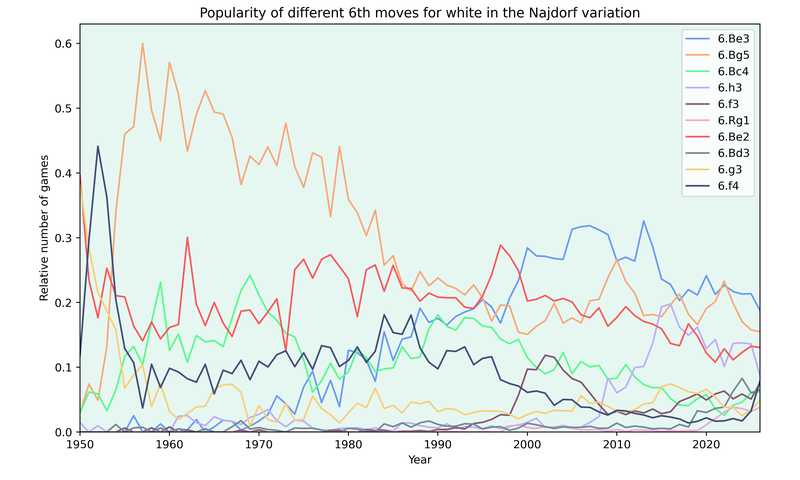
In the 1960s, 6.Bg5 was by far the most common variation, with 6.Be2 and 6.Bc4 being in second and third place. But things started to shift in the 70s and 80s, and the English attack (6.Be3) started to come into fashion, while 6.Bg5 was declining in popularity. Interestingly, 6.Be2 remained at a similar level from 1950 to 2010, only declining a bit in the last 15 years.
In general, all the bigger lines have lost popularity in recent years, while less well known lines started to be played more often. 6.Rg1 started to become more popular around 2020, while 6.Bd3 is also more popular than it has ever been. The move 6.f4 has also gained in popularity in recent years, after it was in steady decline since the 1990s.
Final thoughts
I found the data about the openings really interesting and I’d like to look at more openings in the future.
Ideally, I’d like to create an interactive way to browse through any opening, but at least with the way I’m looking up the games (using the scripting interface of SCID), it takes too long to create an interactive experience, as it takes a couple of minutes to get the data for each graph from the database.
Let me know if there are any openings you’d like to see covered like this in the future.
If you've enjoyed this post, check out my Substack.
You may also like
 CM HGabor
How titled players lie to you
This post is a word of warning for the average club player. As the chess world is becoming increasin… thibault
How I started building Lichess
I get this question sometimes. How did you decide to make a chess server? The truth is, I didn't. ChessMonitor_Stats
Where do Grandmasters play Chess? - Lichess vs. Chess.com
This is the first large-scale analysis of Grandmaster activity across Chess.com and Lichess from 200… jk_182
Predicting the Winner of Tournaments
Using game predictions to predict the outcome of a tournament jk_182
Predicting the Outcome of Chess Games
Approximating the expected score and draw rate based on rating difference and colors jk_182