
The Only Framework for Puzzle-Solving You'll Ever Need
(by a 2700 puzzle solver)When I first started solving chess puzzles, I relied solely on my wit to inspire me to flesh out the correct series of moves. Now that I look back, my process then was: throw everything at the wall in one sweep of creativity and hope something sticks. I learned at a snail's pace.
But that changed when I built out this framework for myself.
Don’t get me wrong: puzzle solving still demanded my wit and creativity, but with my framework, solving a puzzle ceased to depend solely on my spark of creativity and became a methodical effort (similar to baking a cake).
As a result, I was able to detect with great precision the mistake in my reasoning that caused me to fail the puzzle. This has greatly accelerated and sharpened my understanding of the game.
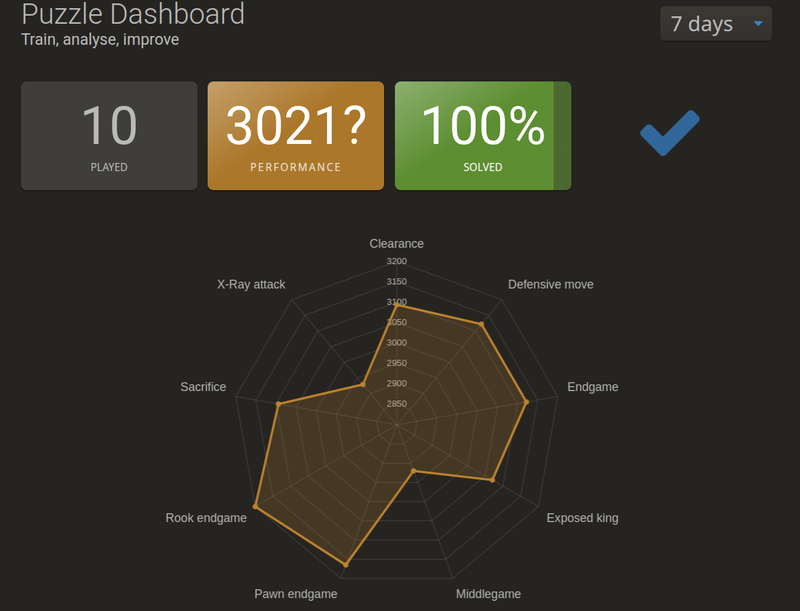
Mandatory proof that I’m not BS-ing.
I’ve listed the steps of the framework in a sequence that I believe is optimal. As I’m solving a puzzle, I go through them exactly in the manner I’ve outlined below.
So, here they are:
1. What attacks what + critical squares
Many times (for me, almost every puzzle), the temptation to plunge straight into calculation is great.
I have lost count of how many times I’ve failed a puzzle at the last (and simplest) move of the sequence, just because I failed to notice my bishop, or some other piece, sitting at the other end of the chessboard.
Luckily, this is avoided with little effort.
Before you make a move, simply determine:
— what pieces attack eachother
— the ‘line of fire’ of yours as well as your opponent’s pieces
— what pieces are undefended
— the critical squares (aka the squares that are the most important to control)
2. Understanding the position
This is the newest concept I added to my puzzle-solving process.
Actually, I managed to climb up to about 2300 without knowing about this principle.
The reason for this is that puzzles rated higher than 2300 often require a not-so-direct sequence of moves and are subtler in nature when compared to lower-rated puzzles where direct tactics dominate.
Understanding the position simply means that after you have identified the critical squares and lines of attack (the micro), you take a step back and look at the entire chessboard (the macro).
Concretely, this means that you are able to come up with statements such as:
- The opponent’s king is weakly defended
- If I manage to defend this attack, I will have a material advantage
- My only chance of winning is by queening the passed f-pawn, etc.
This core concept becomes more and more relevant as your rating increases; however, had I known about it earlier, I would nevertheless utilize it, even on lower-rated puzzles.
Before I knew how important it is to put some attention on understanding the position, I would focus only on direct lines of attack and forced moves. This caused me to often get tunnel vision on a random tactical maneuver, all the while being blind to the correct sequence of moves.
So, another huge benefit of understanding the position is that it gives you (when you combine it with concept 1 — What attacks what + critical squares) a list of possible tactical ideas, which you can then approve or disapprove by going over the forced moves.
Out of all the 3 core concepts, understanding the position has had the greatest impact on my chess knowledge. More often than not, I had trouble assessing the weak points for both sides. But as I got better at it through puzzle practice, I noticed a significant improvement in my understanding of the meaning behind good moves.
3. Forced moves
I often started calculating forced moves before I determined what attacks what, the critical squares, or before I understood the position.
This was very incorrect — it left me with the sole option of going through every remotely attractive variation with the only solution of figuring out the correct sequence by sheer attrition.
I learned nothing doing that.
You, on the other hand, won’t be repeating my past mistakes, because by now, you know that you first figure out what attacks what & the critical squares, then you focus on understanding the position, and finally, you look for the forced moves.
Sometimes, they are obvious (i.e. ̋If I check the king with my rook on a1, he only has one move — b2 ̋).
But in trickier positions, they can be harder to find. Here are my best methods to detect them:
- The double move
If you are not sure about what move to make (or what move your opponent would make as a response), you can make your candidate move and then move again! Act as if your opponent just let you make 2 moves in a row.
After making two moves, you should have a great advantage. The set of moves available to your opponent should be greatly reduced — then you can find the forced moves much more easily.
If it turns out that the variation you were calculating is a winner, all you have to do now is look at your first move (the one where you didn’t let your opponent move)! Given that you calculated the variation and know all of its steps (except your opponent's response to your first move), the forced move he has to respond with shouldn’t be that hard to find.
- Switch sides
This may be completely specific to me, but sometimes I find it easier to detect forced moves if I imagine that I’m playing as my opponent, take a look at the position from his perspective, and ask myself ̋what move would scare me the most? ̋
—————————————————————————————————————————
Another helpful concept:
The breaking point
(If you are rated above 2000, I’d wager you do this subconsciously more often than not.)
Instead of looking for moves that prove why a given variation is correct, look for moves that prove why it’s incorrect — the breaking point of the sequence.
If you can find a move where the variation breaks (i.e. the move where your opponent is now the one who has the advantage), you can safely disregard the entire variation.
Even if you find 10 different sub-variations that prove why your sequence of moves is the best, you can’t be 100% sure that it is, in fact, the best. All it takes is for you to miss one move in the sequence for your opponent to seize the advantage.
So look for moves that foil your plans. With them, you will find the correct variation the quickest.
.
.
.
.
.
— J K
.
.
.
{A PERSONAL NOTE:
I’ve created this framework first and foremost for myself. I solve chess puzzles because I enjoy seeing how my ideas evolve and become more nuanced over time. I’m certain every chess player who is considered ‘good’ uses these principles (whether consciously or intuitively).
Also, you should know that I’m completely isolated from the chess community. I don’t read any chess books; I don’t watch any games. For all I know, there could be an entire book (or an 8-hour stream) dedicated to the principles from my framework. I don’t know.
This text is a result of my own introspection. Should there be any overlap (as I’m certain there is) with other chess content, it’s not due to plagiarism.}