
Do THIS To Blunder Less !
Hey ! I will share with you the calculation methodology that I used in order to become better at chess and get my CM Title. This text is a summary from a huge chapter coming from my book "The Science of Learning Chess", which is no longer available on Amazon.
Case By Case System for the Middlegame
Many chess players believe they lose games because of blunders.
They think, “If I could just stop hanging my pieces, I would win more.”
But the truth is deeper.
Blunders are not the main reason you lose.
They are only the final symptom of a bigger problem in your thinking process.
Use the basic thinking principles.
Candidate moves :
Good moves usually come from a list of candidate moves made out of forcing moves.
Forcing moves :
Look for forcing moves that create responses from the opponent.
Examples:
captures
attacks
checks
TENSIONS
Chess is a game that is simple to understand, but challenging to master.
The key to improving is not about discovering new tricks or secrets—it's about avoiding mistakes and playing with a clear plan.
If you follow this simple principle and apply some basic strategies, reaching a 2000 Elo rating is within your reach.
If you’re aiming for a 2000 rating, you don’t actually need to play every game at a 2000 level.
Many players who reach that level are consistent at around 1850-1900 and build on that with preparation.
Think of it like setting a baseline you can trust, even on days when you’re not at your best.
By focusing on playing steadily at an 1850 level and adding solid opening knowledge, you can reach a 2000 level without needing perfection in every game.
This consistency isn’t about avoiding mistakes entirely; it’s about building a foundation that makes you a difficult opponent to beat.
By keeping your play at a reliable level, you can handle most games well and gradually improve over time as your understanding deepens.
Tactical Practice: Sharpening Your Skills
Tactical strength is critical in chess, but you don’t need to solve puzzles at the highest level to improve. If you’re aiming for a 2000 rating, solving puzzles at around 1900—about 100 points lower than your target—will build a strong foundation without overwhelming you.
Solving puzzles at this level develops your confidence with tactics like forks, pins, and discovered attacks.
Rather than grinding through high-level puzzles, practicing daily at a slightly lower level reinforces patterns you’re likely to see in real games.
Pattern recognition plays a crucial role in becoming a stronger chess player. By recognizing recurring patterns in various positions, players can quickly identify familiar ideas and plans. This skill allows players to anticipate opponent's moves, find tactical opportunities, and make strategic decisions more efficiently.
With consistent practice, honing pattern recognition enhances overall chess understanding and performance.
Why Direct and Forcing Moves Matter
Chess rewards players who make clear decisions.
Direct chess means looking for moves that have an immediate impact, like attacking your opponent’s king or creating threats.
Forcing moves limit your opponent’s options and force them to react to your plans.
Even in a long Blitz game, if you play actively and keep your pieces safe from blunders, you’ll be in a strong position.
Forcing moves help you take control of the game and make it harder for your opponent to execute their ideas.
You do not need to find the perfect move.
Finding forcing moves and calculating them consistently is enough to win many games.
Moves that define the Attack
Focusing pressure on one target (creating tensions)
Breaking the position (trading or sacrificing pawns/pieces in order to get open lines and diagonals).
Creating weaknesses (that’s a symptom of an attack, rarely a goal)
Managing risk and time (human time ticking on the clock, the initiative and material)
Moves that define the Defense
Consolidate the position (releasing tensions)
Exchanging pieces when necessary.
Calculation
Most calculations start with forcing moves.
A forcing move makes the opponent reply immediately.
There are three kinds of forcing moves:
Checks – the opponent must react to protect the king
Captures – material changes happen
Threats – moves that create direct danger
In every position, the first question must be:
“What are the forcing moves for both sides?”
Practicing this question is the foundation of calculation.
A simple rule helps beginners think with structure:
My move – opponent’s move – my next move.
Example:
My move: Bxf7+
Opponent’s move: Kxf7
My next move: Ng5+
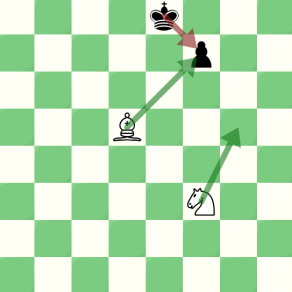
This pattern builds rhythm in your thinking.
Every move is followed by an imagined answer and then by your next idea. Through repetition, your mind learns to continue deeper without losing track.
Example:
White plays Rxd7, Black plays Qxd7, White plays Qxd7+.
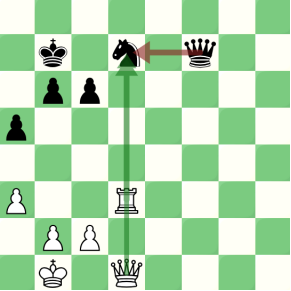
Try to imagine where each piece stands at the end.
This exercise helps you see clearer and avoid confusion when lines get longer.
Practice with small exchanges and short tactics.
Over time, the mind becomes faster and more accurate.
When practicing calculation, honesty with yourself is necessary.
After solving each position, take a few seconds to ask:
Did I make a calculation mistake, or did I simply not calculate?
If you didn’t even try to calculate the right line, it means you lacked focus.
If you calculated but saw the position wrongly or missed a move, then it was a calculation mistake.
Typical focus problems include:
Seeing ghosts (imagining threats that don’t exist)
Overvaluing or undervaluing a position
Missing simple ideas or tactics
Blind spots on certain squares
The first forcing moves that are seen and calculated can’t be tunnel-calculated, because moves are often pushed too fast and too strongly, even though the there mind be something clearer and easier to calculate.
These errors usually appear because the mind is not calm or fully focused.
If you simply cannot calculate a long line, or if the position does not have forcing moves, the mistake comes from a limitation in calculation skill, not from distraction.
Weak Signals
You must know how to identify weak signals in any position:
- Unprotected pieces
- Trapped pieces
- King safety
- Overloaded pieces or tensions
Once the pieces are identified, you must look for forcing moves (checks, captures, threats) around the zone of these pieces.
When a master looks at a position, they don’t search randomly.
They look for patterns they already know: weak squares, open files, good vs. bad bishops.
This helps them make logical decisions instead of emotional ones.
You can do the same.
Before every move, ask yourself:
What is my opponent’s threat?
What is the weakest point in their camp?
Which piece can improve its position next?
Calculation Errors
Calculating in chess does not just mean “looking ahead a few moves.” Calculating means analyzing concrete forced moves on the board.
A forced move is a move that requires a precise response from the opponent. This mainly includes:
- Checks: every time the king is in check, the opponent must respond.
- Captures: if a piece can be taken, the opponent must consider the capture or how to protect it.
- Direct threats: this includes more complex threats, like promoting a pawn, trapping a piece, attacking an undefended piece, or creating an unstoppable attack.
When you calculate, you don’t just look at your own plan. You also need to analyze the opponent’s forced responses. Some people call these “defenses,” but technically, these are also forced moves. So the word “defense” is misleading.
Every move you calculate is forced,whether it’s yours or the opponent’s.
In short, effective calculation means:
1. Identify all immediate forced moves (checks, captures, threats).
2. Check the opponent’s forced responses to each move.
3. Follow the chain logically: each forced move can create new threats or captures.
4. Don’t forget subtle threats: attacking weak pieces, trapping a piece, or pushing a pawn to promotion.
Calculation errors are extremely common at the amateur level. The reason is simple: it requires a lot of experience and self-confidence to avoid mistakes in long games. Many amateurs believe the falsehood: “Oh my god, I should have seen that move; in training, I would have seen it.”
To be good at calculation, you must practice extensively and gain a lot of experience. It’s unfortunate to say, but chess is a game that requires a lot of patience and experience to become good.
Just look at the number of games a grandmaster must play before achieving the title, or even how many games a Candidate Master must play to become a Candidate Master.
To improve your calculation and make fewer errors, learn basic strategic motifs, as many amateurs can confuse positions where calculation is mandatory with those where understanding and calm, long-term play are preferred.
For example, if your opponent has any logical capture in your position, you must calculate because every time a piece is removed from the board, the nature of the position changes drastically.
However, if you are playing a position where there is nothing to calculate because there is simply nothing there, you need to understand this to avoid wasting your time calculating meaningless moves.
You have a deeper explanation in my most recent video.
It was made in order to show you concrete examples from real games and lichess puzzles.
Thank you very much,
Loris
You may also like
 CM loristavernier
15min a day keeps the blunders away !
Sharing a thought that I shared during my group classes. thibault
How I started building Lichess
I get this question sometimes. How did you decide to make a chess server? The truth is, I didn't. DaBassie
Improving at chess: calculation as a skill
This post is about me rambling about calculation. I provide some techniques that make chess calculat… RuyLopez1000
Daniel Naroditsky: The Legend
Remembering one of the icons of the modern era. IM datajunkie
You’re studying chess openings the wrong way (do this instead)
If memorising opening lines made you stronger, many club players would be masters. GM Avetik_ChessMood