
John Chernoff
Are you rated 1600? Good.
It's good to be 1600 and I will explain why
Dear readers who are not particularly good at chess,
I come not to mock you but to praise. For 99.999% of humanity being good at chess is an utterly pointless skill - one which you have sensibly avoided wasting time achieving.
"But wait", I hear some of you cry. "I have spent hours in pursuit of chess greatness, but to no avail. Long have I labored in the mines of endless YouTube and Chessable content. Behold the furrowed sweat upon my virtual brow as I strive to perfect the Jobava London and refute the Stafford Gambit."
Ah, yes, good gentlepeople. I see now your plight, but I cannot honestly sympathize because, and I hope you will forgive this observation, but what you have done is not work. You have not actually labored. You have consumed content that is, and always has been, entertainment masquerading as instruction. This is not a new phenomenon - in previous centuries there were books that operated upon the same principle of making chess knowledge as digestible as possible and they were similarly useless (though perhaps less so because reading a chess book is also, regardless of author, at least an exercise in visualization). But I can see that you are, nevertheless, unhappy with your lack of progress and I have a very simple suggestion.
Don't do that.
Don't be unhappy with your rating. You are enjoying the game arguably as much if not more so than people rated 600 points above you. If you truly want to be higher rated, you won't be, because that's not how it works.
The vast majority of people are higher rated not because they watched the right video or signed up for the proper online training course but because they, for whatever reason, are interested in some aspects of chess more than you, be it rook endgames, isolated queen pawns, the history of chess theory, hyper-modernism, the postwar soviet chess revolution, and so forth. For you some of these things might be things to study for improvement's sake, but to a stronger player they were probably just interesting subjects in their own right because, realistically, for us nonprofessional chess players there is no studying - there is just whatever we happen to find entertaining enough to explore for its own sake. This is not a bad thing - unless you are a professional chess player you don't need to know or care about every aspect of chess. Everyone has their own level of interest in things and a finite amount of time to spend on them.
Perhaps it will soothe that inner voice we all have that says we could be better to remember that if the answer to "Why have I watched every GothamChess video and am still 1600?" was "Keep watching and you'll get to 2000" then the average rating of an online chess player would be about 2000 and we would be having the same discussion but with a different number. Right now, 1600 means something. It means you like chess as a form of relatively light entertainment. That's OK. It's actually probably healthy.
Now go and blunder some more.
Thanks,
- Zug
P.S. - If you are interested in various aspects of chess enough to recognize how utterly useless the vast majority of youtube or the internet in general is, I do have some recommendations:
- Tim Krabbe's ancient chess blog (looks terrible, but worth it): https://timkr.home.xs4all.nl/chess/chess.html
- Almost any book by an actually great player is interesting. Lasker, Capablanca, Alekhine, Botvinnik, Tal, Karpov, Fischer, etc., all wrote wonderful, fascinating books on their games and chess in general. Read them instead of whatever limp regurgitations of what they already said is currently being pushed upon you by a youtube sidebar.
- Use a real chess board and the lichess opening explorer to physically move pieces around. We are physical creatures and we learn by doing.
- Go to a chess club. Talk to good players. A computer screen is a terrible filter of knowledge.
- Try and solve a real chess problem that was composed by a human being, and not a "tactics trainer" puzzle that are essentially the empty calories of chess nutrition. Here's one to start with.
White to Play and Mate in Three Moves
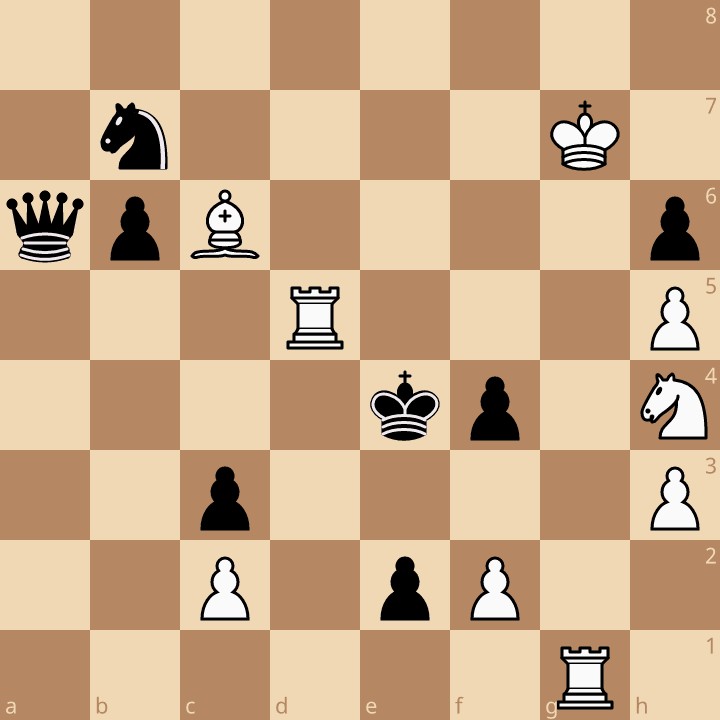
(P.P.S. - This is a pretty hard problem so don't feel bad if you get stuck)
(P.P.P.S. -> Honestly this article would be better if I had chosen 1200 instead of 1600 as 1600 actually represents a fairly dedicated and certainly not an entirely "casual" player. Sorry.)
You may also like
 NM ZugAddict
Behold the Wonders of ClueChess
An addictive mixture of Chess, Minesweeper, and Sudoku CM HGabor
How titled players lie to you
This post is a word of warning for the average club player. As the chess world is becoming increasin… ChessMonitor_Stats
Where do Grandmasters play Chess? - Lichess vs. Chess.com
This is the first large-scale analysis of Grandmaster activity across Chess.com and Lichess from 200… thibault
How I started building Lichess
I get this question sometimes. How did you decide to make a chess server? The truth is, I didn't. NM ZugAddict
The Legend of 1900 (Elo)
You, yes, you, may be in line to play for the most unofficial world championship yet devised thibault