
GIORDANO MACELLARI
Why Are Some Openings So Weird?
In some openings, we can just aim to get our pieces out, castle early, and play a calm, strategical battle, while in others, play immediately gets sharp and irrational. Why is that?
My favourite opening in chess is probably the Ruy Lopez, aka the Spanish Opening.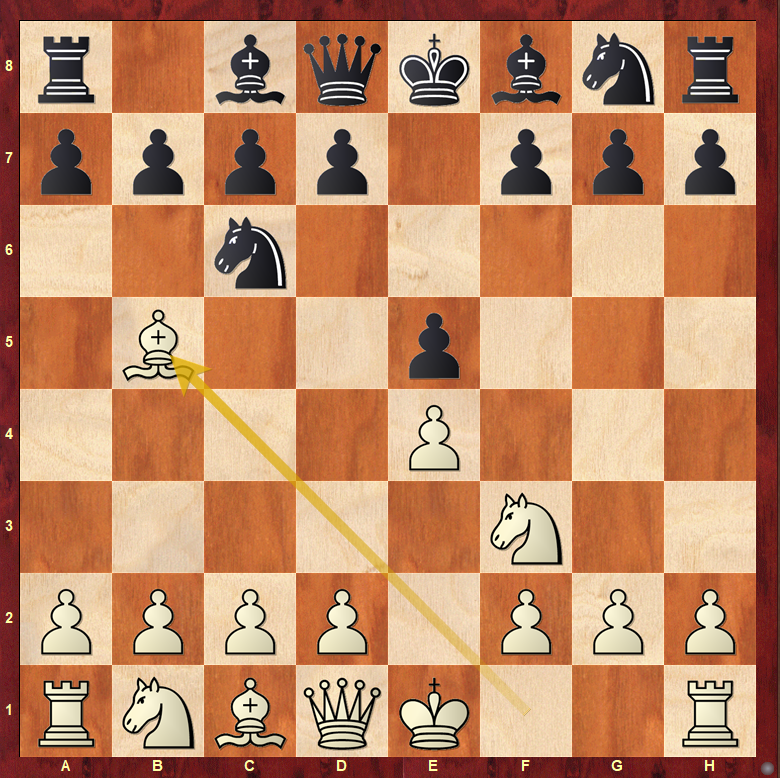 It is the most emblematic chess opening and you have probably seen it before. Though both sides still have plenty of paths to choose from, the game tends to take a slower, positional character. The following is an example of what could be called a typical Ruy Lopez game.
Notice how the game consisted mostly of a manouvering by both sides (though, better manouvering by White!). Black's mistakes were entirely positional and we can explain them through logical means without having to show too many concrete lines. Doesn't mean it's easy to understand or to play like this, but we can try to understand the game mostly using logic.
Now, let's look at a game of mine featuring one of the weirdest computer-sound openings out there.
Take a look at the insane disparity in the style of play between the first game and this one. Almost every move in the opening deserved an exclamation mark for how out of the ordinary it was!
You might think this has mostly to do with the playstyle of the players, but, in fact, that had more bearing on the choice of the opening variation, which in turn pretty much dictated the complexity of the opening and middle game play. The variation itself lead to much more chaotic, move-by-move, concrete lines, which are many times hard or even impossible to understand without computer help.
The large discrepancy between these two examples begs the question: Why Are Some Openings So Weird?
I want to guide you towards my opinion on this, which I will shortly explain, by looking at a couple examples.
The following are 4 positions that arrived from weird, though super theoretical opening lines. (You can see how we got to these positions by clicking the 3 dots in the above game and then click View on Lichess).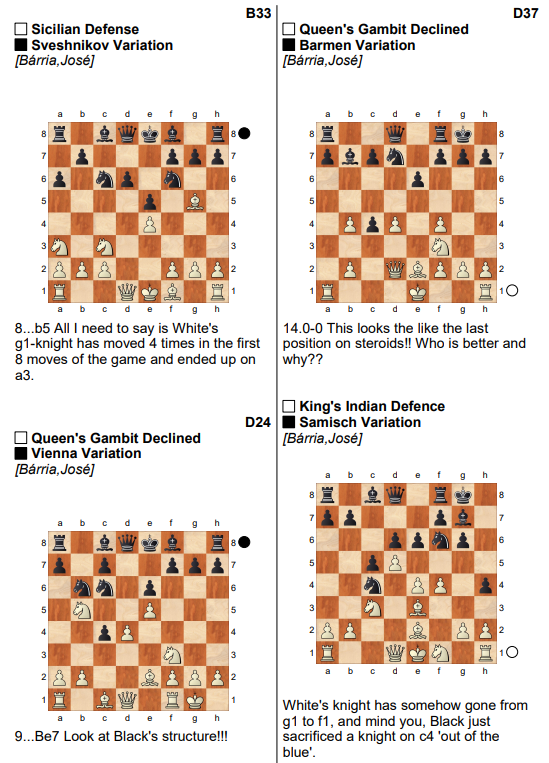 and some examples of normal-looking openings:
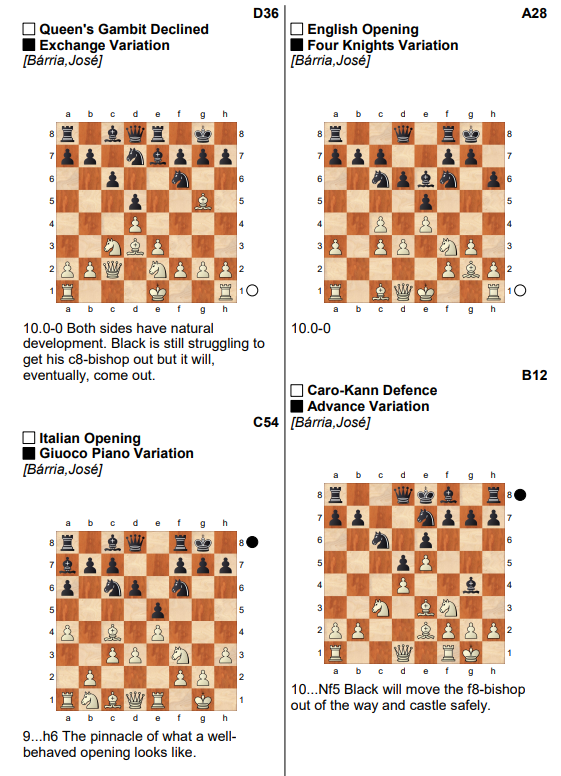 If you go through the opening stage of the 'weird openings', maybe you'll start noticing a pattern...
Here is what I have been thinking about.
Once one player starts playing in a weird manner, sometimes the best way to play against it is to play unorthodox moves yourself, which strays the game further and further away from a 'normal' position.
...until we reach complete anarchy where the all rules go out the window and we are both leaving our kings in the center.
Now, in most games between beginners, if the opponent starts to play anti-natural moves, like not developing pieces, exposing their king, etc, they are likely just mistakes. However, in the master level, if the other guy makes a really weird move, it is more likely that they have seen a deeper idea behind it, and although they are aware that it looks weird, they could't find a refutation. Us humans, we are not that good at finding such good counter-intuitive moves in a chess game. However, do you know who is really good at that? The engines. Nowadays we massively benefit from their help the openings, and it turns out that if you're 3600, you can find ways to make almost any non-sensical opening variation work. And so, a lot of openings previously deemed bad, or just straight-up unheard of, have sprung to life.
Weird attracts Weird, Natural attracts Natural
I want to make an even deeper analysis of what I think is so anti-natural about the opening variation I played that would lead to that chaotic middlegame.
1...c5 is already not super logical as Black is not rushing to castle short. By far the most logical reply to 1.e4 is 1...e5;
5...Nc6 is the huge surprise/apparent mistake as it allows Nxc6 followed by e5, as played in the game. Now black is left with a horrible bishop on c8, and an awful weakness on the d6-square.
8...Qc7 and 9...Qb6 are completely weird, and they are just designed to create weaknesses in White's camp.
And then the rest are just obviously weird concrete moves.
From White's perspective, he was faced with Black disregarding many ancient opening fundamentals, but kept running into concrete problems. Since he also knew the theory, he knew to also play extremely weird moves such as 11.Ke2!! in reply to my insane play.
Compare that to the Giuoco Piano Variation of the Italian on the diagram. If you go through the first moves, you can perfectly understand why both sides have made them without having to calculate too many lines. If you are strong enough, you don't even need the engine to tell you anything! You realize that what both sides are doing can't be bad, and up until a relatively high move count, both sides' moves are self-explanatory. But it is interesting to note that Black has also got many alternative setups at his disposal. Ones where he plays an early g7-g5 before castling, ones where he plays Qf6 followed by Nh5-f4, and against any of these attempts, White has to be rather careful and will have to meet Black's weirdness head on!
Conclusion
If both players play logical moves, chances are the game will be well-behaved for a long time, but the more the players start acting out, the more confusing the position gets and we start finding more exceptions to the rules than rules themselves. However, I would like to end this by pointing out that weirdness does not equal lack of strength. As a matter of fact, I enjoy such chaotic, irrational positions quite a lot. It's harder to find logic within it, but it is there, somewhere, hidden... The great downside is that, when your opponent knows his stuff, and even has ideas prepared against you that you are not aware of, it is extremely difficult to navigate the middlegames without blundering all your pieces. The trick is to try and catch them by surprise so they are the ones navigating the deep, dark forest and you are the only one who knows 2+2.
You may also like
 thibault
How I started building Lichess
I get this question sometimes. How did you decide to make a chess server? The truth is, I didn't. ChessMonitor_Stats
Where do Grandmasters play Chess? - Lichess vs. Chess.com
This is the first large-scale analysis of Grandmaster activity across Chess.com and Lichess from 200… CM HGabor
How titled players lie to you
This post is a word of warning for the average club player. As the chess world is becoming increasin… IM Zorbos
New Chess Tool - Novelty Hunter!
Still searching every Bundesliga game on lichess for an interesting opening idea? Let Novelty Hunter… RuyLopez1000
AI Slop is Invading the Chess World
Claiming that AI can teach chess is the latest fad IM NikolaN98