
The 2026 American Chess Cup Tournament — Round 1
Running from March 2nd through March 13th, the 2026 American Cup has returned, bringing together sixteen of the absolute strongest chess players in the United States. This blog series will analyze every game, every upset, and every moment in this tournament. So let's delve in.
Departing from the conventional round-robin format, the American Cup represents a rigorous test of psychological fortitude, physical endurance, and strategic resilience. For those newly acquainted with the proceedings, the following sections provide an exhaustive overview of the 2026 edition’s technical framework and a detailed analysis of the initial competitive developments observed in Round 1.
The Significance of the American Cup
The American Cup is a preeminent fixture in the United States chess circuit. The event comprises two concurrent elite-level tournaments: an Open division and a Women's division, each featuring eight invited competitors of significant distinction.
The financial stakes are substantial, with a total prize fund of $400,000. This allocation is partitioned into $250,000 for the Open division and $150,000 for the Women’s division.
The participating field is exceptionally formidable. The Open section is led by World No. 3 Fabiano Caruana—who is utilizing this competition as his final classical preparation for the 2026 Candidates Tournament—alongside established grandmasters such as Wesley So, Leinier Dominguez, and Levon Aronian. These veterans are contested by an emerging cohort of American talents, including 22-year-old Awonder Liang and 17-year-old Abhimanyu Mishra. The Women's division is similarly competitive, featuring defending champion IM Alice Lee, three-time victor GM Irina Krush, and IM Carissa Yip, who is currently pursuing the requirements for the Grandmaster title.
The Double-Elimination Format
What truly sets the American Cup apart from other super-tournaments is its double-elimination knockout format. In most elite chess tournaments, a bad day ruins your chances of winning the event. Here, players get a second life.
The tournament is split into two brackets:
- The Champions Bracket: This is where everyone starts. As long as you keep winning your matches, you stay here and march toward the Grand Final.
- The Elimination Bracket: If a player loses a match in the Champions Bracket, they drop down to the Elimination Bracket. Here, the pressure is on—a second match loss means you are officially knocked out of the tournament.
The winner of the Champions Bracket eventually faces the survivor of the Elimination Bracket in the Grand Final (and the Champions Bracket winner gets a $15,000 bonus just for getting there).
The Time Control
Because the two brackets serve different purposes, they are played at entirely different speeds:
- Champions Bracket (Classical Chess): Matches consist of two classical games. Players get 90 minutes for the game, plus a 30-second increment per move from move one (G/90+30).
- Elimination Bracket (Rapid Chess): Since players in the lower bracket are fighting for tournament survival on a tighter schedule, their matches consist of two rapid games. The time control is 25 minutes plus a 10-second increment per move (G/25+10).
Tiebreaks: If a two-game match ends in a 1-1 tie, the tension dials up to eleven. Players enter a playoff consisting of a two-game Blitz match (3 minutes + 2-second increment). If that is tied, they play another Blitz match. If they are still deadlocked, it goes to Armageddon—a sudden-death game where White gets 3 minutes, Black gets 2 minutes, and a draw means Black wins the match.
Round 1 Recap: Upsets and Drama in the Quarterfinals
The first round (Quarterfinals of the Champions Bracket) just wrapped up, and the double-elimination safety net was immediately necessary for several top seeds. Let's look at the significant results.
The Open Division
The story of Round 1 in the Open division was the triumph of the younger, lower-rated players scoring massive upsets.
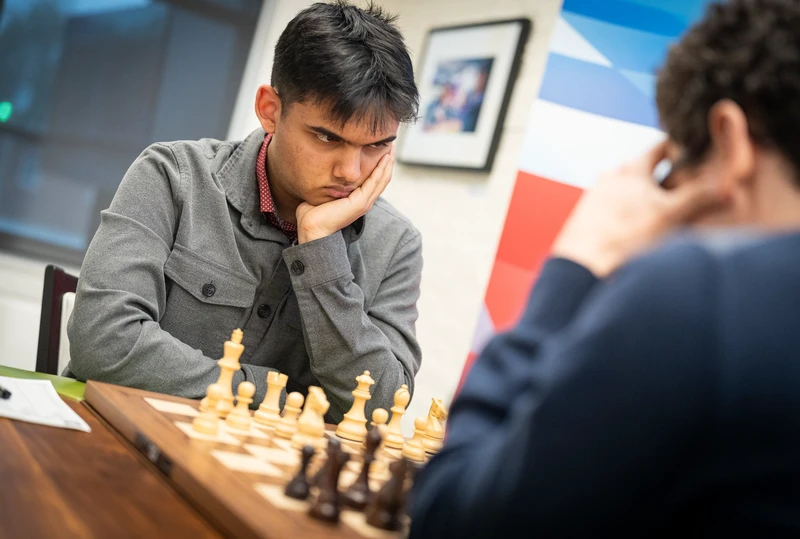
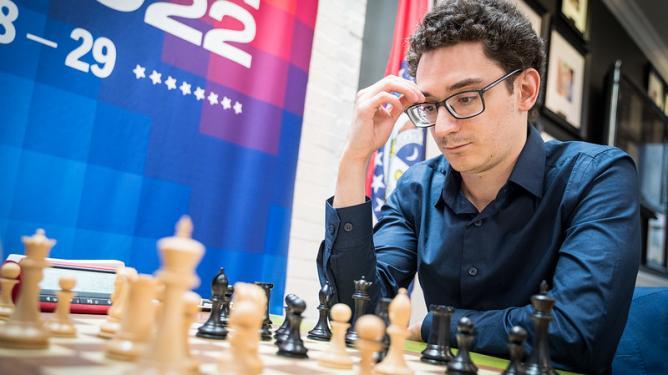
- Fabiano Caruana vs. Abhimanyu Mishra: Caruana came in seeking revenge after losing to the 17-year-old Mishra in a blitz event earlier in the week. Caruana delivered, scoring the only classical victory of Game 1 across the Open division.
Game 1
Caruana opts for a solid, almost "anti-KID" setup with 4. e3 and 5. Be2. Instead of the wild tactical storms usually seen in the King’s Indian, White steers the game toward a Benoni-style structure where he maintains a slight, persistent space advantage.
- 10. Nd2 & 11. e4: Standard maneuvers to clamp down on the center.
- 17. Bc6: A hallmark of Caruana’s style. He sticks a "bone in the throat" of Black's queenside, making it very difficult for Mishra to coordinate his rooks.
The evaluation remains close to equal for a long time, but the position type favors the more experienced player. Caruana is playing for two results (win or draw), while Mishra is under constant pressure to find the exact "equalizing" moves.
- 20. Nf3?!: A rare inaccuracy from Fabi. He allows Mishra to challenge the strong light-squared bishop.
- 25... Re7?!: This is where Mishra starts to lose the thread. By not playing 25... Rbc8, he allows Caruana to stabilize.
- **32. e5!**The break. Caruana opens the center at exactly the right moment to transform his positional edge into something concrete.
Up until move 40, Mishra was holding a difficult, slightly worse endgame. Then, the pressure of the clock and the position finally told.
- 40... Qc7??: A heartbreaking blunder in a high-stakes game. Mishra misses the simple but devastating tactical sequence.
- 41. Bb6!: The killing blow. This skewering of the Queen and the defense of the Nd6 allows White to force a winning simplification.
- 43. Bxd6: After the smoke clears, White emerges a full pawn up with a dominating position.
The final phase is a "Caruana Special." He doesn't give Mishra a single "swindle" opportunity.
- 46. Qc3: Forcing the trade of queens. In a simplified endgame, an extra pawn plus a better king is an easy win for a player of Fabi's caliber.
- 56. Ne5: The final move. If Black takes the knight, the g-pawn promotes; if not, White’s king and pawns simply march through.
For 39 moves, Abhimanyu Mishra showed incredible resilience against one of the best calculators in history. However, Caruana’s relentless 'squeezing' style eventually forced a tactical oversight. Once Fabi gained that one-pawn advantage at move 45, the result was never in doubt. A professional, clinical victory for the veteran.
Game 2
The game began as a Rossolimo Attack (3. Bb5), a favorite of those looking to avoid the deep theory of the Open Sicilian. However, Mishra went for an extremely rare and aggressive sideline:
- 5. h3 and 6. b4!?: This is effectively a "Wing Gambit" integrated into a Rossolimo structure. White offers a pawn to deflect Black’s c-pawn and gain control of the center.
- 7... b3!: Caruana, true to his elite preparation, didn't fall for the trap of holding the pawn. By returning it immediately, he disrupted White’s development and ensured his own pieces remained active.
The game exploded around move 14 when Caruana struck in the center with 14... d5.
- 15. exd5 e4!: A thematic Sicilian counter-strike.
- 16. dxe4 Bxa1 17. Bxh6: This resulted in a massive material imbalance. White gave up an entire Rook for a Bishop and two pawns, plus a very strong initiative.
- The Critical Moment (18. Bxg7?!): The engine prefers the subtle 18. Bg5, keeping the tension. By trading Bishops, Mishra simplified the position. While White still had compensation thanks to the powerful knight on b5 and the exposed Black king, the "venom" of the attack was slightly reduced.
Caruana is arguably the best "defender" of slightly worse positions in the world. He weathered the storm by returning to the exchange at the right moment:
- 31... Rxb3! Black eliminates the dangerous Bishop and simplifies into a Major Piece endgame.
- The Evaluation: Around move 35, the game entered a state of "dynamic equality." White had an active Queen and Knight, while Black had a dangerous passed b-pawn.
The final phase was a masterclass in precision from both sides.
- Mishra pushed his h-pawn to create threats against the Black king.
- Caruana used his centralized Knight on d4 to anchor his position.
- The game ended in a repetition of moves. Neither side could deviate without risking a loss—White’s King was too open to stop checking, and Black’s King couldn't escape the "eternal" harassment of the White Queen and Knight.
It’s impressive to see Mishra hold his own against Caruana using such an offbeat line. He managed to create a "chaos" factor that forced Caruana to use a lot of time early on, though Fabi's endgame technique proved impenetrable. Though the round ended with 1.5 to 0.5, Mishra fought greatly in the game but ultimately lost, sending Caruana to the Semi-final brackets.
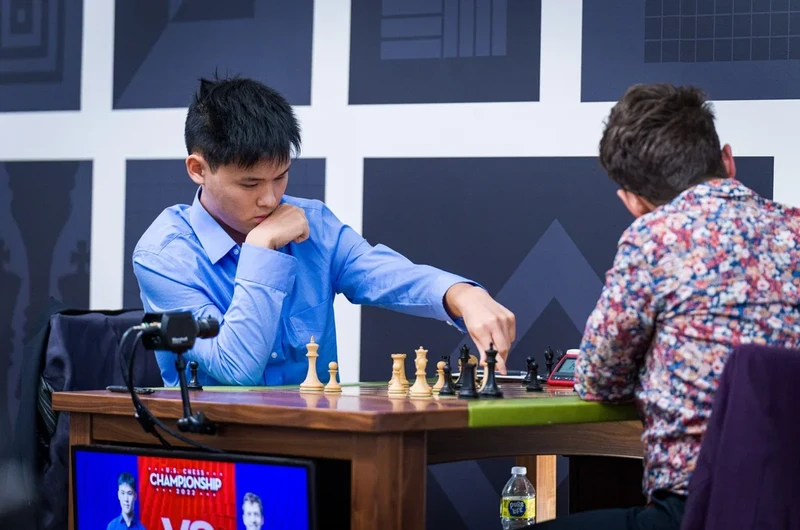
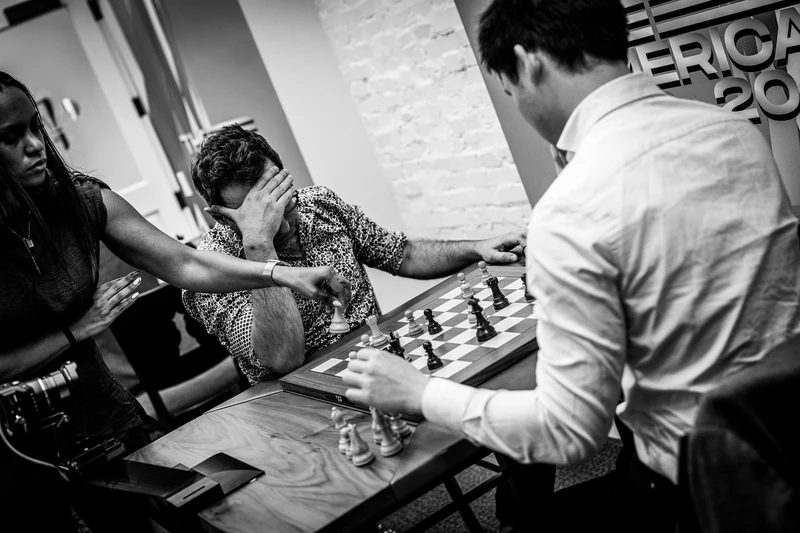
- Awonder Liang vs. Levon Aronian (UPSET): In a massive shocker, 22-year-old Awonder Liang took down the legendary Levon Aronian. After two solid classical draws, the match went to a blitz playoff. Liang thrived in the fast time control, winning with Black and drawing with White to send Aronian down to the Elimination bracket.
Game 1
Aronian chose the Exchange Variation (4. cxd5), a favorite for players looking to exert long-term pressure. However, things got spicy early with 7. Qf3.
- The Trade: By move 9, the Queens were off the board, leaving Awonder with doubled f-pawns.
- The Imbalance: While doubled pawns are usually a weakness, they gave Liang the open g-file and solid control over the center. Aronian’s goal was to prove the f5-pawn was a target; Liang’s goal was to prove his activity compensated for the structural "ugliness."
The game remained remarkably balanced until move 14, where Aronian played 14. Nxg6?!.
Note: Trading the Knight for the Bishop softened White's grip on the dark squares. The engine preferred g3 to keep the tension, but Aronian likely wanted to simplify the position toward a draw or a manageable endgame.
By move 20, we reached a classic "Good Knight vs. Bad Bishop" scenario, with Liang’s Knight on c4 looking particularly dominant.
This is where the game moved from "Grandmaster technical" to "total madness."
- 21. h5?!: -0.14 -1.18: An inaccuracy. Aronian tries to create counterplay on the kingside but overlooks the pressure on his queenside.
- 21... Rh6??: -1.18 +4.24: A massive blunder. Liang misses the simple 21... Nxb2!, which would have snatched a key pawn and left White's position crumbling.
- 22. b3??: +4.24 0.00: Aronian misses his chance! He could have played 22. hxg6, which leads to a winning advantage after some precise calculation. By kicking the Knight, he lets the tension dissipate.
- 23. Rae1??: 0.00 -1.99: The final swing. Aronian ignores the kingside tension again. At this point, Liang actually had a winning position if the game had continued.
Despite the engine screaming that Black was nearly two points (-1.99) up at the end, the players agreed to a draw.
In the heat of the moment, both players likely felt the position was too volatile to navigate safely. Aronian, perhaps sensing he had escaped a worse fate, and Liang, likely unaware of just how winning his position had become after the recent inaccuracies, settled for the split point.
A game defined by 'optical equality' masking deep tactical oversights. While Aronian controlled the pace early, the move 21-23 sequence was a comedy of errors that saw the advantage swing from White to Black and back to neutral. A lucky escape for Aronian, and a missed opportunity for the young Liang.
Game 2
The game began as a Four Knights, Spanish Variation, a solid opening choice for Liang to maintain stability after the chaotic first game. However, the game took a sharp tactical turn early on:
- 10. f3 and 11. Bg5: Liang creates a confrontational setup, forcing Aronian’s light-squared bishop to retreat and preparing to challenge the center.
- 13... Qxb2: Aronian, never one to shy away from a challenge, snatched the b2-pawn. This forced White to find immediate compensation through activity rather than a slow positional squeeze. The game reached a boiling point around move 16 when Liang utilized his centralized pieces to launch a tactical sequence.
- 16. Re1 and 17. Ne7+: A thematic maneuver to displace the Black king and disrupt Aronian’s coordination.
- 20. Nxg6+ fxg6: This resulted in a symmetrical but damaged pawn structure. White traded his active knight to shatter Black's kingside, leading to an endgame where the activity of the Rooks would decide the balance. The Critical Moment (22. Rb7): Liang established a "pig on the seventh," a classic rook placement that exerts maximum pressure. Aronian, showing his elite defensive chops, immediately challenged it with 22... Rb8, forcing a trade that simplified the position and moved the game closer to a draw.
Aronian is a master of technical endgames. He neutralized Liang’s slight initiative by perfectly placing his minor pieces:
- 28... Bb6!: Black anchors the bishop on a strong diagonal, effectively shielding the position and preparing to meet any kingside advances. The Evaluation: Around move 35, the game entered a state of "dead equality." Both players had perfectly coordinated pieces, and neither side had a pawn break that wouldn't lead to immediate liquidation. The final phase was a display of professional caution.
Liang tried to use his king to probe for weaknesses, but the position remained airtight. Aronian used a series of bishop maneuvers to maintain the status quo. The game ended in a repetition of moves. With the material reduced and the structure solid, neither player could push for a win without inviting a disaster.
After two more draws in the Rapid (25+10) phase, the match was decided in a Blitz (3+2) playoff.
The first blitz game was a tragedy for Aronian; he reached a winning Rook and Knight endgame but failed to convert with only seconds on the clock, resulting in a draw. In the second blitz game, the psychological toll showed. Liang remained incredibly composed, while Aronian finally cracked under the pressure, losing the game and the match. Though the classical portion was an even battle, Aronian’s missed chance in the blitz proved fatal, losing the tiebreak 1.5-0.5 and launching him into the Elimination Bracket.
- Sam Sevian vs. Leinier Dominguez (UPSET): Sevian ground out a brilliant positional victory. After drawing with the black pieces, Sevian built a crushing advantage with White in an Italian Giuoco Piano, converting it smoothly in 33 moves to win the match 1.5 - 0.5.
Game 1
The game began as an Open Ruy Lopez (5... Nxe4), a favorite for players who want to avoid the closed, maneuvering struggles of the mainline Spanish. Samuel Sevian chose this sharp, theoretical battleground to challenge Dominguez Perez’s legendary opening preparation:
- 11. Bc2 and 12. Nb3: White aims for a stable edge by challenging Black’s d4-pawn. However, Sevian went for a deeply theoretical response: 12... d3!: This is a standard but high-level resource in the Open Spanish. Black sacrifices structural "neatness" to wedge a pawn deep into White’s position, disrupting the development of the light-squared bishop. The game reached a critical strategic junction around move 16 when Dominguez Perez decided to centralize his forces to eliminate the d-pawn.
- 18. Re3 and 19. cxd4: Dominguez maneuvers to collect the d3-pawn, but this allows Sevian to strike back with 19... c5!, a thematic counter-strike that opens lines for Black’s heavy pieces.
- 20. Bxd3 cxd4 21. Re2: This resulted in a very specific material and structural imbalance. White secured the "bishop pair" in an open position, but Black’s centralized queen and active rooks provided full compensation.
The Critical Moment (31. Kg2): Dominguez managed to simplify into an endgame, but Sevian’s 31... Qc3! forced a queen trade. This transition was a masterclass in evaluation; Sevian realized that the resulting rook endgame, despite being slightly unpleasant, was technically holdable.
Sevian is one of the most resilient young defenders in the elite circuit. He weathered the pressure of Dominguez’s extra pawn by simplifying into a drawn rook endgame:
- 35... Rxe1 36. Rxe1 Bb4!: Black uses a tactical sequence to trade off the remaining minor pieces, ensuring the game enters a Rook + Pawns ending where the drawish tendencies are much higher.
The Evaluation: Around move 40, the game entered a state of "static equality." White had an extra pawn on the kingside, but Black’s rook was active enough to prevent any meaningful progress. The final phase was a display of technical persistence from Dominguez and cold-blooded defense from Sevian.
Dominguez pushed his g-pawn to create a passed pawn and pressure the Black king. Sevian used his rook to check the White king from the flank, never allowing it to reach a winning post. The game ended in a repetition of moves. Despite Dominguez’s best efforts to squeeze a win out of a 3-vs-2 pawn endgame, Sevian’s "active defense" was impenetrable. Neither side could make progress without allowing the opponent’s king to escape or the pawns to be traded off.
It’s impressive to see Sevian hold his own against a veteran like Dominguez Perez in such a theoretically heavy line. He managed to navigate the complications of the Open Spanish and force a draw through precise endgame technique.
 Game 2
The game began as a Giuoco Piano (Italian Game), with Sevian opting for a sharp, central-focused line featuring an early 6. e5. This variation is designed to create immediate imbalances and pressure Black’s coordination from the very start.
- 11. Qc2 and 13. Bxc6: Sevian intentionally traded his valuable Italian bishop to compromise Dominguez’s pawn structure. By doubling the c-pawns, White secured a long-term strategic target while preparing to occupy the e5-outpost with a knight.
- 16. Qa4: Sevian immediately put pressure on the weakened c6-pawn, forcing Dominguez into a difficult defensive posture where he had to find active counterplay to stay in the game. The game exploded around move 21 when Sevian initiated a sequence that forced a material transition.
- 21. dxc5 Qxe5 22. cxb6: This resulted in a simplified position where Sevian possessed a superior pawn structure. While the material was equal, White’s pieces were much better coordinated, particularly with the looming pressure along the e-file.
The Evaluation: Around move 31, the engine evaluation skyrocketed. Black’s pieces were completely tied down to the defense of g7, and White’s queen and rook were perfectly synchronized for the kill. The final phase was a masterclass in relentless pressure.
Sevian used the hook on h4 to create further luft and attacking options, eventually forcing Dominguez into a hopeless situation.
Dominguez tried to stay afloat by returning his rook to f7, but the infiltration was already too deep. The game ended with a resignation after 33. Qe6+. Dominguez realized that after the trade of queens, the resulting endgame would be a trivial win for White due to the overwhelming activity and the unstoppable pressure on the seventh rank.
Though the first game was a draw, Sevian’s clinical victory here secured the round 1.5 to 0.5, sending him through to the next stage of the bracket.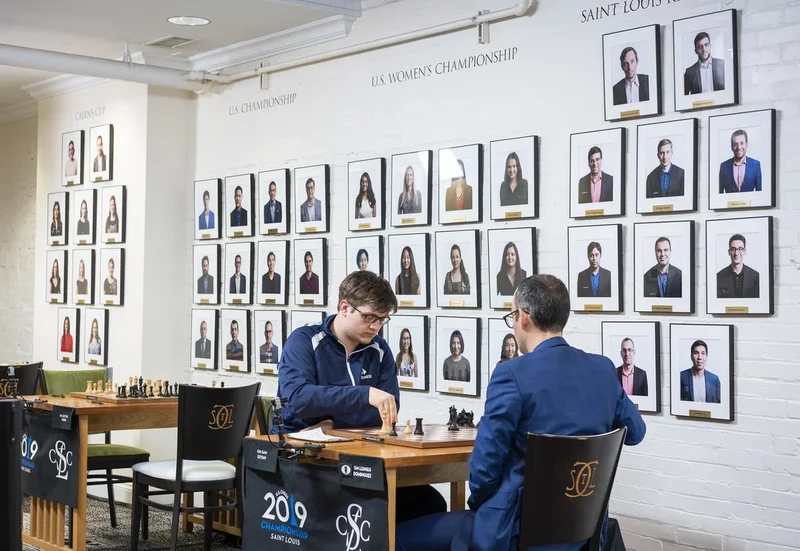
- Wesley So vs. Ray Robson: These two played incredibly accurate chess, with both classical games ending in draws. In the ensuing blitz tiebreaks, So's legendary speed-chess prowess shone through, allowing him to win the match 2.5 - 1.5.
Game 1
The game began as a Catalan Opening, a staple in Wesley So’s repertoire known for its deep positional pressure and long-term squeeze. Ray Robson, however, entered a well-trodden line of theory designed to neutralize White’s kingside bishop:
- 10. Bf4 and 11. Nc3: So develops naturally, aiming to keep a firm grip on the center. Robson responded with 11... h6, a useful "prophylactic" move that prevents any future piece activity on g5 while preparing a solid regrouping.
- 14. Ne5 and 15. gxf4: Wesley chose a very distinct strategic path. By recapturing on f4 with a pawn, he accepted doubled f-pawns and an open g-file. This transformed the position into a dynamic battle where White had an open line toward the Black king but a slightly fractured pawn structure. The game reached a strategic crossroads around move 17 when So decided to clarify the center.
- 17. d5 exd5 18. Nxd5: Wesley initiates a trade of minor pieces to transition into a heavy-piece endgame. 20. Nc4 and 21. Nxd6: This resulted in a Queen and Rook endgame where the material was perfectly equal. While Wesley’s king looked "exposed" on g3, he calculated that Black had no way to exploit it, using his king as an active piece to support his defense.
- The Critical Moment (28. f5): After some maneuvering, Wesley decided to push forward. By playing 28. f5, he aimed to restrict Black’s queen and create a small structural weakness in Robson's position, though at the cost of further loosening his own king's safety.
Wesley So is renowned for his iron-clad accuracy in equal or slightly better positions. He tested Robson’s resolve by transitioning into a pure Queen ending:
- 33. Rxe5 dxe5 34. Qe4: White attempts to utilize his more active queen and centralized king to probe for a win. However, Robson demonstrated elite-level precision in the "technical draw."
The Evaluation: Around move 35, the game entered a state of "unshakeable equality." Despite the lopsided pawn structure, the presence of queens meant that any attempt to push for a win would leave enough holes for a perpetual check. The final phase was a display of mutual respect and high-level technique.
Wesley probed with his queen, looking for a path into Robson’s queenside. Robson remained rock-solid, keeping his king safe and ensuring his e5-pawn was never truly vulnerable. The game ended in a repetition of moves. After 39. Qe4, both players recognized that the position was a theoretical deadlock. Neither side could deviate without giving the opponent an immediate winning chance, leading to a peaceful conclusion in the first round of their match.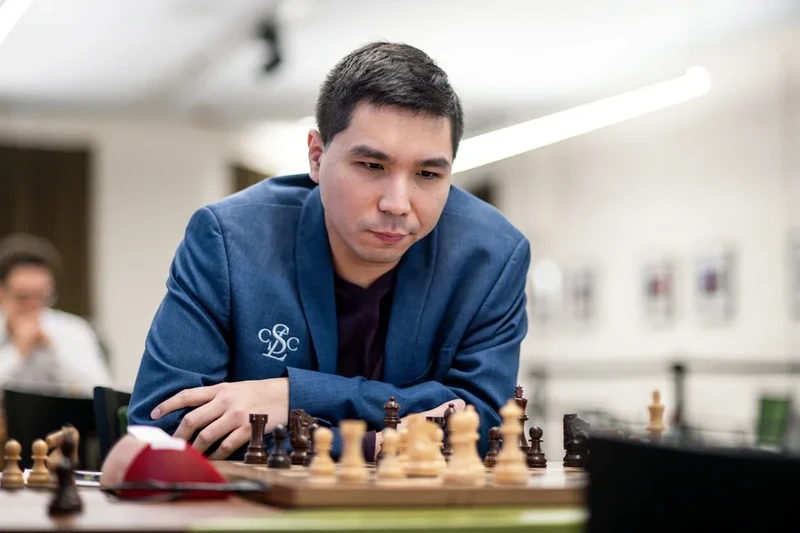
Game 2
The game began as a Berlin Defense (3... Nf6), the "Berlin Wall" of modern chess. Ray Robson chose the 5. Re1 variation, an extremely solid line that often leads to symmetrical structures where White hopes to squeeze out a microscopic advantage through superior endgame technique.
- 11. Nd5 and 11... Bh4: Robson immediately sought to challenge the center. So’s choice of 11... Bh4 was a provocative attempt to induce weaknesses, but Robson remained cool, meeting it with a solid regrouping.
- 14. dxe3 and 15. e4: Robson opted for a structure that invited a mass liquidation in the center. By playing 15. e4, he signaled his readiness to trade down into an endgame, trusting his ability to hold the balance against one of the world's best technical players.
The game simplified rapidly around move 16 as both players prioritized safety over aggression.
- 16. exd5 Qxd5 17. Qxd5 cxd5: This resulted in a completely symmetrical pawn structure after the queens were traded. The position was the definition of "dead drawn," but with several minor pieces remaining, there was still a sliver of room for maneuvering.
The Critical Moment (21. Be3): Robson offered the trade of bishops to further simplify the position. By move 24, the players had reached a Rook + Bishop vs. Rook + Bishop endgame where the pawns were perfectly balanced.
Wesley So is famously impossible to break in these "nothing" positions. He neutralized any small ideas Robson had by initiating a final trade of rooks:
- 27... Rxd1+ 28. Bxd1: This transition into a pure Bishop endgame was a mutual handshake. Both players knew that with bishops of the same color and a symmetrical structure, there was zero winning potential.
The Evaluation: Around move 30, the evaluation sat firmly at $0.00$. The kings were centralized, the pawns were secure, and neither side had a target to attack.
The final phase was a technical formality.
Robson and So traded f-pawns to eliminate any remaining tension on the kingside.
The kings shuffled in the center, ensuring that no breakthroughs were possible.
The game ended in a repetition of moves after 39. Be2. It was a masterclass in professional solidity, with neither player giving an inch of ground.
With the classical portion ending in a 1-1 deadlock, the match moved into a high-stakes Rapid and Blitz playoff. After a series of tense draws in the rapid segment (25+10), the pressure reached its peak in the Blitz (3+2).
Wesley So’s legendary stability finally proved to be the difference maker. While Ray Robson fought valiantly, Wesley’s speed and "robotic" accuracy in time scrambles allowed him to eventually break Robson’s defenses. Wesley took the first blitz game with a crushing technical display and held the second to a draw. This 1.5-0.5 blitz victory secured the match for Wesley, advancing him to the next round, while Robson was forced down into the Elimination Bracket to fight for his tournament life.
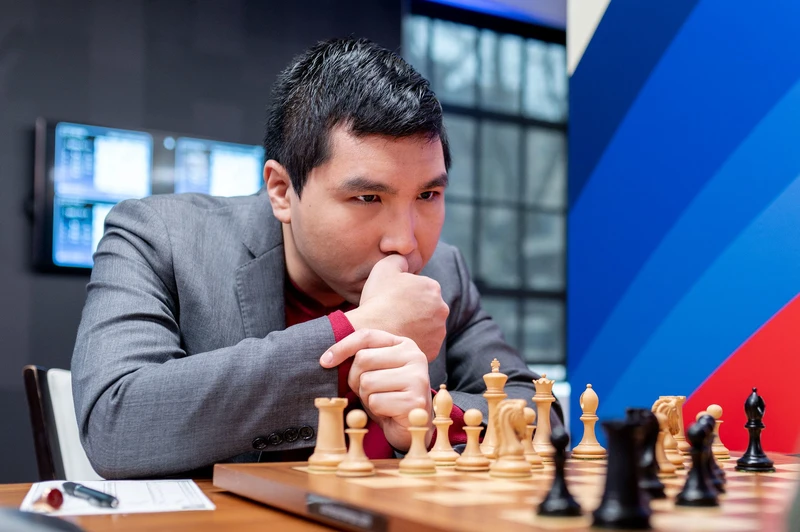
The Women’s Division
The Women's bracket was just as bloody, featuring a mix of dominant sweeps and marathon playoffs.
- Zoey Tang vs. Irina Krush (UPSET): The "Game of the Day" honors went to this incredibly tense match. Krush, the second-highest rated player in the field and a three-time champ, faced off against Tang, the second-lowest rated. After a 1-1 tie in classical, they played a grueling four-game blitz playoff. Tang lost from a winning position, recovered to win the next, and eventually ground down Krush on the clock to win the match 2.5 - 1.5.
- Alice Lee vs. Rachael Li: Defending champion IM Alice Lee showed exactly why she holds the title, delivering the only 2-0 sweep of the round. She completely controlled the board, finishing her Game 2 victory with three queens on the board!
- Carissa Yip vs. Anna Zatonskih: Yip managed to overcome a difficult position in her match, eventually winning with the black pieces in classical to take the match 1.5 - 0.5.
- Tatev Abrahamyan vs. Anna Sargsyan: Abrahamyan showed incredible grit. In Game 1, she found a beautiful resource to save a draw despite being down a pawn, and then pushed forward to win the match 1.5 - 0.5 in a marathon queen endgame in Game 2.
The Verdict: A Changing of the Guard?
The opening round of the 2026 American Cup suggests a significant shift in the competitive landscape of American chess. While veteran titans like Fabiano Caruana and Wesley So have successfully navigated their initial hurdles, the vulnerability displayed by established legends such as Levon Aronian and Irina Krush indicates that the rating gap between the "old guard" and the "rising generation" has effectively closed.
In the Open division, the resilience of Awonder Liang and Sam Sevian demonstrates that top-tier preparation is no longer the exclusive domain of the World Championship candidates. Meanwhile, the Women’s division remains highly volatile; the loss of the second seed, Irina Krush, to the younger Zoey Tang serves as a stark warning to the field.
The double-elimination format now becomes the focal point. While the eliminated players retain a path to victory, the mental tax of playing consecutive high-stakes rapid games in the lower bracket often proves insurmountable. The tournament is currently favoring momentum and youth, but the true test will be whether these younger victors can maintain their clinical precision as the classical time controls intensify in the Semifinals. Based on Round 1, the 2026 American Cup is poised to be the most unpredictable iteration in the event's history.
Credits
Image Credits:
- Thumbnail: Saint Louis Chess Club (edited in Canva), American Cup 2026
- Mishra vs Caruana (Image 1): Lennart Ootes | Saint Louis Chess Club
- Mishra vs Caruana (Image 2): FM Carsten Hansen (chansen64; chess.com)
- Liang vs Aronian (Image 3): Igor Zveglic | YouTube
- Liang vs Aronian (Image 4): Lennart Ootes | Saint Louis Chess Club
- Sevian vs Perez (Image 5): Lennart Ootes | United States Chess Federation
- Sevian vs Perez (Image 6): Lennart Ootes | United States Chess Federation
- So vs Robson (Image 7): Crystal Fuller | Chess Base News Deutschland
- So vs Robson (Image 8): Lennart Ootes | NM Anthony Levin (AnthonyLevin; chess.com)
Note: Some of the images are not from Round 1 of the American Chess Cup. Some are from different years or different rounds.
Retrieval of Games:
- Chess.com
- Lichess
Info of Round 1
- Chess.com
- Lichess
- Saint Louis Chess Club
- YouTube
- United States Chess Federation
- Chess Base News English | Deutsch
Courtesy of:
- FM Carsten Hansen
- NM Anthony Levin
- Igor Zveglic
- Lennart Ootes
- Crystal Fuller
- Saint Louis Chess Club
- United States Chess Federation
You may also like
 FrancisLudwigII
The Daily Gambit #11: The Cochrane — The "Death to the Petrov" Opening
Welcome back, you absolute madlads, to Season Two of The Daily Gambit. FrancisLudwigII
The Daily Gambit #1: The Jerome (Sorry Stockfish!)
Hey everyone! I’m Lorenzo Abing (francisludwigii), your online super-prodigy, and I’ve decided to co… FrancisLudwigII
The Daily Gambit #5: The Grob (The "I'm Not Even Sorry" Opening)
The Jerome was a crime. The Englund was a heist. The Halloween was a federal offense. The Latvian wa… FrancisLudwigII
The Daily Gambit #4: The Latvian (The Psychopath’s Counter-Strike)
The Jerome was a crime. The Englund was a heist. The Halloween was a federal offense. But the Latvia… FrancisLudwigII
The Daily Gambit #10: The Evans (The "Hold My Monocle" Opening)
We made it. FrancisLudwigII