
A Guide to Online vs OTB Chess
Chess, one of the oldest and most revered strategy games, has undergone a massive transformation with the advent of online play. While traditional over-the-board (OTB) chess remains a gold standard for competitive play, online chess has opened the doors to rapid games, global competition, and new strategic considerations. In this blog, we’ll explore the major differences between online and OTB chess, how they impact gameplay, and what players can do to adapt effectively.
1. Time Controls and Pacing
One of the most noticeable differences between online and OTB chess is the time control. Online chess offers a variety of rapid formats such as bullet (1-minute per player), blitz (3-5 minutes per player), and rapid (10-15 minutes per player). These fast-paced games demand quick decision-making, pattern recognition, and strong pre-move strategies.
In contrast, OTB chess generally adheres to classical time controls, often allowing 90 minutes or more for the entire game. This enables deeper calculations, long-term strategic planning, and psychological battles that are less common in online blitz games.
Adjustment Tip: If you are transitioning from online to OTB, practice longer games to improve deep calculation skills. If moving from OTB to online, work on playing confidently with limited time.
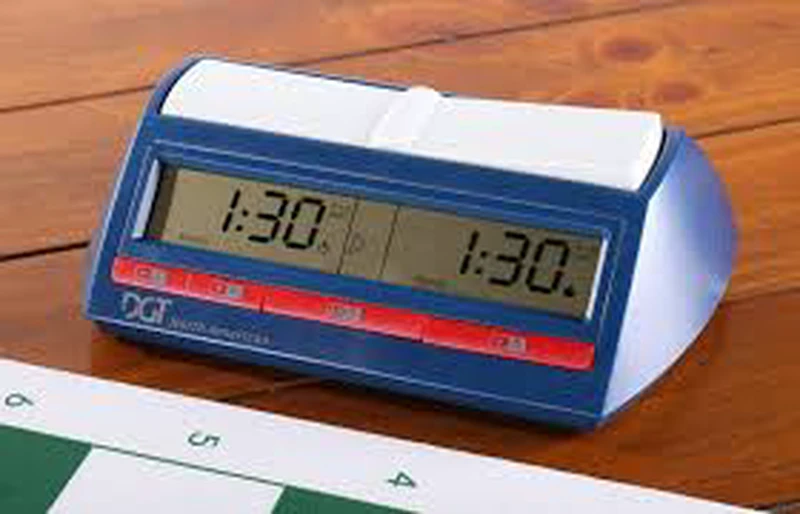
Remember...the clock is a piece! Use it wisely!
2. Psychological and Physical Elements
OTB chess introduces human elements that online chess lacks. Factors such as body language, facial expressions, and psychological warfare play a crucial role in high-stakes games. A strong stare or an unexpected sacrifice can rattle opponents in ways that are nonexistent in online play.
Additionally, sitting at a physical board for hours demands stamina and endurance, whereas online games can be played from the comfort of one’s home, often with distractions nearby.
Adjustment Tip: OTB players should work on emotional control and reading opponents, while online players should develop concentration techniques to minimize distractions.

Magnus Carlsen is well known for the psychological assault he plays upon his opponents.
3. Cheating and Fair Play
Cheating is a significant concern in online chess, where players may use computer assistance. While platforms implement anti-cheating measures, the risk remains. In contrast, OTB games have strict regulations, often requiring players to leave electronic devices behind and adhere to fair-play rules enforced by arbiters.
Adjustment Tip: Online players should ensure they are improving through self-analysis rather than relying on external tools. OTB players must be prepared for rigorous fair-play enforcement in competitive settings.

Hans Niemann, a divisive young chess star, has been embroiled in serious fair play scandals over the last few years.
4. Openings and Preparation
Online chess allows instant access to vast opening databases, engines, and pre-game preparation. Players can play multiple games in quick succession, testing and refining new opening lines.
OTB tournaments, on the other hand, require deeper memorization and preparation without the aid of instant resources. Grandmasters spend weeks preparing for specific opponents, making theoretical preparation more demanding.
Adjustment Tip: Online players should work on memory and recall, while OTB players can take advantage of online play to test new openings before a tournament.
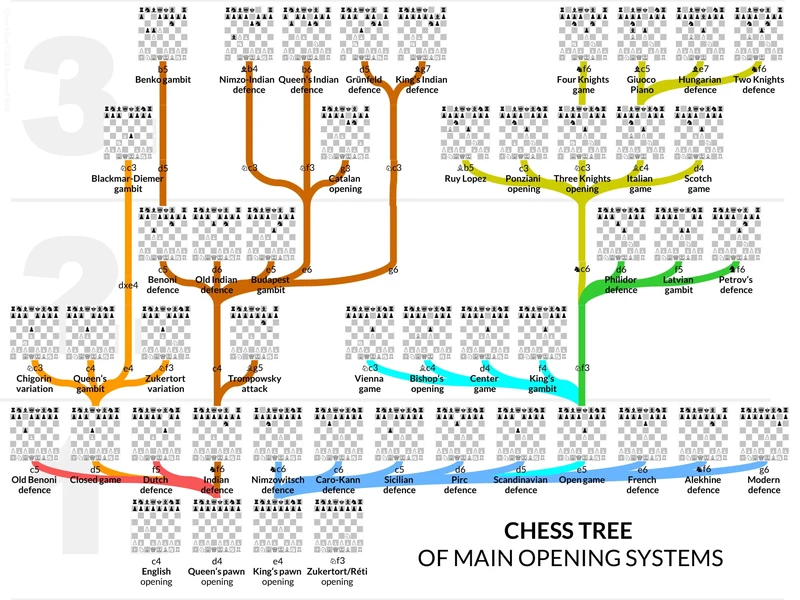
Above is a tree of the game's major openings, sorted into family groups.
5. Board Vision and Tactile Experience
Online players rely on a 2D screen where piece movement is assisted by highlights and arrows, which helps with visualization. In OTB chess, players must manually move pieces, visualize threats without assistance, and consider board orientation.
Adjustment Tip: Online players transitioning to OTB should practice physical board setup to improve board vision. Conversely, OTB players can use online tools to simulate difficult tactical positions for training.
 When compared, the difference between a physical and online board is stark. Visualization must be practiced in both formats for positive results.
Conclusion
Both online and OTB chess offer unique experiences and challenges. Online chess fosters speed, accessibility, and convenience, while OTB chess hones endurance, psychological skills, and deep strategic thinking. By understanding and adapting to these differences, players can become well-rounded competitors in both domains. Whether you’re playing from a tournament hall or your laptop, mastering both formats will elevate your overall chess ability.