
AI-generated
How Strong Can a Teenager Become at Chess?
Four years ago, my young son joined a chess club, and I’ve been mentoring the teens there ever since. The club was only founded in 2018, but it grew very quickly, not least due to the COVID-19 pandemic and the resulting trend toward online activities, which gave chess a major boost overall. Within five years, the club had grown to about 200 members, making it one of the ten largest chess clubs in Germany. The club is dominated by young people, who make up 80% of the membership. This large number of young chess players therefore offers a great opportunity to have a deep dive into just how well young people can play chess.In 2014, as part of his thesis for his coaching license, Frank Schubert analyzed the rating database of the German Chess Federation, with DWZ denoting the german chess rating. He found that, as shown in the following figure, players with a rating are distributed as follows: 60% recreational players, 25% advanced players, and 15% talented players.
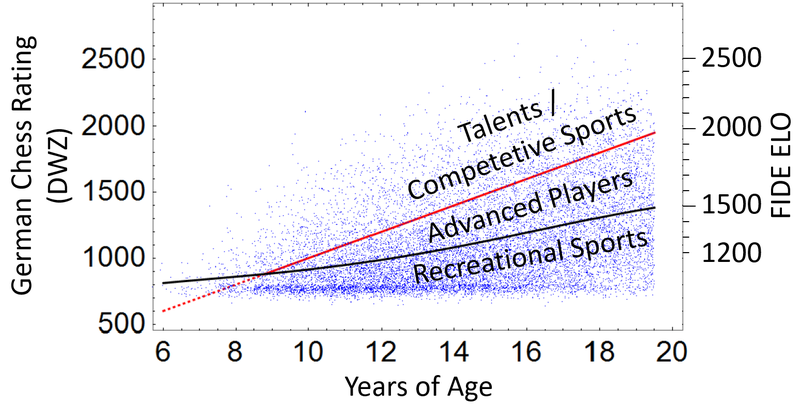
The black line marks the upper limit of recreational players—that is, those players who, by the end of their youth careers, have developed into adults who play just below average. Players above the talent threshold marked in red even have the skill level to perform well in youth district championships. This definition of the talent threshold ranges from a DWZ rating of 1000 at age 10 to a DWZ of 2000 at age 20. In this scenario, talented players increase their DWZ by 100 per year.
But is progress really that steady? Naturally, one learns quickly at first, until this process slows down and eventually stagnates completely. Franz Schubert has plotted this development for recreational players, advanced players, and talents based on the number of tournament evaluations, as shown in the following figure.
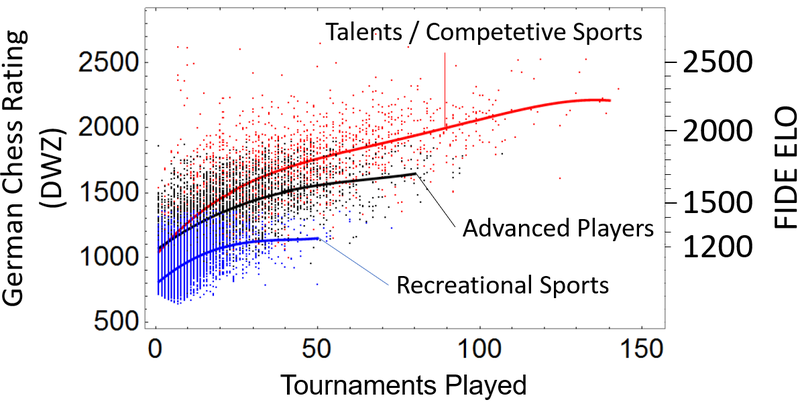
We want to answer the question of how well young players can perform, so let’s now look at the talented players. Talented players have the potential to exceed a rating of 2000. Although the rise is still steep at first, the rate of increase drops significantly for these players as well once they reach a DWZ of 1600. Being aware of this is important for players who were used to rise in rating with ease, so they can cope well with the changed pace of development.
Let’s now take a look at how this plays out in practice. The following chart shows the development of young players in our club over the past four years. After they start playing rated games, their progress sometimes takes a sharp upward turn. This can, of course, be encouraged by offering appropriate training and plenty of opportunities for practical play. For one of my club’s youth teams, for example, I also created an opening repertoire, and such favorable conditions really pay off—a year and a half after the course began, they won a trophy at the German National Championships :-)
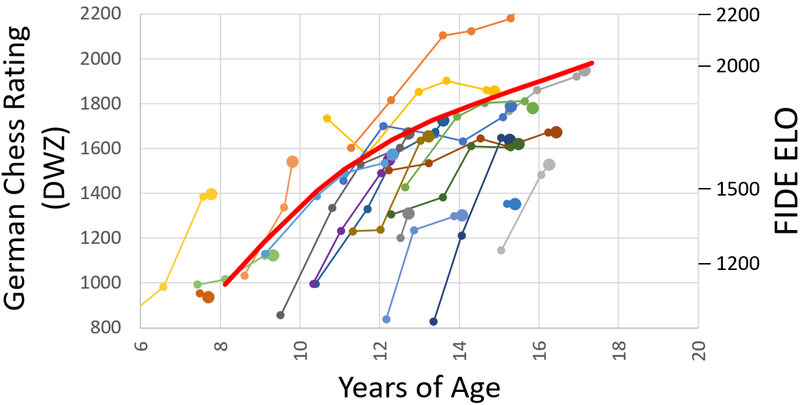
Nevertheless, progress cannot be increased at will, as this chart also shows the boundary marked by a thick red line within which development typically occurs—a boundary that, at least within this sample, was permanently broken only by one exceptional player. This red line corresponds exactly to the talent development curve shown in the chart before, applied to a player who begins playing DWZ-rated games at around age 7 and participates in about 11 tournaments per year.
With this in mind, we are now well-equipped to answer the question posed at the beginning:
How well can a young player perform?
There is a certain limit, marked in red in the last chart, within which even talented young players typically develop. Only a very few exceptional players can consistently exceed it. One should not expect more, because if a young player comes even close to this level, he has already achieved outstanding development by reaching the upper boundary of the group of typical talents.