Tactics Analysis #13
Analysing some of the tactics problems I struggled with this weekCurrent Puzzle Rating: 2311 (+123)
Current Puzzles Completed: 2650 (+150)
This is pretty close to my peak puzzle rating (highest I can see on the graph is 2317) and I feel like I had a good week, solving some puzzles really well. Of course, there were still some misses, and it's not that important what my exact puzzle rating is. I'm trying not to attach too much importance to my rating - other things, like finding the positions in actual games, speed, confidence and calculation are more important - it's still nice to see it go up instead of down.
Lets look again at some of the positions in my list that I failed or found hard to understand this week. I've gone into more detail on my thought process as I attempt to re-solve these, to try to help me find weaknesses and areas to improve along the way.
Position #1
https://lichess.org/training/vhnNP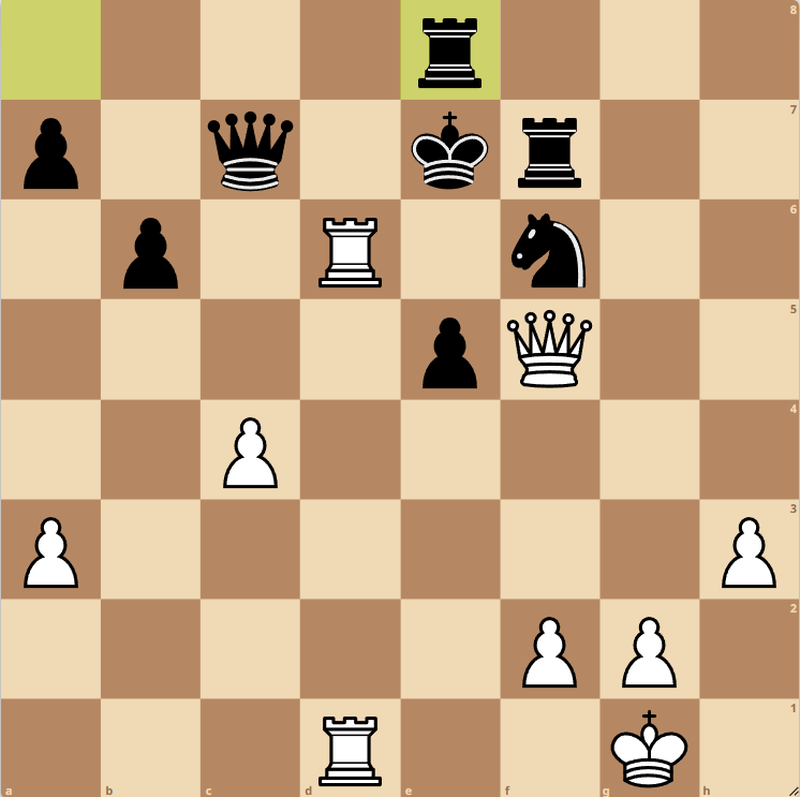
When I add positions to my list, I usually make a little note to tell me what I was thinking, or what I tried that didn't work, or something about the position. For this one, the note just says "?" so that tells me I had no idea what was happening.
Looking at it now, Black's king is very restricted - something like Re6 is almost mate, with only f8 to escape to. So I would look for a way to take that square away from the king, but I can't see one. White has no dark square bishop and the queen is on a light square so doesn't have any way I can see to block that square (and is part of the attack anyway, so if it moves to take the escape away, the attack breaks down). Rd7+ forks the king and queen but the square is defended by king, knight and queen so if we try to fork immediately the defenders are too numerous.
Qxe5+ also looks interesting, forcing the king away and offers a discovered attack on the queen, but I don't see where it goes as our own queen will immediately be under attack from the rook on f8 and there's no way I can see to give check with the d6 rook to exploit the discovery.
I still have no idea, so let's move on to the first move.
1. Re6+ Kf8
From there - well I don't know why I couldn't see this in the initial position. I think when I looked at Re6 I was only looking for mate, but in fact we just win a piece with Rxf6 and our two extra pawns and better king position are enough to get the win.
SOLUTION
1. Re6+ Kf8 2. Rxf6
Position #2
https://lichess.org/training/gSofY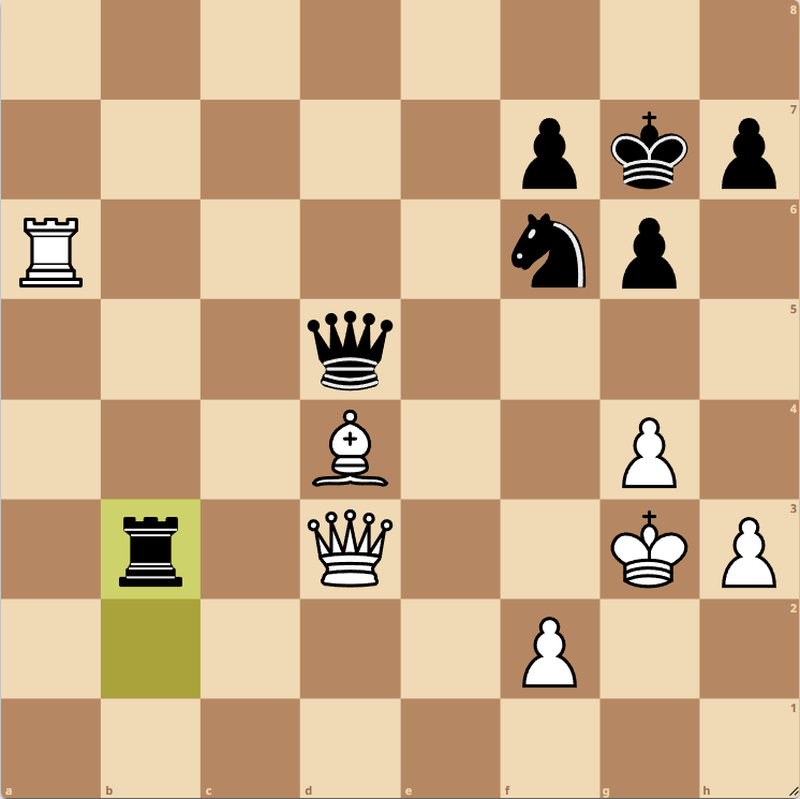
Another one I just gave a "?" to in my notes.
I have some ideas about mate - it took me a while to find, but 1. Kh4 Rxd4 2. Bxf6+ Kh6 3. g5# works, I just don't know what the play would be after 2. ... Kg8. From there I wondered about 1. Qxb3 Qxb3 to try to unguard the a8 square, but I don't see how that works as the Black capture is check. Something like 1. Qxb3 Qxb3+ 2. Kh4 Qd5 and all I've done is exchange a queen for a rook .
Except what if I then play 3. Bxf6+, with the same mate plan as before, or if Kg8 I've got B+R vs Q. I don't know if that's good for me and if it is can he play something else at move 2, like g5+
SOLUTION
1. Bxf6+ Kh6 (Kh8 2. Rh8 Qxh8 3. Qxb3) 2. Kh4 Rxd3 3. g5+ Qxg5 4. Bxg5+
It wasn't about finding a mate - taking with the bishop immediately forces Black into losing a piece to prevent mate.
Position #3
https://lichess.org/training/xovTa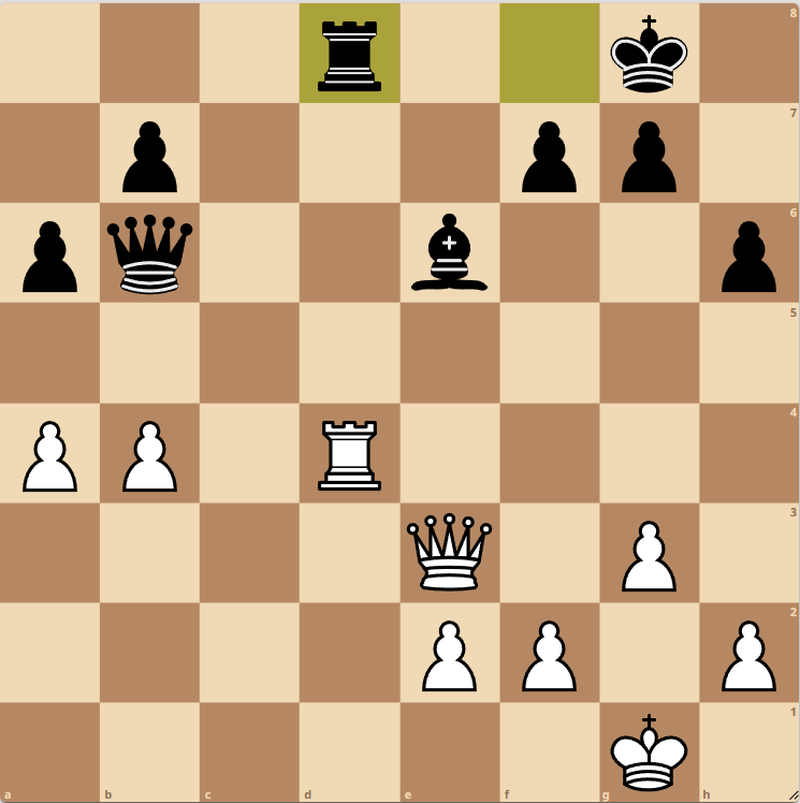
This one should be a little easier to analyse, as the ideas are clearer. The rook on the back rank is vulnerable as it can be captured with check. We also have a discovered attack on the queen we can exploit. I know the move I tried the first time was Rxd8+, but after Qxd8, now what? There's nothing loose in the Black position to attack and nowhere to go.
Instead we need to combine the ideas in a different way to find the answer - and for me, remember to look at all the options.
SOLUTION
1. Rd7 Rxd7 (if the queen tries to move, the rook must be undefended - natural to me here would maybe be Qxe3 instead, but the position after 2. Rxd8+ Kh7 3. fxe3 is materially worse for Black) 2. Qxb6
Position #4
https://lichess.org/training/lUPA8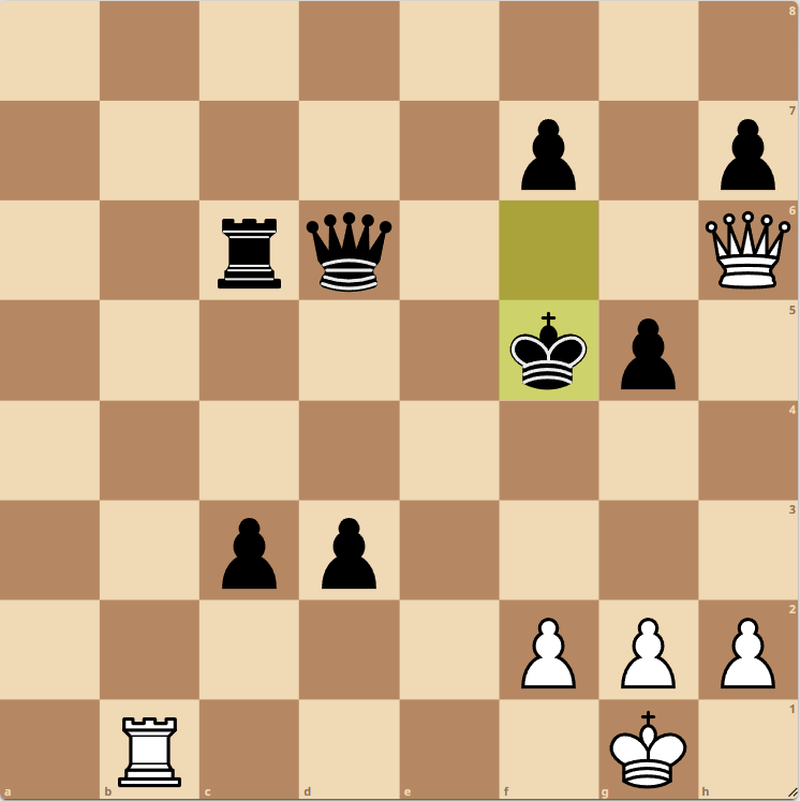
1. Rb5 seems like the most obvious choice here. Blocking with the rook doesn't work (1. Rb5+ Rc5 2. Qxd6 Rxb5 3. Qd7+ or something is crushing I assume) and if he blocks with the queen we just take it with check, take the rook and win up a queen and a rook. So let's try moving the king.
1. Rb5 Kg4 2. Qh3 Kf4 3. Qf3# is all forced. 1. Kb5 Kf4 2. Qxg5 Ke4 3. Qe3# is also forced. So the only move left is 1. Rb5 Ke4 after which I again look at checks, either Qxh7 or f3. f3 opens up the escape square e3 so let's leave that for a minute.
2. Qxh7 Kf4 3. Qf5# is no good for Black. The only other king move is Kd4 (f5 is on the table as well - 2. Qxh7 f5 3. Qxf5 Kd4 will almost certainly be losing if 2. ... Kd4 is so I'll ignore it for now). So 2. Qxh7 Kd4 what? Well 3. Qb7+ Kc4 and the king is getting away from the pieces and the rook is threatened so that looks wrong. I can't see a mate here.
What I really want is to play Qe3# but there's a pawn in the way. So what I should do is play Qxg5, with the threat of mate on e3 (or for example 2. Qxg5 Qd4 to defend e3 3. Qf5#).
What I think I didn't do here was trust my calculation. I saw 2. Qxh7+ didn't work, but I played it anyway, on the assumption that I would find an answer over the board (once the next Black move was played and I could see the reality more clearly). If I had trusted my calculation, I would have known not to play it and would have maybe gone on to find the winning move.
SOLUTION
1. Rb5+ Ke4 2. Qxg5
