
Mastering Chess Planning: How to Generate Ideas, Ask the Right Questions
In this blog, I’ll show you how to spot patterns, recognize opportunities, and develop a plan that turns your position into a real advantage—making your chess not just about moves, but about strategy.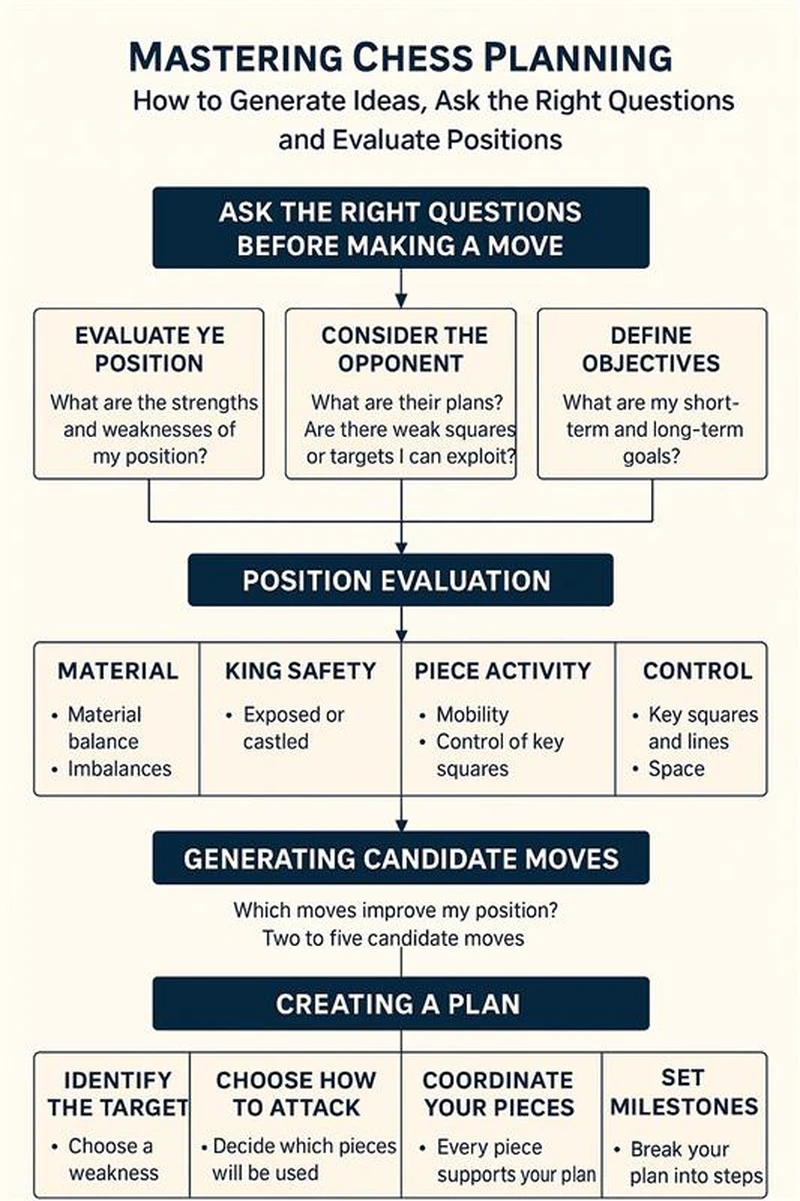
1. Why Planning Matters
Without a plan, your moves are reactive, and your game becomes inconsistent. Planning allows you to:
• Coordinate your pieces efficiently
• Exploit weaknesses in your opponent’s position
• Turn small advantages into winning positions
• Avoid falling into tactical traps
A strong plan doesn’t need to be complicated—it must be coherent, flexible, and aligned with the position’s demands.
⸻
2. Asking the Right Questions Before Making a Move
Key Questions to Ask Before Making a Move
- What are the strengths and weaknesses of my position?
• Are my pieces well-developed?
• Is my king safe?
• Which files, ranks, or diagonals are open?
2. What threats does my opponent have?
• What are their immediate tactical threats?
• Are any of my pieces under attack?
3. Which pieces can become more active?
• Can I reposition a knight, bishop, or rook for greater effect?
• Which pieces are currently limited or passive?
4. What are my short-term and long-term goals?
• Is there an immediate tactical opportunity?
• Does a strategic plan, like controlling an open file or attacking the enemy king, make sense?
Before committing to any move, ask yourself a series of guiding questions. This turns your thinking from instinctive to purpose-driven.
2.1 Evaluate Your Position
- Strengths and Weaknesses
• Which of your pieces are active or passive?
• Are your pawns well-placed, or do you have structural weaknesses?
• Is your king safe? - Immediate Threats
• Which pieces of yours are under attack?
• Are there tactical threats such as forks, pins, or discovered attacks against you? - Potential Improvements
• Can any piece be repositioned for maximum activity?
• Are there squares that can act as strong outposts for knights or bishops?
2.2 Consider the Opponent
• What are their plans?
• Are there weak squares or targets you can exploit?
• Which of their pieces are strong and which are poorly coordinated?
2.3 Define Objectives
• Short-term goals: Capture a key pawn, control an open file, or create a tactical threat.
• Long-term goals: Dominate the center, restrict opponent pieces, improve pawn structure, or prepare a king-side attack.
⸻
3. Position Evaluation: The Core of Planning
A proper position evaluation forms the foundation of a plan. A systematic approach considers five main factors:
3.1 Material
• Count material, but don’t overvalue it. A rook trapped behind its own pawns can be less valuable than a centralized knight.
• Evaluate imbalances: bishop pair, pawn structure, or piece activity.
3.2 King Safety
• Check for exposed squares near your king.
• Look for potential attacking lines against the enemy king.
• Consider pawn shields and open files.
3.3 Piece Activity
• Evaluate the mobility of all your pieces.
• Pieces should be active, centralized, and controlling key squares.
• Ask: Which pieces are restricted or blocked? Can they be repositioned?
3.4 Pawn Structure
• Identify weaknesses: isolated, backward, or doubled pawns.
• Strong pawn chains can support piece activity and attacks.
• Look for opportunities to create pawn breaks that open lines.
3.5 Control of Space and Key Squares
• Which areas of the board do you dominate?
• Are there files, ranks, or diagonals you can invade?
• Can you occupy or restrict the opponent’s strong squares?
⸻
4. Generating Candidate Moves
Once the position is evaluated, generate a list of candidate moves—typically 3–5 options. Don’t focus immediately on finding the “best” move; focus on creating possibilities.
• Ask: “Which moves improve my position?”
• Include tactical shots and strategic repositioning.
• Consider forcing moves first (checks, captures, threats).
⸻
5. Creating a Plan
5.1 Steps to Formulate a Plan
- Identify the Main Target
• Choose a weakness in the opponent’s camp (weak pawn, exposed king, poor piece coordination). - Choose How to Attack It
• Decide which pieces will be used in the attack.
• Determine the route or method (pawn push, piece maneuver, doubling rooks). - Coordinate Your Pieces
• Every piece should contribute to your plan.
• Avoid moving pieces aimlessly; each move should support your overall goal. - Set Milestones
• Break your plan into achievable steps.
• Example: “Control open file invade seventh rank attack king.” - Maintain Flexibility
• React to your opponent’s moves without abandoning your long-term plan.
• Adjust tactics if your opponent creates threats.
⸻
6. Strategic vs. Tactical Thinking
• Tactical plans: Short-term, concrete sequences (2–5 moves), often involving captures, threats, or combinations.
• Strategic plans: Long-term ideas (6+ moves), focusing on piece placement, pawn structure, and space control.
Strong players combine both: a strategic foundation supports tactical opportunities.
⸻
7. Practical Tips to Improve Planning
- Think in Candidates
• Always generate multiple possibilities before committing. - Ask “What Would My Opponent Do?”
• Anticipating threats prevents blunders and reveals opportunities. - Use Patterns
• Learn common mating nets, pawn breaks, and tactical motifs. - Simplify or Complicate Wisely
• Simplify when ahead; complicate when behind. - Evaluate Every Move
• Ask: Does this move help my plan? Does it improve my worst-placed piece?
⸻
8. Exercises for Idea Generation
• Take a master game and pause every 5 moves: identify the plan, then try to guess it before seeing the move.
• Practice “candidate move drills”: for each position, write down 3–5 candidate moves and justify each.
• Play slow games with planning focus: before each move, verbally ask yourself key questions about position evaluation and planning.
⸻
9. Conclusion
Generating ideas and planning in chess is not about memorizing sequences—it’s about systematic thinking. By evaluating the position, asking the right questions, and creating coherent plans, you can transform your play from reactive to proactive.
Remember: a plan is a living strategy—it evolves as the game progresses. With practice, planning becomes second nature, and every move will carry a purpose, improving your results and understanding of chess.
10. Words of Wisdom from Chess Champions
Many of the greatest chess players in history have emphasized the importance of planning, idea generation, and careful evaluation. Here are some of their most inspiring quotes:
• José Raúl Capablanca:
“You may learn much more from a game you lose than from a game you win. Plan carefully, but always be ready to adapt.”
• Bobby Fischer:
“You must take your opponent into a deep dark forest where 2+2=5, and the only way out is through your own calculation and ideas.”
• Garry Kasparov:
“In chess, ideas matter more than memorized moves. A strong plan is worth a thousand tactics if your opponent has no counterplan.”
• Vladimir Kramnik:
“Evaluating the position correctly is more important than moving fast. A good move in a bad position will not win you the game.”
• Mikhail Tal:
“Chess is life in miniature. A good plan is like a good story: it must have coherence, purpose, and the ability to surprise your opponent.”
• Anatoly Karpov:
“Strategy is about patience. You do not rush your plan; you gradually improve your position and wait for the opponent to make mistakes.”
You may also like
 GM Avetik_ChessMood
7Q Method: Your Roadmap to Formulating Chess Plans in Any Position
You'll never get stuck again, unsure of what plan to choose. GM HomayooonT
“Chess Psychology: Why We Play Worse in Tournaments Than in Training”
“Why do we play better in training than in tournaments? Is it nerves, time pressure, or fear of losi… FM MattyDPerrine
Why Masters Crush Lower-Rated Players (and You Struggle)
Hint: The secret isn’t a high ceiling CM HGabor