
Lichess vs. Chess.com: The 1,000-Game Verdict
If you’ve ever tuned into my stream, you know the question that pops up at least 1 to 2 times every day: "Why aren't you playing on Chess.com?” It’s a fair question. One site is a global giant, and the other is an open-source labor of love. For years, I didn’t completely avoid that other site, but only played there occasionally. I’ve stayed on Lichess, encouraging my viewers to use Lichess because it felt right. To me, Chess.com felt like a strange neighborhood. The subscription model didn’t appeal to me, the interface felt "heavy," and I simply felt more at home in the Lichess ecosystem. But as a streamer, I realized I was giving an answer based on habit and opinion, not current data. I wanted to know if my preference was backed by facts. So, I set a goal: 1,000 games of Bullet in 31 days. 500 games on each platform, tracked and analyzed.Rating Performance: The Progress Report
To see if the 1,000-game grind actually improved my standing, I compared my starting point with my final results.
Rating Baseline (Before the Challenge)
Rating Results (After the Challenge)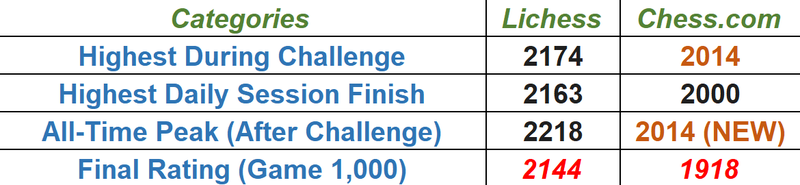
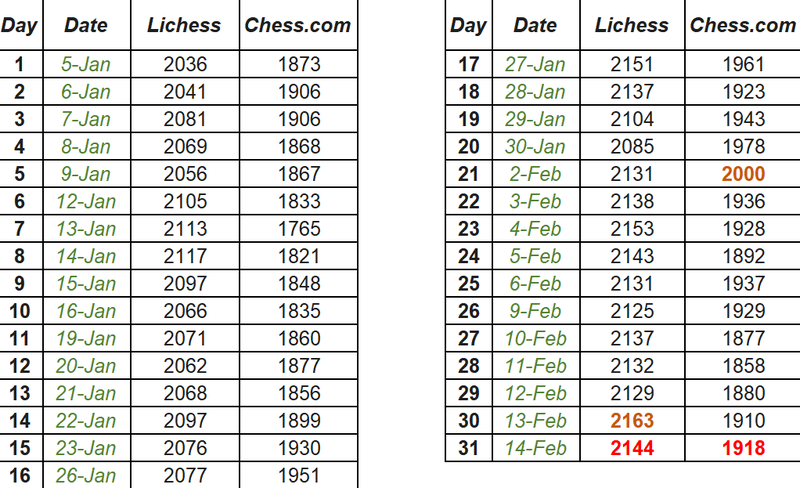
Note on "Daily Session Finish": I tracked my rating at the end of every day after completing all scheduled games. This reflects my standing at the conclusion of each session, providing a more stable look at my progress than a brief peak reached mid-session each day.
Plans vs. Reality
This challenge was originally designed for a strict 30-day streak, playing 17 games on each site per day (with 7 games on the final day) to hit exactly 1,000 games. However, as any streamer knows, the plan is only as good as the internet provider.
- The Lag Extension: On Day 4, the lag was so severe I could only finish 5 games on each site. I followed this with a 12-game session on Day 5 to compensate. To reach the full 1,000-game count, I eventually extended the challenge to 31 days.
- The Weekend Break: While the goal was "30 days in a row," I had to pause on weekends. My internet becomes incredibly unstable on those days, and I didn't want to give either site an unfair disadvantage by playing during a connection blackout.
- Zero Study Policy: I didn't study or look at opening theory during these 31 days. I wanted the data to reflect how I actually play (raw and unfiltered). Some days I was in full concentration mode; other days, I was just a "blunder machine" lol. This is the reality of the grind.
Top 10 Openings Faced as White (Lichess vs Chess.com)
| Rank | Lichess Top 10 | Total | Chess.com Top 10 | Total |
|---|---|---|---|---|
| 1 | C00: French Defense: Knight Variation | 22 | B10: Caro-Kann Defense | 27 |
| 2 | B10: Caro-Kann Defense | 21 | B06: Modern Defense | 20 |
| 3 | B30: Sicilian Defense: Old Sicilian | 20 | C00: French Defense: Knight Variation | 20 |
| 4 | B01: Scandinavian Defense: Valencian | 18 | B00: Pirc Defense | 17 |
| 5 | C46: Three Knights Opening | 15 | C47: Four Knights: Scotch Accepted | 16 |
| 6 | B06: Modern Defense | 15 | B50: Sicilian Defense: Modern Variations | 11 |
| 7 | C01: French Defense: Exchange | 11 | A00: Van't Kruijs Opening (1. e3) | 11 |
| 8 | B50: Sicilian Defense: Modern Variations | 10 | B01: Scandinavian Defense: Mieses-Kotroc | 10 |
| 9 | B40: Sicilian Defense: French Variation | 9 | C46: Three Knights Opening | 10 |
| 10 | B00: Pirc Defense | 8 | B00: Owen Defense | 8 |
Top 10 Openings Faced as Black (Lichess vs Chess.com)
| Rank | Lichess Top 10 | Total | Chess.com Top 10 | Total |
|---|---|---|---|---|
| 1 | B23: Sicilian Defense: Closed | 22 | A43: Benoni Defense: Old Benoni | 49 |
| 2 | B50: Sicilian Defense: Modern Variations | 17 | B23: Sicilian Defense: Closed | 23 |
| 3 | A43: Benoni Defense: Old Benoni | 12 | A00: Van't Kruijs Opening | 12 |
| 4 | B21: Sicilian Defense: Smith-Morra | 11 | A04: Zukertort Opening | 12 |
| 5 | D30: Queen's Gambit Declined | 10 | B50: Sicilian Defense: Modern Variations | 11 |
| 6 | D02: Queen's Pawn Game: Zukertort | 10 | B22: Sicilian Defense: Alapin Variation | 10 |
| 7 | B20: Sicilian Defense: Bowdler Attack | 9 | A01: Nimzo-Larsen Attack | 9 |
| 8 | B22: Sicilian Defense: Alapin Variation | 8 | B50: Sicilian Defense: Delayed Alapin | 7 |
| 9 | B21: Sicilian Defense: McDonnell Attack | 7 | A00: Hungarian Opening | 6 |
| 10 | A50: Indian Defense: Normal | 7 | A00: Mieses Opening | 6 |
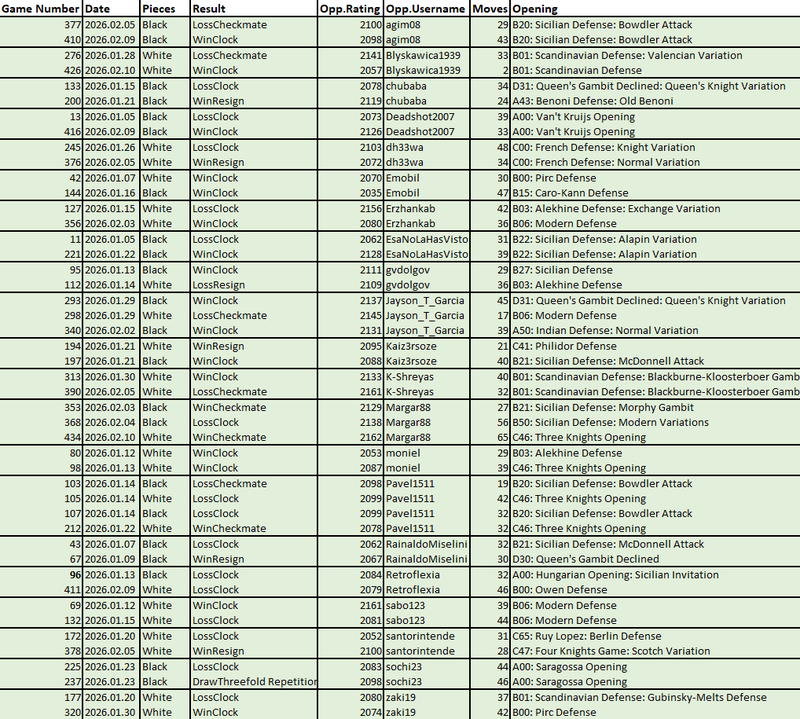
Repeated Opponents (on Lichess)
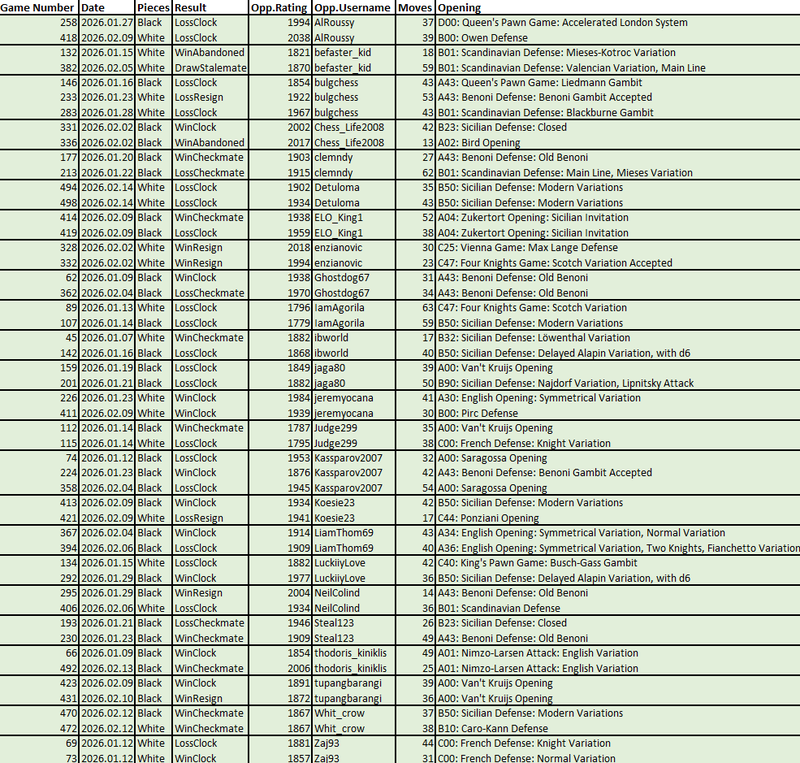
Repeated Opponents (on Chess.com)
The "1,000 Game Challenge" Quick Summary
1. The Rating Battle: Peaks & Progress
- I entered the challenge with a peak of 1826 on Chess.com and shattered it, hitting an all-time new high of 2014.
- On average, my Lichess rating remained roughly 200–250 points higher than my Chess.com rating throughout the 31 days.
- According to ChessGoals.com, this 200–250 point offset is standard for Bullet players. This proves I was playing at the exact same strength on both platforms. The numbers are just measured on a different scale.
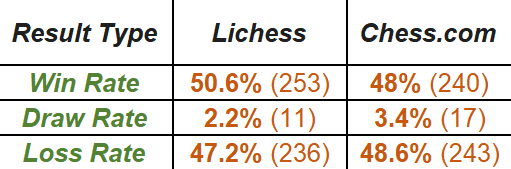
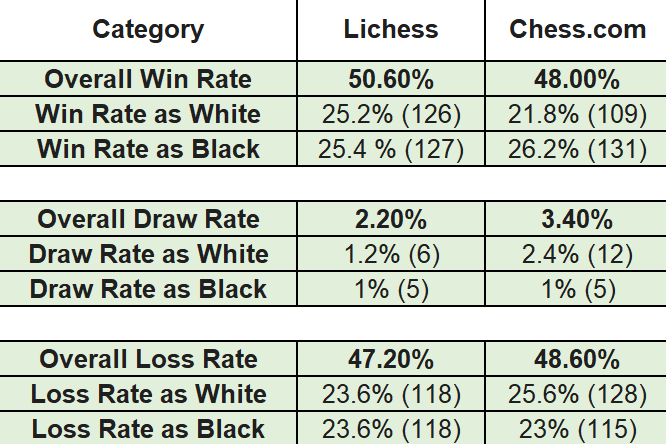
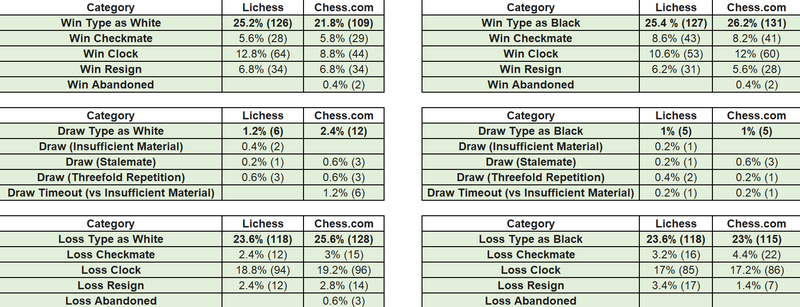
- I was slightly more successful on Lichess (50.6% win rate) compared to Chess.com (48% win rate).
2. The Premove Battle: 0.0s vs. 0.1s
This was the biggest "culture shock" of the challenge. The two sites handle speed very differently, and it completely changed how I had to play.
- Lichess : Lichess allows for 0.0s premoves (eventho you can't stack multiple premove). If you are fast enough, you can make 30 moves without losing a single second. This makes time scrambles feel smooth, rewarding, and incredibly intense.
- Chess.com (The Time Tax): Every single move on Chess.com, even a premove costs a mandatory 0.1 seconds. While you can "stack" multiple moves, you are essentially paying a time tax just to play.
- The Discomfort: I felt significantly less "safe" on Chess.com. Having only 1 or 2 seconds left on Chess.com is a death sentence because you literally only have 10–20 moves left before you auto-flag. On Lichess, I felt I could still win from any position as long as my hands were fast enough. It made Chess.com feel "heavy" and restricted compared to the freedom of Lichess.
3. Lag and UI gaslighting
For me, the most frustrating part of the 1,000-game grind wasn't the opponents.. it was fighting the interface itself.
- The Great Ping War: On Lichess, I average 200–300ms. On Chess.com, it routinely spiked past 600ms to 800ms.
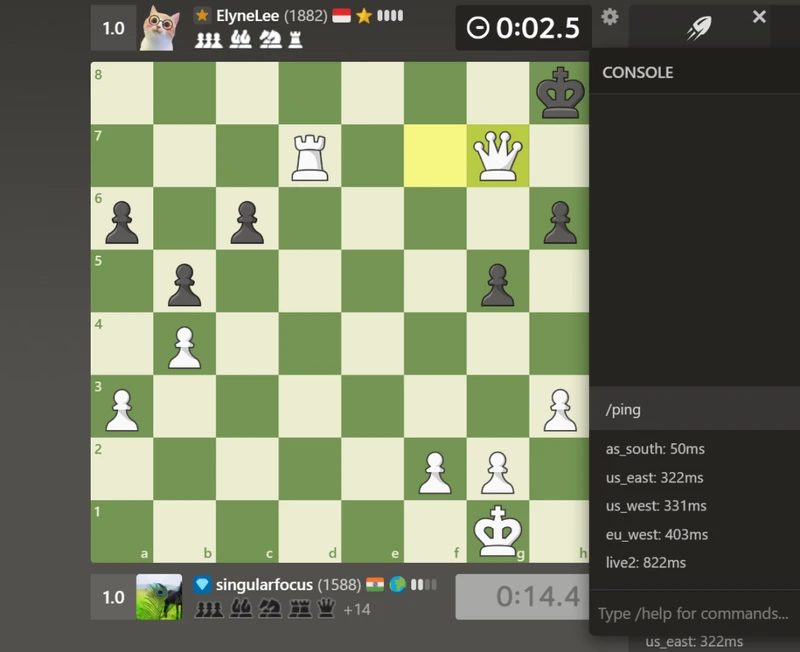
- The Gaslighting Bars: I tested this with a viewer from India while we play on Chess.com. My screen showed that he had 4/4 "perfect" bars while i only had 2/4 bars. He lost on time. He then sent me a screenshot from his side: it showed him that i'm the one who had full 4/4 bar while he got 2/4 bar with 822ms ping
- The "e3" Disaster: I always try to play 1.e4 as white in the challenge session. I'm so used to Lichess UI. And all I can say is Muscle memory is a dangerous thing. Lichess centers the board. Chess.com does not. My data shows I played 1. e3 (a misclick) 11 times on Chess.com, whereas it happened zero times on Lichess.
- The "Hidden" Ping: Checking your connection speed shouldn't be a chore.
- On Lichess: I just click my profile icon, and the ping shows up instantly at the bottom of the menu.
- On Chess.com: I have to hover over "Play," click "Play Online," click the message icon, and manually type
/ping. To make it even more frustrating, the command is case-sensitive. If you accidentally type/PINGin all caps, it won't even work.
4. The "Big Pool" Myth
There is a common belief that Chess.com’s massive user base ensures a constant stream of new opponents; however, my data shows the opposite.
- The Numbers: Over 1,000 games, I encountered 21 repeat opponents on Lichess and 24 on Chess.com. Despite the difference in total site traffic, the "active pool" at the 2100+ Bullet level on Lichess is remarkably similar in size to the 1900–2000 level on Chess.com.
- Density of Play: While I had more unique "rivals" on Chess.com, the frequency of encounters was higher on Lichess. The Lichess pairing system matched me against the same person three times in a single day and even paired us again on a different day. In contrast, Chess.com never paired me with the same person more than twice in a single day.
- The Color Bias (Repeat Encounters): When facing the same opponent twice, the algorithms handled piece colors very differently:
- On Lichess: Out of my repeat matches, I faced 13 people on different days where the site gave me the exact same color both times, and 1 person on the same day with the same color.
- On Chess.com: I faced 9 people on different days with the same color and 5 people on the same day with the same color.
5. The Opening Paradox: The "d4" Mystery (I Need Your Opinion)
One of the most surprising findings in my data was the shift in what my opponents played when I had the Black pieces. Despite playing at the same relative strength on both platforms, the tactical landscape was completely different. On Lichess, the games were open and chaotic and I was constantly fighting off aggressive 1. e4 players. But on Chess.com, I constantly ran into a "d4 Wall."
- The Benoni Grind: As Black on Chess.com, I faced the Old Benoni 49 times (nearly 20% of my games).
- On Lichess, the meta felt much more diverse and "Bullet-oriented," with a high frequency of open games and tactical piece play.
The Question is: Why is there such a massive gap in opening choices between the two sites at the exact same skill level?
- The "Safety" Factor: On Chess.com, where you lose 0.1s per move, players might play 1. d4 systems (like the London or Benoni structures) because they are "safer" and require less calculation under time pressure.
- The Rating Pressure: Because Chess.com ratings feel "harder" to earn (1900 vs. 2150), are players more afraid to take risks with 1. e4?
What do you think? Is the Chess.com community just more "positional" by nature, or does the 0.1s time-tax force people to play more boring, solid openings to avoid flagging? Or is there any other reason?
Join the Investigation: Data, Vlogs, & Your Thoughts
Check the Data Yourself: For the real chess nerds and data enthusiasts, I have made my full database public. You can find every game, opening, and result in this spreadsheet: [ Complete 1000 Bullet Challenge Data ]
Coming Soon: My First Vlog! Data only tells half the story.I am currently working on a full video breakdown about this challenge for my YouTube channel. I’ll be showing the most insane games, the worst blunders, and I’ll also be sharing my final thoughts on the technical pros and cons and features of both platforms.
Community Feedback
I value the perspective of the community and would like to hear your thoughts on these findings. I will be reviewing the comments and featuring the most insightful opinions, theories, and questions in my upcoming breakdown video.
- What is your take on the data presented here?
- Do you have a theory on the opening differences or the pairing behaviors I encountered?
Please share your thoughts below. Your input will help shape the final analysis for the vlog.
*I have already uploaded the full VODs of every single session to my YouTube channel.
https://www.youtube.com/@ElyneLee
*I stream a mix of chess and viewers' radio daily on Twitch from 5:00 AM to 10:00 AM CST
elynelee - Twitch
You may also like
 IM Fins
What I Learned from Spending 1,000+ Hours Writing an Opening Course
Reflections on a 2+ year journey (and 25+ year career) with the 3...Qa5 Scandinavian Lichess
Lichess: End of Year Update 2025
Is it just us, or has this year flown by? As we say goodbye to 2025 and enter 2026, let's look back … FM MathiCasa
Chess Football: A Fun and Creative Variant
Where chess pieces become "players" and the traditional chessboard turns into a soccer field ElyneLee
30 Days of Puzzle Racer: The Challenge That Made Me Feel Weaker
Last year, I did a 30-day challenge to gain 100 blitz rating points without studying. It worked, and… thibault
How I started building Lichess
I get this question sometimes. How did you decide to make a chess server? The truth is, I didn't. ChessMonitor_Stats