
All About Chess Evaluation!
What is evaluation? What does the number really mean? What are all the symbols? All these questions are answered in this blog post! Continue reading....
What is Evaluation? More on the basics...
Let's go back to basics for a second and talk briefly about what an evaluation really represents. You may have seen that Stockfish or another engine constantly spits out a decimal instantly when a move is played. It is often accompanied by a plus or a minus. The easy part: a plus before the number indicates white is better, and a minus indicates black is better.
An evaluation of 0.00 indicates that the position is equal, or that the game is in equality. This can either be static equilibrium (i.e. a theoretical draw, dead/boring position, or fortress (that is, in some cases)) or dynamic equilibrium (i.e. there are imbalances based on pieces or pawn structures but the objective evaluation is still equality).
The number you see after the plus or minus sign gives an indication of the size of the advantage. It is compared to the equivalent advantage if a player were up that many pawns. For example, an advantage of +2 in a position means that white's advantage is equivalent to the advantage they would have if they were up 2 pawns in an otherwise equal position. However, it is important to note that the material on the board and the evaluation given are by no means related. For example, consider the following position, played between Deep Blue and Kasparov in 1997:
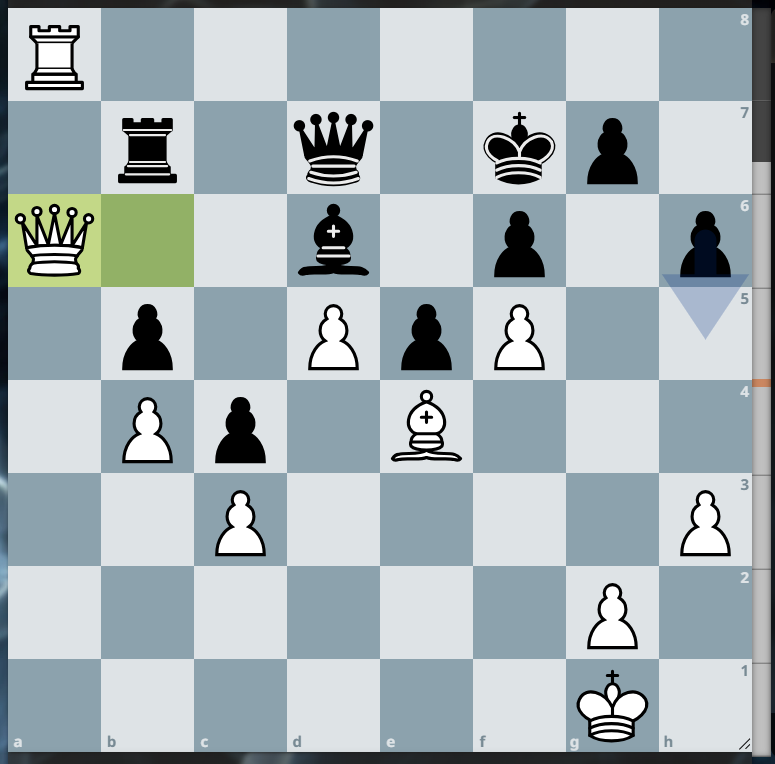
The material is completely equal, however Stockfish 18 gives this an evaluation of +3.7. This means that despite material equality, Deep Blue's advantage is greater than that of an entire minor piece! This is clearly evident by the lack of space for Black and the passive pieces that Kasparov has compared to Deep Blue.
A Quick Note on the Bar on the right...
The bar, colloquially known as the eval bar, is a visual representation of the quantification that you see with the decimal. If the evaluation is 0, the bar would have equal portions of white and black --- that is, if you think of it as a white bar, the top of the white bar would end at where the orange mark is. If the top of the white bar is above that orange mark, it indicates white has the advantage. If the top of the white bar is all the way at the top (i.e. there is no space or no black region left) it means that White is mating Black by force. For the opposite side: if the top of the white bar is below that orange mark, it means that Black has an advantage, and if there is no white region visible for the bar, it means that Black is checkmating by force.
How should I interpret the numbers?
The following explanations I will demonstrate only for the plus side (that is, the case where White has the advantage). You can mirror these cases to find out about the opposite cases where Black is favoured.
- An eval between 0 and +0.5 I will label as "dynamic equilibrium." For several cases in terms of intermediate and advanced players, the eval may show up to +0.5, yet Black is still found to be doing just fine. Remember that the starting chess position is given as +0.2 or +0.3, due to the extra tempo that white has. Even positions in the Kings Indian are thought to be around +0.5, while it is still considered dynamic equilibrium. This in chess symbols is given by = (equal position).
- An eval between +0.5 and +1 to +1.2ish I would call "slightly better." You are past dynamic equilibrium and probably have a positional advantage, but it is nothing extraordinary or decisive yet. You have a comfortable plus and would probably look to press or extend it. This in chess symbols is given by a plus sign over an equal sign (read as plus over equal - white is slightly better).
- An eval between +1-+1.2ish to around +2 is considered "better." You have a decent advantage, and at this point you are definitely pressing with space or you probably have a slight material advantage (probably a pawn's worth). You are not "winning" yet, but you are close to and if you continue to press, attack, and induce mistakes from the opposition, you may surely end up winning. It is indicated as a plus sign over a minus sign (read as plus over minus - white is better).
- An eval above +2 is considered a decisive or a winning advantage. The baseline can be extended to +2.5 depending on your level, but for intermediate/advanced players anything in this range is usually enough to have a significant advantage. It is indicated by +- (a plus sign right next to a minus sign - white is winning). You either have a significant positional advantage and are squeezing the opponent, or you have a substantial material advantage. Usually an exchange in a middlegame is good enough for a winning advantage, and the example with Deep Blue-Kasparov is an example of a winning advantage for White.
What can affect an eval?
- Well the most obvious is probably material. The evaluation directly reflects the equivalent of your advantage in terms of pawns, so if you are up on material you can probably expect that the eval reflects that appropriately.
- Pawn structure: if your pawns are more advanced (i.e. past your four ranks) you are actively gaining space and entering opponent territory. Also, centre control is directly reflected through the eval. Both of these can increase the magnitude of the evaluation.
- Piece dynamics and position: Especially crucial for minor pieces. For example, bishop-knight dynamics are the most interesting, and the closed or open nature of the position can favour knights or bishops respectively. Also, a good bishop over a bad bishop can significantly increase the size of the eval, especially in an endgame.
- Whose turn it is to move: one tempo can change an eval drastically. Sometimes, a side may have only one move to maintain dynamic equilibrium, and if the other side can just get one extra move, they could practically build up a winning advantage (or even a checkmate!).
How do you gain more experience?
One way is to analyse more games, study more games with the engine, or watch live commentary provided by GMs and IMs! For example, the Norway Chess 2026 tournament is concluding by Friday, so if you want to catch the action of the last two rounds, you can always catch chess24's live broadcast on 6/4 and 6/5 at 8am PDT!
Another way is through a fun game called Guess the Eval. More about it below!
Guess the Eval is a fun game that you can use to practice guessing the evaluations of certain positions. While there are many forms of this game, I especially like the open source github one: https://makotoe.github.io/guess-the-eval/
There are 5 positions, usually from grandmaster games, and you have the freedom to guess the evaluation of that position. It will tell you whose turn it is to move. In this specific version you also get to test your skills further by playing one of Stockfish's top three recommendations. The max points possible is 850, so hope you have fun and let me know what you get! I've been averaging around 650-700 so maybe you can beat that!
Conclusion
Well that brings me to the end of this blog! Let me know if you have any questions, doubts, or clarifications! I haven't posted in a while but I hope to get back to posting regularly!
You may also like
 RuyLopez1000
Does Stockfish Dream of Electric Knights?
Could Stockfish be Conscious? flash3s
How you should build your repertoire
A level-based approach to selecting and learning your openings BigBrainChess_08
Beautiful Puzzles/Studies #5 - A Genius Endgame Save!
Learn how to solve this incredible puzzle when it looks like all hope is lost! CM HGabor
How titled players lie to you
This post is a word of warning for the average club player. As the chess world is becoming increasin… BigBrainChess_08
Timeout vs. Insufficient Material - A Deeper Dive
Learn more about this rule that is not only confusing at times but also very controversial. thibault